Engineers Sink Nazi U-Boat For Chicago Naval Exhibit 9/20/2004
 |
| MOVING DAY. Riggers used hydraulic dollies to move the 700-ton sub over 1,000 ft in April. |
...risk is that something is going to crack or weaken," says M. Richard Klarich, field engineer for Jones Lang LaSalle, the owner’s Chicago-based program manager.
Klarich has directed construction at the museum since 1992 and compiled years of plans for the U-505 effort. "He has encyclopedic knowledge of the building," says Joel Asprooth, the owner’s vice president of finance and administration.
Led by Chicago-based general contractor W.E. O’Neil Construction Co., pavilion workers installednsteel sheeting and a jet-grout wall to keep the 8-ft-deep water table at bay. To the west, the slurry wall of an existing 1,500-car parking garage provides additional protection.
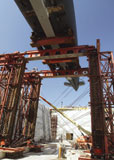 |
| GOING DOWN. Jacks, timber move 4 in. at a time. |
Under the building are 9-in.-dia micropiles driven 60-ft deep into hardpan and supplemented with 40-ft-deep, hand-dug underpinning piers. Above them spans two 40-ft-long, post-tensioned concrete beams that are anchored to the old load-bearing masonry walls.
In the main exhibit room, W.E. O’Neil built 34-ft-tall concrete walls that recline back 10°. Ready-mix was pumped in from the bottom up for smooth consolidation and finish. Wall sections have two-directional reinforcement, are 3-ft-thick and span 30 ft between pairs of concrete buttresses that bear on concrete footings.
The canted walls give the space a "bunker" look and also help support the soil around them, says David Black, project executive and Jones Lang LaSalle senior vice president. "We now are building around the sub," Black says.
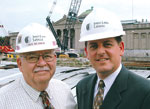 |
| UP FOR AIR. Klarich, Black lead the team. |
Norsar Services Inc., Everett, Wash., handled U-505 this past April. Riggers moved the sub 1,000 ft to the pit with 18 self-propelled dollies. Workers lowered the sub, four inches at a time, using wood cribbing and hydraulic jacks.
Moments before the descent, the sub waited on skids near the pit. As planned, the cantilevered south wall withstood the 700-ton surcharge. "That was a scary moment," Kaye recalls. Asprooth says the move was pulled off "like a ballet."
(Photo top and center courtesy of the museum of science and industry/Scott Brownell; bottom by Tudor Hampton for ENR)
|