Massachusetts School Project Team Avoids Procuring PFAS
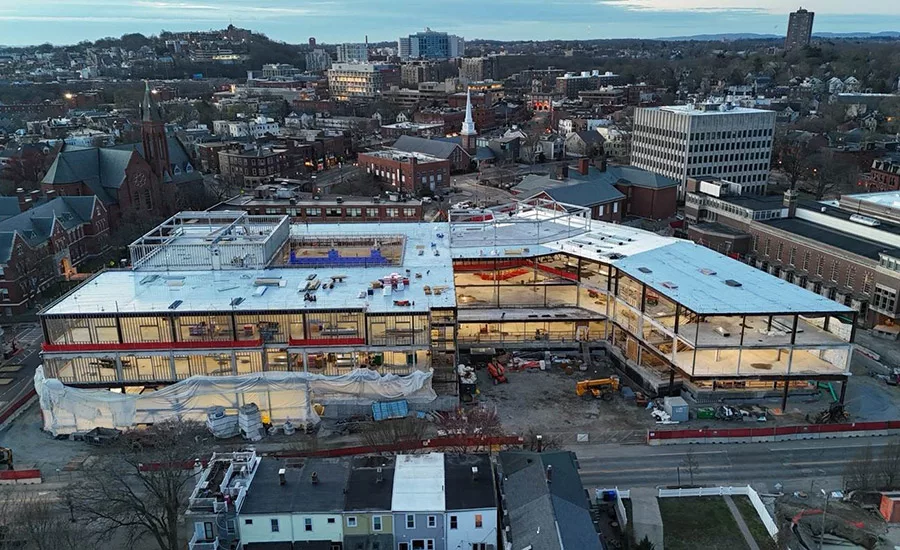
The project team building the reported $211-million John Pierce School in Brookline, Mass. is procuring green materials for the 172,300 gross sq ft school project to avoid so called “forever chemicals,” known as PFAS substances, in their selected materials.
When students and staff return to the K-8 John Pierce School in Brookline, Mass. in September 2027, the building materials they touch inside and outside the new structure, costing a reported $211 million, which will meet the highest health standards.
Boston-based design firm Sasaki teamed with Harvard University's Office of Sustainability for support to procure clean and green materials for the 172,300-sq-ft project that includes a 75,300-sq-ft underground parking garage.
Alison Nash, architect and sustainability coordinator at Sasaki—which is working on the project with design firm MDS/Miller Dyer Spears—says the project team is “going above and beyond” to select materials that contain no low volatile organic compounds or PFAS substances—the so-called “forever chemicals."
“There are literally tens of thousands of [PFAS],” she says. "Unless you have an advanced degree … you're not going to really know if this a forever chemical.”
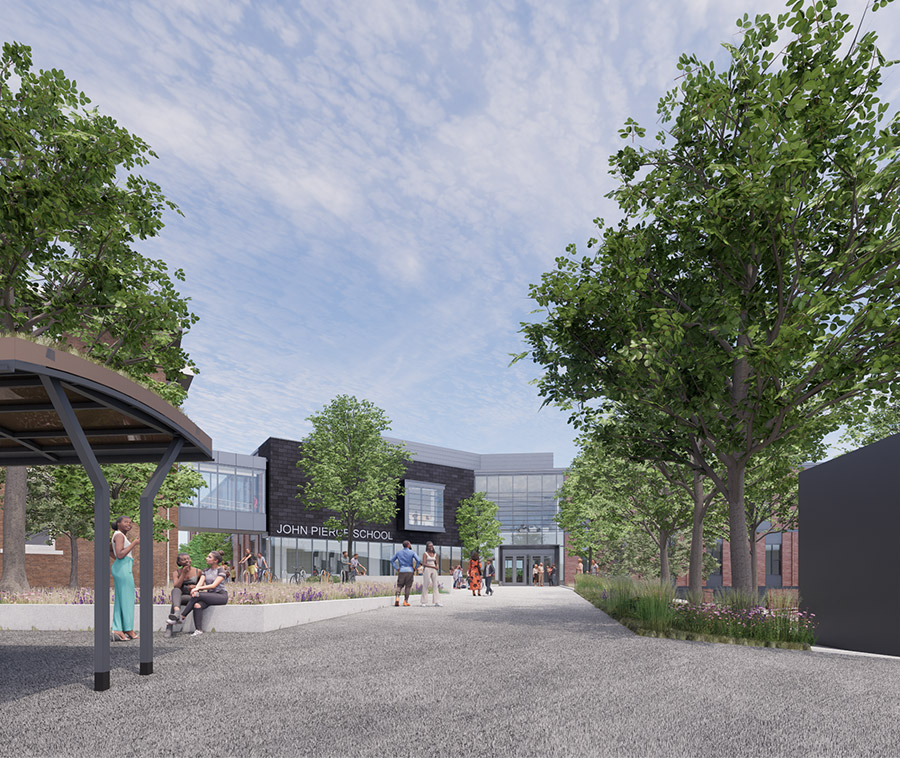
The new Pierce School will include a redesigned drop-off zone and entrance.
Rendering courtesy Sasaki
Since John Pierce School is a public project, Sasaki and MDS needed to find three equals for each material, which is a challenge as PFAS science and regulation develops..
“Having Harvard's researchers partnered with us was so important, because they could help dig into some of the [chemical] categories where it was harder to find three equals,” says Sarah Lesher, MDS director of interior design.
Special attention was given to materials that students come in contact with, such as playground surfacing. Team members worked to find a product that did not include recycled tire rubber, which has often had PFAS chemicals baked into it. They found a manufacturer that provided a letter stating that the product would not include tire rubber.
Lesher says some PFAS-free products are more expensive, but many are longer lasting. Linoleum flooring is durable and has a 30-year warranty, while viny composition tile flooring requires annual maintenance.
Nash says the design team partnership with Harvard, enabled by the Town of Brookline PFAS Committee, will help the Massachusetts School Building Authority and other states replicate their process.
The three-story LEED-certified elementary and middle school will serve 725 students on the dense urban site of the Pierce school’s former building in Brookline Village.
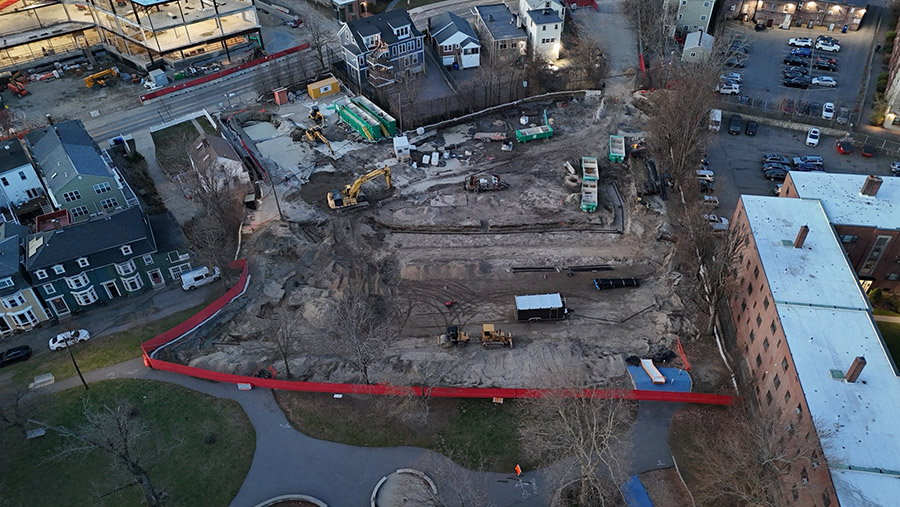
The Pierce school will be powered, in part, by geothermal energy to help meet the Brookline, Mass. goal to be carbon neutral by 2050. The project team drilled geothermal wells in a park across the street from the project.
Photo courtesy Consigli Construction Co. Inc.
“One of the primary challenges of this project has been managing construction within a dense, highly active urban environment,” Jody Staruk, director, project executive at Consigli Construction Co. Inc., wrote in an email to ENR. “From coordinating road closures and utility work to carefully sequencing deliveries, demolition and excavation activities, the team has taken a highly collaborative and thoughtful approach to maintaining safe access and minimizing disruption in a very busy neighborhood environment.”
The facility will be powered, in part, by solar and geothermal energy to help meet the Brookline goal to be carbon neutral by 2050.
The building will have a ground source system for efficient heating and cooling, a displacement ventilation system for occupant comfort and a passive house-level envelope design for aiir tightness and insulation. “Energy modeling, embodied carbon modeling, daylight and shadow studies and outdoor thermal comfort modeling were integral to the design workflow, Sasaki says on its website. "This process informed selection of the preferred option and shaped the new school’s design.”
The design also calls for keeping the original Pierce School four-classroom building—built in 1855 and expanded in 1904—intact and tying it into the new buildings. Preserving a historic structure and building something new directly adjacent required working with historic preservation stakeholders and taking extra steps to protect the existing building.
“Careful structural monitoring and support has been required from the beginning, especially during demolition and excavation activities, to ensure that the historic building remained stable and protected at all times,” Staruk wrote.
One particular challenge was working with the historic building’s original stone foundation, which was not waterproof. “We had to excavate around the entire perimeter of the historic structure and then form up concrete to encapsulate the existing foundation, allowing us to create a modern waterproofing barrier while still preserving the integrity of the original building,” said the spokesperson.
Another goal of the project was “integration with the broader fabric of the town, including its town hall, library and sports fields,” says Vinicius Gorgati, principal at Sasaki. The school sits on a slope connecting the upper civic plaza to sports fields and has historically been more of an accessibility impediment than a link between the two areas, he adds.
There is also a significant drop from the school's upper section to the lower level. The buildng also is located on Harvard Ave., a busy thoroughfare.
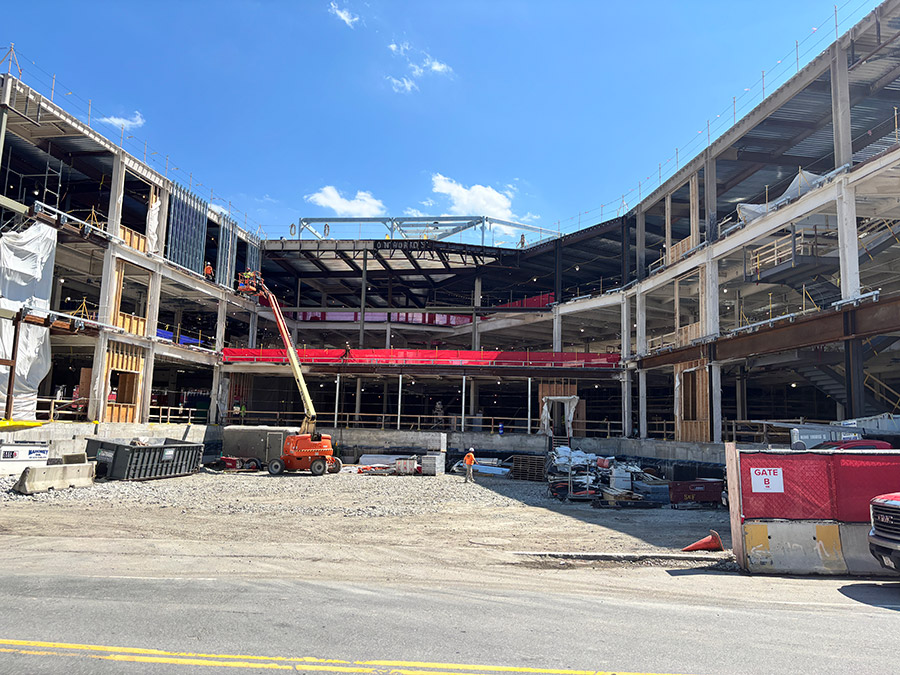
The 172,300 sq ft school project, which includes a 75,300 sq ft underground parking garage, will serve 725 students on a dense urban site
Photo by Justin Rice/ENR
“From the beginning … our strategy was to create a linear park that would connect [the] upper plateau and lower plateau—creating a community link accessible through ramps and other garden strategies, so that ... you could connect from the upper plateau, the civic plateau, to the school [and] across the linear green to the fields and the courts,” says Gorgati.
The architects made sure to design the school in a way that matched foot traffic in the community.
"The beauty of it is that the majority of students come to school by foot ... coming from different directions. So we created two or three points of right-of-way connection that can be monitored and used intelligently by the school itself,” says Gorgati.
Other priorities included making sure that the Brookline community could feel connected to the building.
“When you walk by the building, there is school activity happening [that is] feasible to you as a citizen, as someone going by the school … as opposed to the more anonymous, sort of introspective design that informed schools of years past.”
The building is currently being enclosed, with the roof and exterior sheathing nearing completion, and mechanical, electrical and plumbing underway. Exterior brickwork will begin soon after the building’s enclosure is complete.
The project remains on budget and on schedule.