Digging Deeper | K-12 Educationn
New Jersey Project Team Converts Doll Factory into School
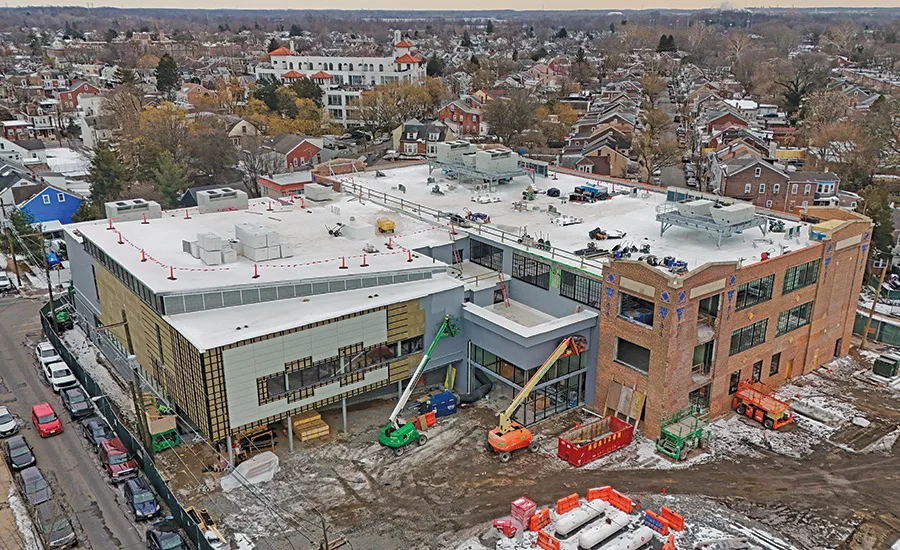
In a complete renovation, the Foundation Academy Collegiate project transformed the 1930s-era Horsman Doll Factory in Trenton, N.J into a charter high school. Work included demolition of two smaller structures to make way for a circulation core and two-story gymnasium.
In planning its new 91,600-sq-ft charter school in Trenton, N.J., Foundation Academies chose a path that would preserve the city’s past while looking toward its future. The new high school repurposes the nearly 100-year-old former Horsman Doll Factory into academic spaces and adds an expansion for a gymnasium, orchestra room, fitness room and other specialized spaces.
“If we continue to invest in our history as well as our present, we can maintain what has been while continuing to build upon that—that’s what this school symbolizes,” says Andre Moore, chief operations and financial officer of Foundation Academies.


The 91,600-sq-ft project maintains the historic structure of the old doll factory while providing new accommodations for the facility to better serve students and staff.
Photos courtesy Foundation Academy Collegiat
Linking Old and New
The school is split between two structures. The existing 40,000-sq-ft factory—with its heavy concrete structure and brick facades—is joined with a new steel-structure building, clad in white fiber-cement panels. Architect Michael Farewell says the new building was designed to appear as if it had been pulled out of the existing building, like a drawer from a dresser.
“It’s literally like you’ve pulled the [school’s] program out into the city,” he says. “The inside fabric of the brick building—with its white walls—is extruded out into the urban grid. We very much liked the idea that within this brick shell of an old building, we moved the program out so that it’s visible, it’s part of the community.”
Farewell worked with Foundation Academies and owner’s representative 22Beacon on initial site selection. Although the team was able to do some general surveys of the site, it was not a deep dive.
“We really weren’t given full access to the building while it was being negotiated for sale,” he says. “As a result of that, we didn’t truly know what its condition was. We couldn’t do the kind of invasive forensic work on the slabs and the facade that we would ordinarily do.”
Initial investigations suggested that the factory’s heavy concrete structure held up well enough over the years to be used as the bones of the building. Originally built as an industrial structure, the thick concrete slab-on-grade foundation, concrete floorplates and hefty 14-ft-tall columns provided more than enough support for the structural demands of a high school.
INTECH was selected as general contractor in September 2024 and started preconstruction work. Abatement and demolition started in January 2025 followed by construction in March. The project is on schedule for substantial completion in June.

Fusing the existing structure with a steel frame presented structural and alignment challenges.
Rendering courtesy Farewell Architects
Into The Unknown
Although the overall project was awarded under a design-bid-build contract, INTECH worked under a separate design-build package with its own structural engineer for the concrete structural rehabilitation. In the end, the existing structure required minimal repair, according to the company.
While the structure was sound, the unknown condition of the brick facade proved to be a major challenge. “We didn’t really know a lot when we went into the job,” says Jesse Chladil, INTECH project manager.. “We knew that the whole building [facade] needed to be repointed, but they didn’t do a lot of exploratory work to develop a full mainstream restoration package. You had to get into some selective demo to really uncover it. So once we were able to start peeling it back little by little and get another consultant involved, we were able to clearly identify the scope and develop a plan from there.”
“We didn’t truly know what its condition was. We couldn’t do the kind of invasive forensic work on the slabs and the facade that we would ordinarily do.”
—Michael Farewell, Founder, Farewell Architects
Ultimately, it was determined that three of the four facades could be preserved. The north facade, where the old building would join with the new one, was too deteriorated and had to be demolished. The remaining brick facades would need to be repointed and some existing parapets would need to be rebuilt while others were demolished.
Lintels on the existing 17-ft-wide window bays proved to be one of the main challenges of the facade. Nearly every one needed major structural repair, Chladil says. To properly sequence the work, lintel repairs had to stay ahead of the facade restoration crews. “Those were two separate contractors, so the timing of that was always difficult to manage,” he says.
INTECH was able to create a playbook of the variety of conditions encountered and how to make needed repairs or restoration. “The big lift there was coming up with basically a set of conditions so that when you run into [a certain] issue, you apply [a certain] detail,” Chladil explains.
Throughout the process, an engineer worked ahead of the restoration crews to determine the condition of each brick before work was done.

Designers had to wait to finalize information technology plans until after the demolition finished, unsafe conditions were eliminated and surveys and assessments were completed.
Photo courtesy Foundation Academy Collegiate
“Our structural engineer had to ride scaffolding or a scissor lift to assess each of these different conditions on the property,” says Sriram Chintamaneni, project manager at 22Beacon. “At first, it was very closely coordinated so that they were always just ahead of the contractor. But we quickly got to a point where we had enough typical details that, while the contractors were busy with what the engineers had already assessed, the engineer could get well ahead of them on the rest of the facade.”
The crews also faced unknown conditions in an existing stair tower and two elevator shafts. Ultimately, the existing stairwells were too deteriorated, so they were redesigned as a mechanical shaft. Instead, stairs were added to the elevator shafts.
Although the existing concrete slabs were generally in good condition, the building had settled unevenly over the years and crews had to do extensive topping of each slab to get them level. The existing roof slab was also in good condition, although the roof itself had to be entirely replaced. Mechanical equipment on the roof had to be designed to be precisely placed over the existing structural columns. “We spent a good bit of time scanning the existing rebar to make sure those anchor bolts that they drill down on top of those columns don’t hit the rebar,” Chladil says.

A brightly lit double-height entry vestibule welcomes students and visitors, while stairs connect the space with second- and third-floor classrooms.
Photo courtesy Intech Construction
Something New
While one set of crews was engaged on the existing building, other crews worked on the new building. Once INTECH got to work on the project, it determined that initial designs had sited the new building’s foundations 11 in. higher than the existing building. “It was hard to tell the exact elevation of the existing building until we really did the demolition,” he says. “It ended up being a fairly straightforward solution to a problem that got everybody extremely worried when we first encountered it.”
The new steel structure is supported by a slab-on-grade foundation system with spread footings. During foundation work, some soil remediation was required due to contaminants from the old factory. As part of that effort, a vapor mitigation system was added below the foundation.
Because the team had to work within space constraints of the existing building, the new building added opportunities for more atypical and less repetitive spaces. The school is designed with classrooms, labs, offices and other educational spaces in the existing building. The new structure houses a gymnasium, auditorium, dance studio, fitness studio, orchestra room and spaces for other specialty uses.
“I’m still impressed at what the team has been able to accomplish in this amount of time.”
— Andre Moore, Chief Operations and Financial Officer, Foundation Academies
The two-story gymnasium, which can be repurposed as an auditorium or theater as needed, is set on the second floor and features the longest span spaces in the building. “That was a big coordination effort, figuring out how the ductwork runs through the trusses and setting the lights in their spots,” Chladil adds.
The longest truss was nearly 80 ft long, which was brought on site in one piece and picked off a truck from the road directly into the structure.
Most of the new building is clad in fiber-cement panels from Equitone, with most panels sized at roughly 2 ft by 4 ft. The backside of the building, where the loading dock is located, uses a more standard and economical Hardie siding.
While the factory building retains the large existing window bays to provide ample natural light, fewer windows were needed for the spaces in the new building. The gymnasium is topped by an opaque clerestory window system.
Throughout the project, windows were a critical component in the schedule. Extensive work was required on the window openings in the existing building, and the team had to push to keep them on schedule for delivery of custom windows fabricated in Lithuania. “We knew that in order to have a chance at meeting schedule, we had to get [the building] dried in before the winter. So that really came down to making sure the windows got in in time,” Chladil says.
During the project, the team also became aware that tariffs could pose a problem. But INTECH was able to get windows ordered in time. Similarly, steel from a mill in Canada was ordered in advance of any potential tariff issues. “We saw a decent amount of ... letters from our suppliers [about rising tariffs], but we managed to avoid any of that,” he adds.
At the connection between the new and old buildings, a large glass cube signals the entry. Farewell says the entry design plays on the transparency of the large factory windows. The three-story atrium houses an open stair that ties to both structures. “It is the major spine of the school,” he says. “All the students come in through this transparent cube, then move into this atrium, which goes all the way across the entire width of the site.”
Despite a long list of unknowns that needed to be addressed amid a tight timeline, the project is on schedule to finish by summer. “I’m still impressed at what the team has been able to accomplish in this amount of time,” Moore says.