Digging Deeper | Airport/Transit
United’s Terminal B: The New Gateway to Houston
Progressive design, rapid sequencing and real‑time problem‑solving keep the project cleared for on‑time departure
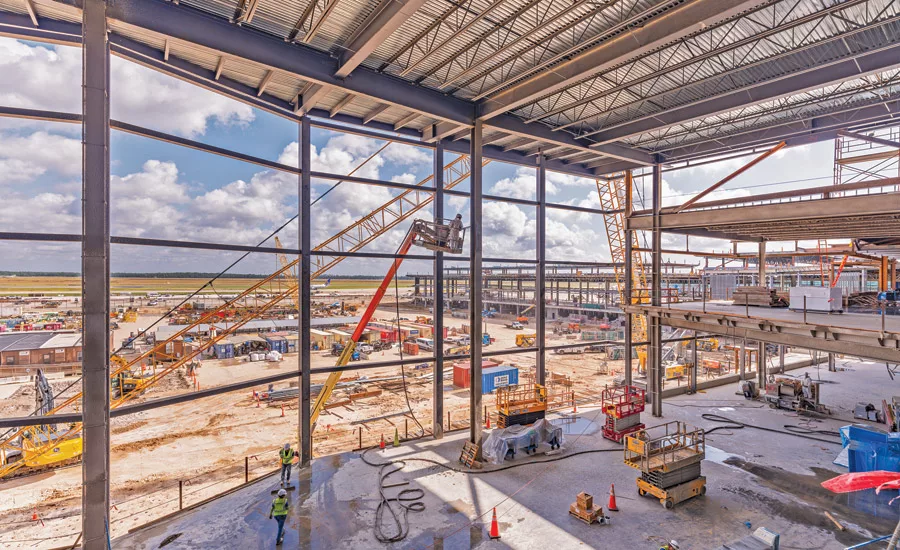
Crews advance steel and enclosure work on the new Terminal B Central Processor at George Bush Intercontinental Airport, part of United Airlines’ $2.55‑billion Terminal B transformation program.
Before dawn at Houston’s George Bush Intercontinental Airport, the Central Processor rises in pieces—steel climbing over the old terminal footprint while the skyway glides overhead and the underground Inter‑Terminal Train (ITT) hums below. Part of United Airlines’ $2.55-billion Terminal B transformation, the new processor is taking shape at one of the country’s more constrained construction zones—a site that has already logged more than 2.4 million work hours as of late January.

Crews hoist a major steel truss into place on the new Terminal B Central Processor at Houston’s George Bush Intercontinental Airport.
Photo courtesy Clark Construction
An Airport in Motion
Clark Construction crews work in tight windows between active roadways and rail systems, preparing another lift on the new security hall. The 180‑ton truss they set earlier this year—hoisted by two 1,100‑ton cranes working in tandem on opposite sides of the site—now frames the roofline that will guide passengers toward the screening area.
A few hundred yards away, Manhattan Construction advances the new Terminal B North concourse at a similar pace. Crews place more than 1.6 million sq ft of replacement apron paving, trench nearly 20,000 linear ft of jet‑fuel lines and erect steel for the 765,000‑sq‑ft concourse in 44 sequences. PGAL designers walk the site with Manhattan superintendents, checking drawings against the structure as it rises, level by level.
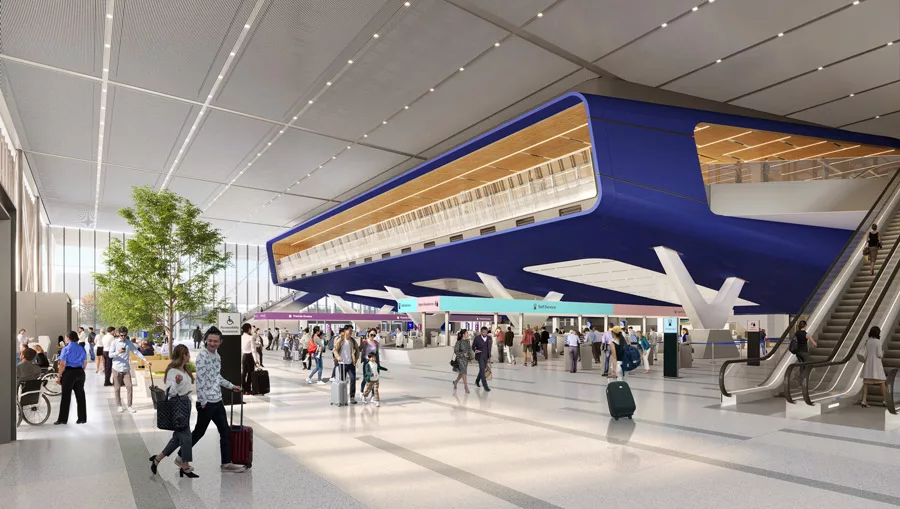
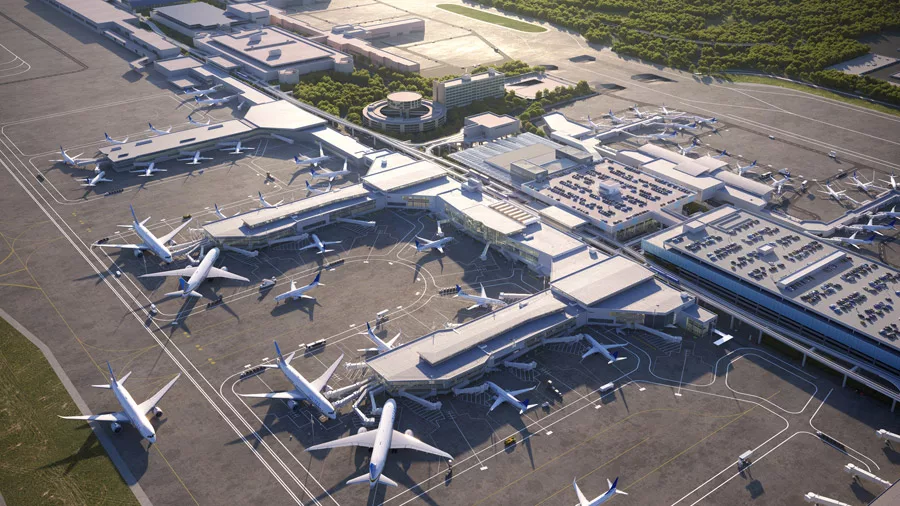
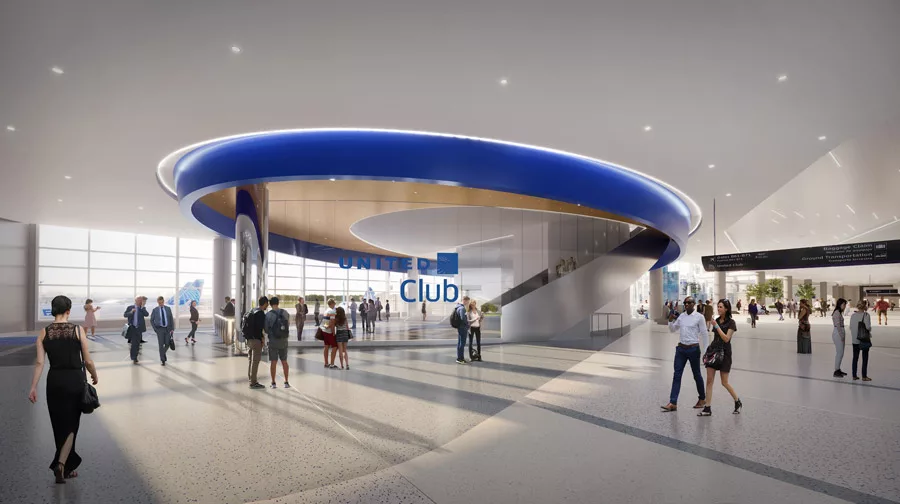
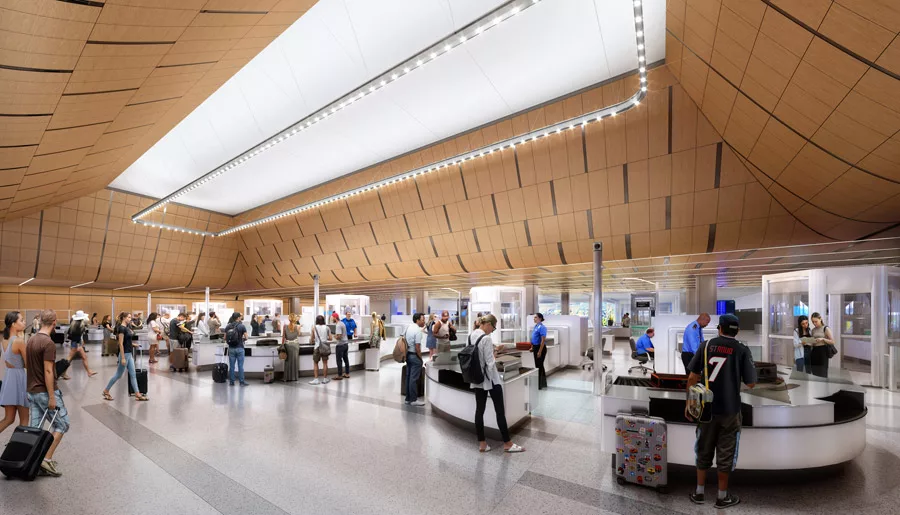
Inside the old processor, Clark teams navigate a building still partially alive. A year of enabling work rerouted police operations, shifted 40‑year‑old train controllers and built a new kitchen to keep concessions running. Pedestrian tunnels were demolished with only inches of clearance between an active roadway and the Skyway above.

Night crews cut through steel beneath an active overpass as demolition advances in a tightly controlled work zone.
Photo courtesy Clark Construction
Rhythm of the Day
By midmorning, more than 400 United flights move through the hub, and construction runs in parallel—crews, cranes, trains and passengers all flowing through the same tight footprint. The choreography is constant, and the stakes are high; every hour of construction must coexist with a hub that moves tens of thousands of people a day.
“People show up because they believe in the mission.”
—Rob Walker, Managing Director for Planning and Development, United Airlines
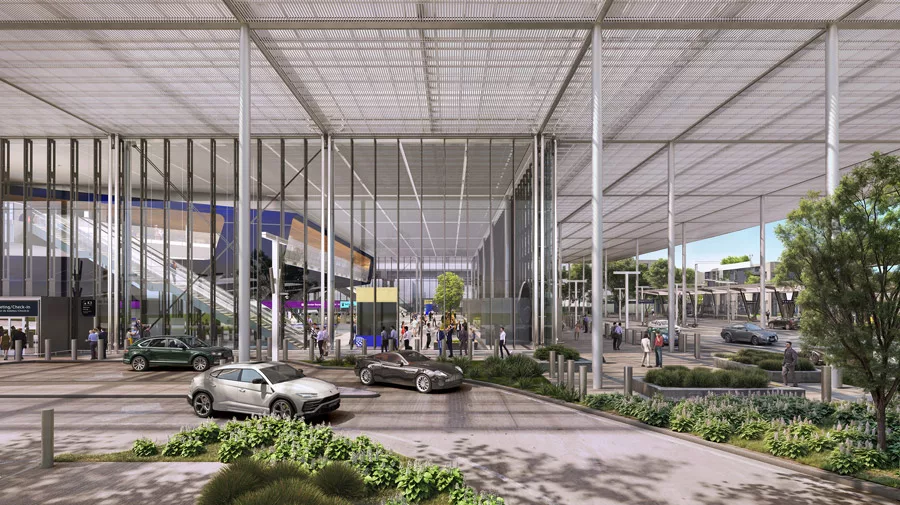
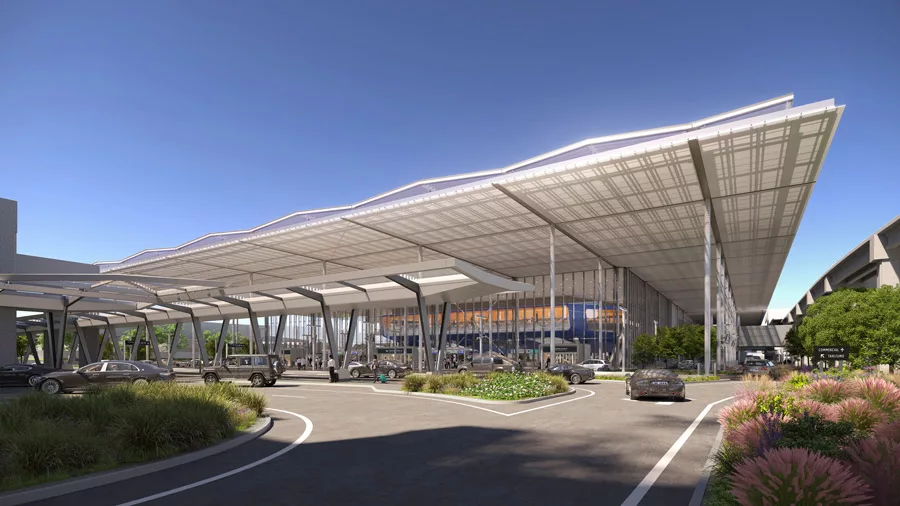
Clark’s scope includes a 250,000‑sq‑ft addition for ticketing, security and baggage handling, along with a 275,000‑sq‑ft renovation of the existing processor into the post‑security zone. Delivered under a construction‑manager‑at‑risk progressive‑design model, the work advances even as design packages continue to develop—an approach the team says is essential to meeting United’s September first‑flight target. The processor deactivation, completed in a single overnight shift, capped more than a year of enabling work. Demolition required careful sequencing, including tunnel removal with minimal clearance and a tandem-crane pick-over of the ITT tunnel. The processor’s ETFE roof canopy, fabricated in Spain and shaped in Germany, adds another layer of long‑lead coordination.
Clark’s early investigative work revealed that the processor, built in 1969, had undergone decades of undocumented renovations. Crews cored slabs, laser‑scanned the building and opened ceilings while the processor was still functional. When conditions didn’t match drawings, Clark and Page/Stantec developed new solutions, including a lattice bracing system that allowed roadway demolition and steel erection while baggage systems and passengers continued to move below. Traffic planning required similar creativity. Named for the A‑ and B‑terminal loop it relied on, the AB Loop Optimization shifted vehicles off North Terminal Road so crews could install utilities without disrupting airport traffic flow, allowing the work to wrap up in about three months.

Crews work beneath the active skyway as construction progresses on the new Terminal B Processor at Houston’s Bush Intercontinental Airport, part of United’s ongoing transformation program.
Photo courtesy Clark Construction
The Nerve Center
The coordination behind that progress is housed within a single project management office, simply referred to as the PMO, where United, Clark Construction, Manhattan Construction, PGAL, Page/Stantec, AECOM and Jacobs work side by side. The space is more than a logistical hub; it is the cultural center of the entire program.
“A major element in the successful closing … is having everybody co‑locate in the building,” says Kayla Wengler, United’s director for planning and development. “Collaboration is much easier when you can walk over and see somebody and talk something through.”
This project is “the new front door of Houston.”
—Jason Fuller, Project Executive, Manhattan Construction
United’s leadership describes the culture in the PMO as grounded in the program’s nine pillars: safety‑focused; schedule‑driven; resource‑innovative; structured and adaptable; planning‑focused; resilient and aggressive; ethical; reliable; and unified and supportive. Those principles show up in daily behavior: decisive action, shared ownership and a refusal to let bureaucracy slow the work.
“You can feel the momentum in this place,” says Rob Walker, United’s managing director for planning and development. “People show up because they believe in the mission and in each other. When hundreds of people pull in the same direction, it changes what’s possible—and that unity is the heartbeat of this program.”
For Clark, that culture underpins the fast‑track strategy. “It all starts with having a strong relationship among all partners and a collaborative approach,” says project executive Nick McAlister. Page/Stantec principal Jeff Mechlem calls the setup “unique” at this scale. “It’s one thing to sit in the same space, but it’s another to truly work and act as one team,” he adds.

Crews dismantle sections of the original 1969 Terminal B processor, clearing space for the new central processor as United’s fast‑track transformation pushes through decades of undocumented renovations and tight airside constraints.
Photo courtesy Clark Construction
Unified Approach, Fast‑Track Delivery
Down the hall, Manhattan and PGAL rely on the same co‑location model to drive the North Concourse at record speed. When they first pursued the project, both teams assumed United wanted to keep as many gates open as possible. Ivan Pire, PGAL principal, says the team had prepared a phased plan to rebuild the concourse in sections while maintaining five or six flight stations at a time. But once they sat down with United, the direction shifted immediately. The airline needed the full North Concourse delivered in 2026, and partial phasing wouldn’t support the baggage‑handling system or the airfield operations required to make that possible. “They told us, ‘We have airplanes coming,’” Pire says.
That pivot required a complete resequencing of the work and a full shutdown of the North gates. Early packages included relocating 1,800 linear ft of 21‑in. sanitary line at depths of 20–25 ft, installing two 16‑in. aviation fuel‑line bypasses to keep Terminal C supplied and developing plan B strategies for the concourse’s self‑sufficient chilled‑water system and data connectivity. Those moves cleared the way for deep foundations, structural steel and the rapid vertical construction now visible from the airfield.
Being in the same building allowed the team to resolve issues quickly. “Emails only go so far,” says James Matthews, Manhattan project director. “When you can look at the same thing and point and talk … you minimize days of time that elapse from an issue arising to an answer.”
Manhattan project executive Jason Fuller says sharing a workspace with other CMRs and design teams also helps sharpen processes. Case in point: Manhattan’s 30-30-30 safety practice, which was developed from teams working shoulder to shoulder in an environment with thousands of people moving through confined areas. An audible tone every 30 minutes prompts crews to pause for 30 seconds and scan 30 ft around them—a simple, disciplined reset for a job in constant motion.

A prefabricated walkway is lifted into place as crews thread work through tight airside windows, part of the carefully sequenced build‑out.
Photo courtesy Clark Construction
Pace, Partnership and the Push Ahead
As the program drives toward its two major milestones—opening the Terminal B North concourse in September and completing the South concourse work in 2028—the teams say the traveler experience is never far from mind.
Even with the planning, sequencing and coordination required to keep the project moving, they’re always thinking about what passengers will feel the first time they walk through the finished spaces.
Fuller calls the project “the new front door of Houston,” a sentiment shared by Clark senior superintendent Zack Rajter. “I’m a United flyer, and I’ll be walking through this terminal with my own family,” he says. “I want people to feel the pride and the effort that went into it, even if they never see the challenges we worked through to get here.”
That pride is especially personal for Manhattan general superintendent Blake Bielski. “I grew up 10 minutes down the road,” he says. “To build something of this scale in the place where I watched planes as a kid, that means a lot.”
And as the teams look ahead to opening day, Walker frames the ethos in the simplest terms: “Expect that things are gonna be tough, but expect that if you work together … you can get it over the finish line.”
The finish line, though, is only part of the story. The new Terminal B will serve millions of passengers for decades, but for the people building it, the legacy is already visible. It’s in the overnight processor deactivation that happened in a single shift. It’s in the bypasses and bracing schemes that kept critical systems running while construction pressed forward. And it’s in the nine program pillars displayed in the PMO hallway—passed every morning by the teams who shaped them.