2025 Mountain States Best Projects
Project of the Year, Best Office/Retail/Mixed-Use: T3 RiNo | Denver Reimagines the Urban Office in Timber
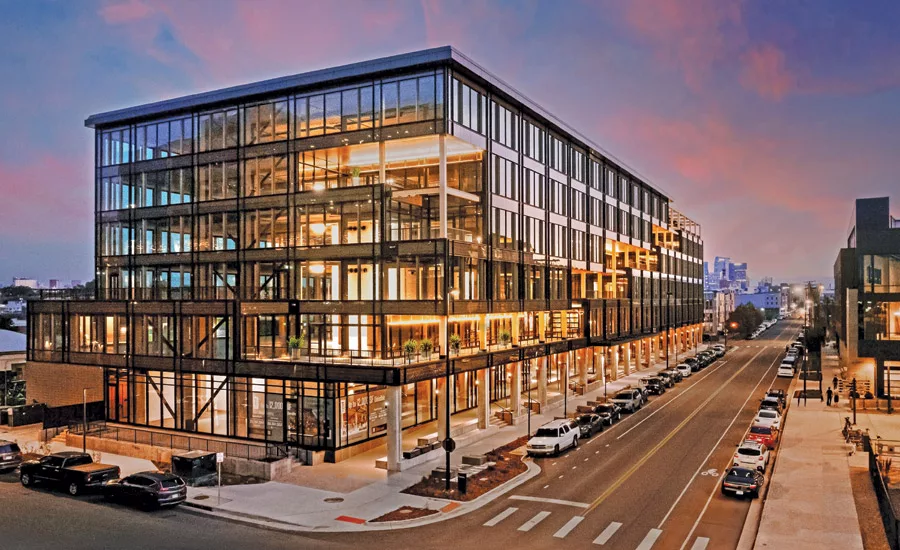
Stepped-in terraces increase usable floor space and provide access to fresh air, sunlight and views.
T3 RiNo
Denver
BEST PROJECT, OFFICE/RETAIL/MIXED-USE
Submitted by Pickard Chilton
Owner Hines
Lead Design Firm Pickard Chilton
General Contractor Whiting-Turner
Civil Engineer S.A. Miro
Structural Engineer Magnusson Klemencic Associates
MEP Engineer Alvine Engineering
Architect-of-Record DLR Group
When Hines and its partners set out to bring their T3—timber, transit and technology—brand to Denver, they chose the city’s River North Art District (RiNo) for good reason. The once-industrial corridor, reborn as a hub for artists, brewers and tech start-ups, provided the ideal canvas for what would become Colorado’s first mass-timber office building.
“We knew from the first site visit that RiNo was the perfect setting for a heavy-timber building,” says Anthony Markese, principal at Pickard Chilton, the project’s design architect. “The neighborhood’s older brick-and-timber warehouses gave us a natural lineage to build upon.”
Completed in January 2025 after a pandemic-delayed start, the six-story structure delivers 239,000 sq ft of office space and 17,000 sq ft of retail on a tight, transit-adjacent site.
Co-developed by Hines, McCaffery and Ivanhoé Cambridge and built by Whiting-Turner, the project embodies the next generation of sustainable, human-scaled workplaces.
Whiting-Turner’s role was pivotal in turning the design vision into reality. The firm began preconstruction services in early 2020, just before the COVID-19 shutdowns, and stayed engaged throughout the 18-month pause that followed.
When work resumed in late 2021—amid sharp material inflation and supply disruptions—the contractor resequenced procurement and trade schedules to maintain cost targets without compromising quality.
Mass-timber erection required an unusually high degree of coordination among trades.
Each glulam column and CLT panel was prefabricated to exact dimensions, then craned into place in a precise order that left almost no tolerance for field adjustments. To achieve the smooth transitions that Pickard Chilton envisioned, Whiting-Turner and timber supplier Nordic Structures used digital models to confirm every connection point before shipping components to the site.
Crews averaged 18 to 20 panel placements per day, allowing the timber superstructure to rise in just over five months. Field teams devised special rigging to prevent damage to exposed surfaces and installed temporary protective sheathing until glazing and roofing were complete.
The contractor’s emphasis on craft extended to the finishing stage, where workers sanded, sealed and inspected each timber bay to ensure a consistent tone throughout the interior.
Whiting-Turner project manager Levi Rohleder said the team’s goal was to make the structure appear effortless, requiring close communication with designers and precision from every trade.
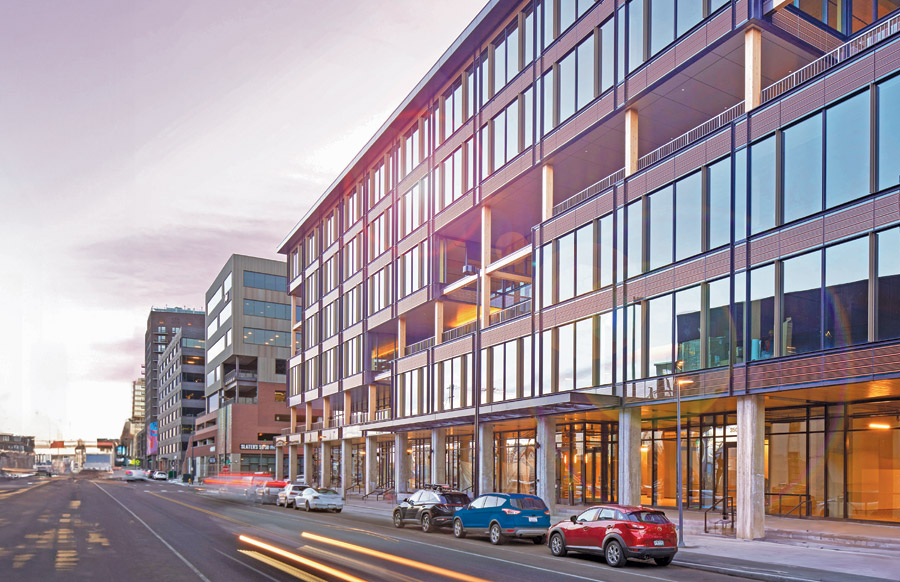
T3 RiNo is the first large-scale implementation of mass timber in Denver.
Photo courtesy Brad Nicol
Crafting a Carbon-Smart Landmark
Denver zoning limited building height to 85 ft for exposed-timber structures, encouraging designers to sculpt massing through setbacks rather than stacking floorplates vertically. Instead of a simple ziggurat, Pickard Chilton and architect-of-record DLR Group carved a series of outdoor terraces that cascade up the facade.
“The terraces let every level access daylight and fresh air,” Markese says. “They also allow the facade to peel away and reveal the timber grid beneath. From the street, you immediately sense that warmth.”
Each terrace doubles as a shaded workspace, the glulam beams extending outward to support canopies and define the rhythm of the glass envelope.
Inside, Magnusson Klemencic Associates designed a glulam post-and-beam frame supporting cross-laminated-timber (CLT) panels topped by a thin concrete slab to control vibration and sound.
Timber supplier Nordic Structures joined early to fine-tune beam sizes and connections for efficiency. Transitioning from the concrete podium to exposed timber at the second level posed one of the job’s biggest technical hurdles: a 1-in. tolerance for concrete meeting one-eighth-in. tolerances in wood.
Engineers and contractors devised a knife-plate base connection that maintained waterproofing and visual integrity while absorbing movement.
Another breakthrough—the so-called “MEP superhighway”—kept building systems organized without concealing the structure. Designers created a narrow raised zone around the core supported by short steel beams, freeing the rest of the timber ceiling to remain exposed.
“It sounds mundane, but it’s transformative,” Markese contends. “When tenants step off the elevator and see uninterrupted wood overhead, their first instinct is to reach out and touch it.”
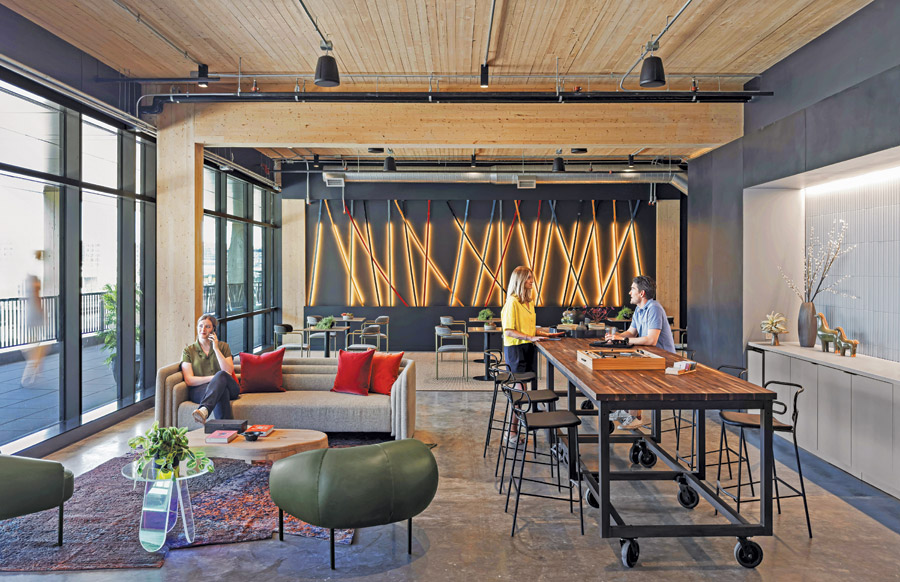
In 2023, Xcel Energy, the public utility in Colorado, signed a full building lease at T3 RiNo, making it the utility’s Denver headquarters.
Photo courtesy Eric Laignel
Precise BIM coordination among Pickard Chilton, DLR, MKA and Alvine Engineering preserved floor-to-ceiling heights typical of a steel frame, giving the loft-style interior the airy quality of RiNo’s old warehouses.
Subsurface surprises added complexity. Excavation for the below-grade garage revealed groundwater several feet higher than expected, forcing installation of a temporary—and later permanent—dewatering system.
“We wanted T3 RiNo to feel like it belonged to Denver—to draw from the city’s industrial DNA but express something forward-looking.”
—Anthony Markese, Principal, Pickard Chilton
Heavy water tanks were repositioned to avoid overstressing completed slabs. Throughout construction, Whiting-Turner enforced an intensive safety program requiring subcontractors to submit activity-hazard analyses and daily task plans.
Despite nearly 317,000 worker hours, the project logged zero recordable incidents and no lost-time injuries.
Environmental performance matched the precision of its engineering. T3 RiNo incorporates 188,000 cu ft of mass timber that sequesters 4,155 metric tons of CO₂—equivalent to removing more than 1,200 cars from the road for a year.
The structure also uses 38% less embodied carbon than a conventional concrete or steel building and has earned LEED Gold Core & Shell, WELL Silver v2-Pilot and Energy Star certifications, with WELL Health-Safety pending.
In 2023, Xcel Energy leased the entire building for its new Denver headquarters—the largest office lease ever signed in RiNo—confirming market confidence in low-carbon workplaces.
“We wanted T3 RiNo to feel like it belonged to Denver—to draw from the city’s industrial DNA but express something forward-looking,” Markese says. “It proves that mass timber can compete with steel and concrete while creating a warmer, more human environment.”