ENR West October 2025 Industry News: Hawaii's Aloha Stadium Project Moves Forward and Other News
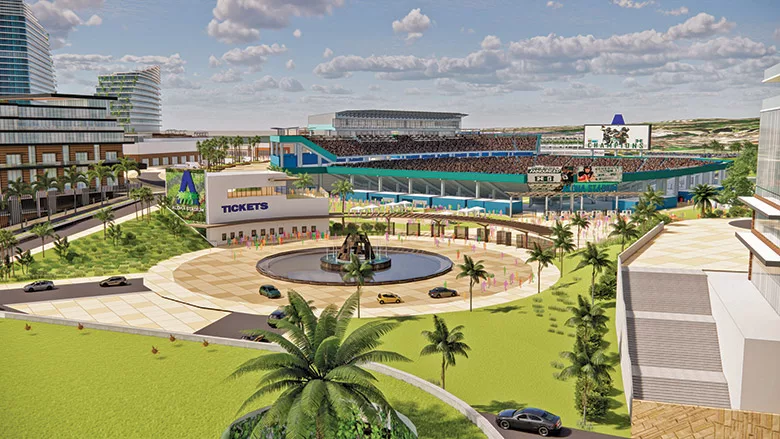
Plans now call for the existing stadium to be demolished next year. The new one is expected to be ready in 2029.
The New Aloha Stadium Entertainment District (NASED) project has reached a major milestone with the signing of its first two agreements with Aloha Hālawa District Partners (AHDP), officially authorizing dismantling of the existing Aloha Stadium and construction of a new, modern facility. The Stadium Development and Operation Agreement outlines AHDP’s responsibilities to dismantle, design, build, operate and maintain the new 22,500-seat stadium during a 30-year period before returning it to the state. Dismantling is expected to conclude by July 2026, with the new stadium opening in March 2029. The initial ground lease grants AHDP access to portions of the site for construction activities. The state is contributing $350 million toward the project, which will include 10 luxury boxes and host University of Hawaii football and other events.
The San Diego County Regional Airport Authority celebrated the opening of Phase 1 of the New Terminal 1 at San Diego International Airport on Sept. 23. The $3.8-billion replacement of the 58-year-old facility is slated to provide a total of 30 gates for the airport in the next three years. The project is designed to enhance efficiency, comfort and sustainability while meeting the region’s growing travel needs. Phase 1 was delivered by the Turner-Flatiron joint venture, with Gensler as lead architect. Phase 1A delivers 19 new gates, a modern ticketing hall with 69 kiosks and 66 counters, 13 security lanes, seven baggage carousels, 17 restaurants and retail spaces. Construction on Phase 1B will begin in 2026 and will add three additional gates by spring 2026. The remaining eight gates are scheduled to open in early 2028.
The U.S. Navy has awarded Core Tech-HDCC-Kajima LLC a $289.8-million firm-fixed-price contract to construct a consolidated communications center at Marine Corps Base Camp Blaz, Guam, with completion scheduled for March 2029. NAVFAC Pacific received three proposals for the project, which includes the main communications facility, two warehouses and fiber communications infrastructure. The contract features four options that could increase its value to $357 million. The project will enhance the effectiveness and productivity of Joint Region Marianas tenant commands. Core Tech-HDCC-Kajima, based in Tamuning, Guam, is also among eight firms selected for task orders under a $15-billion, eight-year IDIQ multiple-award construction contract covering Guam and other Pacific locations.
The Associated General Contractors of California’s Construction Education Foundation (AGC CEF) has received a $2.5-million Equal Representation in Construction Apprenticeship (ERiCA) Round 2 grant from the California Dept. of Industrial Relations to expand access to construction careers for women and underrepresented groups. The award, part of a $26-million statewide initiative, builds on AGC CEF’s successful Round 1 program completed in June 2025. In partnership with the Northern and Southern California Laborers Training Centers, the grant will advance AGC CEF’s Build California initiative in three areas: recruiting 20,000 prospective apprentices through outreach and career navigation programs; providing $1.2 million in childcare stipends and wraparound support services; and improving workplace culture through bystander intervention and mental health training.
The U.S. Army Corps of Engineers has broken ground on the Joint Integrated Test and Training Center (JITTC-E) at Joint Base Elmendorf-Richardson in Alaska. A $332-million, 150,000-sq-ft, two-story facility is being constructed by ASRC Builders-Caddel and scheduled for completion in fall 2029. The center, the first of its kind, will enable U.S. and allied forces to train and test strategies in realistic scenarios across land, air, sea, space and cyber domains. It will feature adjustable mock-up cockpits, 11 simulator rooms, mission operation centers, briefing rooms and a central server room, supporting a variety of missions and team configurations. Designed to withstand cold-weather conditions, the facility will allow face-to-face mission planning, execution, supervision and debriefing at the highest tactical and operational levels.

A section of beach near Redondo Beach Pier, one of three beaches targeted for preservation through the Living Shoreline Project.
Photo By Mayra Beltran Vasquez/Los Angeles County
The Los Angeles County Dept. of Beaches and Harbors (DBH) is advancing “living shoreline” projects at Dockweiler, Zuma and Redondo beaches, supported by $5.1 million in Measure A funding from the Regional Park and Open Space District (RPOSD). These projects, part of DBH’s Coastal Resilience Initiative, aim to restore dune habitats, enhance beach access and strengthen coastal defenses against rising seas and stronger storms. The funding will support design and environmental review phases following feasibility studies launched in 2024. At Zuma Beach, $3.1 million will widen the beach and expand dune habitat; Dockweiler Beach will receive $230,000 for dune restoration and sand management; and Redondo Beach will receive $1.7 million for new dune creation and beach widening.
Gilead Sciences has broken ground on its new Pharmaceutical Development and Manufacturing (PDM) Technical Development Center (NTDC) at its Foster City, Calif., headquarters, advancing the company’s multiyear strategy to expand innovation and leadership in virology, oncology and inflammation through enhanced biologics capabilities. The five-story, 180,000-sq-ft facility will serve as a hub for collaboration and innovation, featuring flexible pilot labs, advanced digital infrastructure, autonomous robotics and real-time monitoring—making it one of the most AI-enabled biopharma centers in the industry. The NTDC supports Gilead’s plan to invest $32 billion in U.S. innovation by 2030. The investment is expected to generate more than $43 billion in economic value nationwide.
McCarthy Building Cos. has completed the $285-million, 424,000-sq-ft North District Phase 2 Student Housing project at UC Riverside, designed by Solomon Cordwell Buenz. The project delivered 1,568 beds across 429 apartment-style units in just 21 months—making it one of the fastest projects of its scale in the U.S. This is the first completed public intersegmental student housing project, serving both UCR and Riverside City College students. Innovative prefabrication of cold-formed steel wall and floor panels enabled production of 18,000 sq ft per week with zero failed inspections. A design-build innovation model leveraged real-time BIM coordination and early procurement to accelerate delivery. The two new buildings, five to seven stories tall, add to the North District, which opened in 2021 with 1,500 beds across 544,000 sq ft.