2025 Texas & Southeast Best Projects
Best Energy/Industrial: BAE Jacksonville Ship Repair Shiplift and Drydocking Complex

BAE Jacksonville Ship Repair Shiplift and Drydocking Complex
Fla.
BEST PROJECT
Submitted by Kiewit Infrastructure South Co.
Owner BAE Jacksonville Ship Repair LLC
Lead Design Firm, Civil/Structural Engineer Foth Infrastructure & Environment
General Contractor Kiewit Infrastructure South Co.
MEP Engineer EUA
Geotechnical Engineer Ardaman & Associates
Subcontractors Birken Construction; Gulf Coast Rebar; MacAljon/SCL; Miller Electric Co.; Peterson Contractors; Terracon Consultants
Part of a $200-million marine infrastructure project designed to dramatically expand the shipyard’s capacity to service both U.S. Navy and commercial vessels, the advanced shiplift system is capable of lifting vessels weighing up to 25,000 tons for transport via self-propelled modular transporters across a robust transfer bridge into a land-level maintenance dry dock. The dry dock was constructed on a matrix of 2,400 18-in. rigid inclusions, topped with a 2.5-ft-thick reinforced concrete slab and a 4-ft-thick aggregate base.
With multiple repair berths equipped with integrated utilities such as power, water and stormwater containment, the dry dock layout allows for multiple vessels to be serviced simultaneously, vastly improving efficiency, safety and throughput.
More than 20,000 tons of recycled concrete were repurposed for the dry dock subgrade’s load transfer pad. This solution not only met all structural performance requirements but also drastically reduced the project’s carbon footprint by minimizing the need for long-distance material transport.
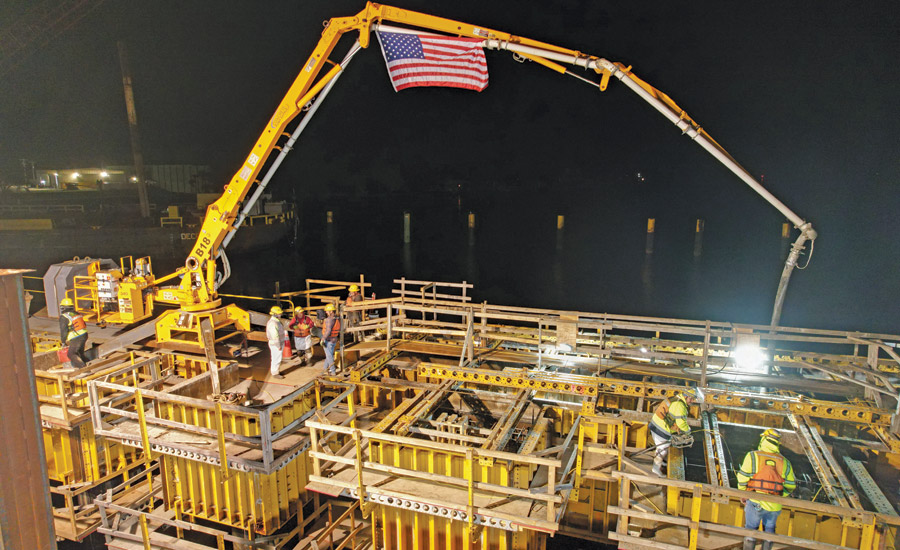
Photo by Game of Drone
Two 560-ft-long concrete piers were constructed using 36-in. and 60-in. driven piles up to 160 ft in length. The team also placed more than 5,000 cu yd of concrete over water. This effort required meticulous marine logistics planning, specialized equipment and highly trained crews capable of safely executing work in an active tidal zone.
A phased work plan allowed construction to proceed in parallel with evolving design elements, helping to mitigate issues such as equipment delivery delays and third-party contractor coordination. This adaptability, paired with proactive problem-solving and daily communication across all project stakeholders, allowed the team to recover time and accelerate work where feasible.
The final pier concrete pour was completed three weeks ahead of an accelerated schedule, and all pier accessories were able to be completed eight weeks ahead of plan.
A major contributor to success was the team’s cohesive safety culture, which resulted in the completion of more than 205,000 work hours with zero recordable incidents, even while working through high-heat conditions, marine hazards and heavy lift operations.
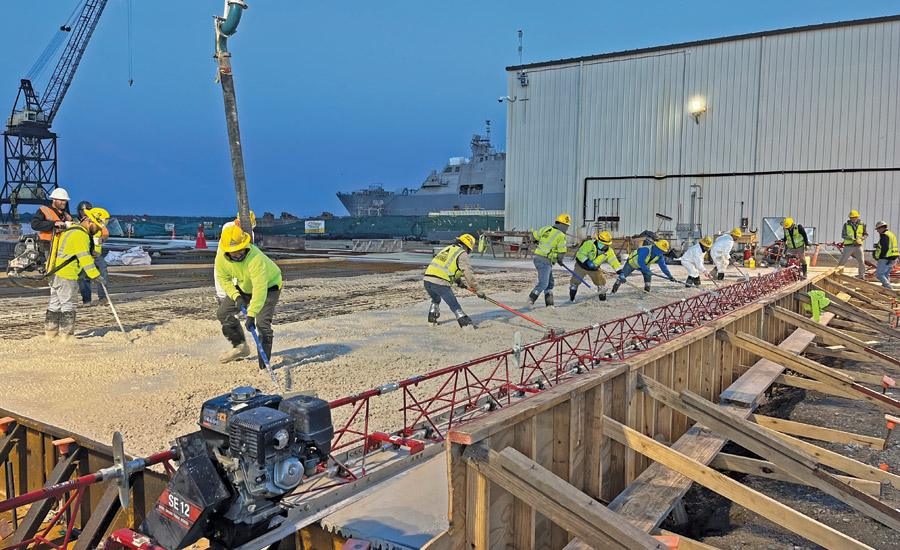
Photo courtesy Kiewit
Key challenges included working directly over the St. John’s River, placing 5,004 cu yd of concrete and driving 144 piles in the water, according to the Kiewit Infrastructure South’s Best Projects contest submittal.
This demanded extensive marine safety training, including water rescue and fall protection for tasks near or over open water. Crews also had to navigate risks such as crane movement on barges, weather fluctuations and marine traffic.
A tailored marine safety program addressed these hazards by means of rigorous protocols that regulated pile template access, rigging, panel setting and concrete placement.
To combat heat and humidity, Kiewit implemented a comprehensive heat stress mitigation plan featuring shaded rest areas, hydration schedules, work rotation and mandatory cool-downs during heat advisories.