Transportation
Trump Administration Pulls $4B in California High-Speed Rail Funding, But State Has a New Plan

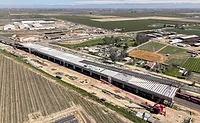
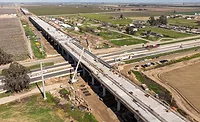
Workers prepare rebar for a support column on one of the Calif. High-speed rail overcrossings in Fresno County
Photo by Scott Waters/Calif. High-speed Rail Authority
FRA and CAHSR Correspondence:
June 4 - FRA's Notice to Terminate CAHSR Cooperative Agreements
June 11 - CAHSR's Initial Response to FRA
July 7 - CAHSR Formal Response to FRA
July 16 - FRA Termination of Cooperative Agreements with CAHRS
The Trump administration on July 16 pulled the plug on $4 billion in grant funding that had already been awarded for the California high-speed rail project. The California High Speed Rail Authority will pursue other ways to keep it going.
Transportation Secretary Sean Duffy attacked the project and California officials, saying “it’s time for this boondoggle to die.”
“This is California’s fault,” Duffy stated in a press release. “Governor Newsom and the complicit Democrats have enabled this waste for years. Federal dollars are not a blank check—they come with a promise to deliver results. After over a decade of failures, CHSRA’s mismanagement and incompetence has proven it cannot build its train to nowhere on time or on budget.”
In a statement, California Governor Gavin Newsom said the decision to terminate the funds was illegal and that the state was “putting all options on the table” to fight the action. [UPDATE 07/21: California subsequently sued to have the funding reinstated.]
The two grants being pulled are a $928-million grant awarded in 2010, and a $3.1-billion grant awarded in 2024. Duffy defended the Federal Railroad Administration (FRA) decision by saying that the 171-mile initial portion of the greater 800-mile project is nearly $7 billion short of the estimated $35 billion in funding needed for completion and unlikely to meet its originally projected 2033 completion deadline.
Opposing Points of View
In a July 7 letter to the FRA, CHSRA Chief Executive Officer Ian Choudri calls Duffy’s view of the project a “misrepresentation of the facts” and stated that the Federal Railroad Administration “wholly fails to support its conclusion that the authority is unable to deliver the [project] and commence revenue operations by 2033.”
He noted that the “authority has made substantial progress on the project and its work has reshaped the Central Valley,” citing one of three construction packages substantially complete on the first 119 miles from Merced to Bakersfield and the remaining two on track for a 2026 finish. So far the project has constructed 54 structures and 70 miles of rail bed, 59% of the total. “Crucially,” he writes, “the authority is on schedule to begin revenue passenger services on the EOS by 2033.”
In the final decision letter, Duffy stated that an exhaustive compliance review included two opportunities for California to respond, which he claimed did not address the significant concerns. He noted the CHSRA’s Inspector General report in February highlighted serious issues with the project. It all added up to the federal agency believing “CHSRA simply cannot meet its obligations under the grant agreement.”
The DOT cited nine findings that led to the final decision, including expenses related to project delays and change orders, missed deadlines for rolling stock procurement, funding gaps, overrepresented ridership projections and a belief that there is a lack of capacity to deliver the project in time.
In addition to revoking the two federal grants, Duffy has directed FRA to review other obligated and unobligated grants related to the CHSRA project.
“The Department of Transportation will also consult with the Department of Justice on the finding of FRA’s Compliance Review, including potentially clawing back funding related to California’s train to nowhere and other potential issues under Federal law,” he said in a statement.
Reiterating that the federal funding pullback is illegal, Choudri stated: “These are legally binding agreements, and the Authority has met every obligation, as confirmed by repeated federal reviews, as recently as February 2025. America’s only high-speed rail project underway is fast approaching the track-laying phase, with 171 miles under active construction and design, 15,500 jobs created, and more than 50 major structures completed."
In a statement released July 17, Newsom said: "Trump wants to hand China the future and abandon the Central Valley. We won’t let him. With projects like the Texas high-speed rail failing to take off, we are miles ahead of others. We’re now in the track-laying phase and building America’s only high-speed rail. California is putting all options on the table to fight this illegal action."
Going to California
The official loss of the federal money isn’t going to immediately derail one of the country’s largest-ever infrastructure projects. California official are already looking at the next phase of funding to get the first 171 miles of high-speed rail—the complete section between Merced and Bakersfield— open by 2033.
While the project will continue to be financed through state taxes, as residents voted for in 2008, the CHSRA is moving forward on bringing private money into the mix, hoping to both speed the build-out of the 800-mile Los Angeles to San Francisco promise while infusing the project with additional capital to make it happen.
Choudri said during the American Public Transportation Association’s High-Speed Rail Seminar on June 27 that the CHSRA needed both stable funding from the state and a public-private partnership.
“With our friends in the private sector,” he says, “we should be putting forward as our new scheme of having a true public-private partnership discussion and true investment plan where we can advance this program—not at a $1-billion-a-year construction, but provide the securitization mechanism to them so they can advance the program way faster than we were thinking.”
On the state side of the equation, Gov. Gavin Newsom’s proposed 2026 budget calls for the Legislature to commit $1 billion annually to the project from cap-and-trade funding sources through 2045. That foundational backing, which is still in negotiation with the Legislature, would be enough to get private money interested, as CHSRA has already published a request for expression of interest from private companies.
“Private equity is taking serious note about this and there is excitement on a global basis,” Sia Kusha, senior vice president of Plenary Americas, said on the same stage as Choudri during the seminar. He added that the backing from the public owner gives developers assurance to know there is a commitment to complete the project.