City Scoop | Des Moines
Data Centers and Housing Drive Growth in Des Moines
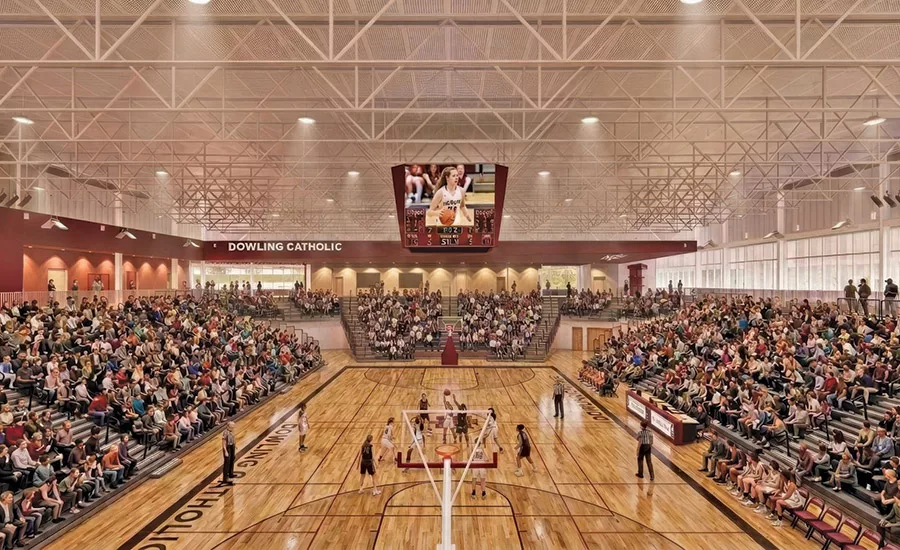
Baker Group is providing mechanical, electrical and sheet metal services for an expansion of Dowling Catholic High School in West Des Moines.

Craig Erickson
Managing Director
Shive-Hattery

L. Brandon Hummel
Executive Vice President – Preconstruction
The Baker Group
Originally established in 1843 as a U.S. Army military post, Des Moines transformed into a 19th-century railroad hub and the Iowa state capital. Then came urban renewal, prompting the loss of historic structures and businesses. Now the downtown is experiencing a renewal.
“The Greater Des Moines market continues to see strong investment across multiple sectors, but one of the biggest topics is the continued evolution of downtown,” says L. Brandon Hummel, executive vice president for preconstruction at Baker Group, a specialty contracting firm. “Owners and developers are finding creative ways to repurpose existing buildings into multifamily housing, mixed-use developments and destination spaces that support the city’s long-term growth.
“Demand is strongest in adaptive reuse, housing, education, manufacturing and infrastructure. Downtown redevelopment and office renovations—focused on smaller, amenitized spaces—are gaining traction, supported by public investment,” adds Craig Erickson, managing director for architectural and engineering consulting firm Shive-Hattery.
One notable project planned in the downtown is the Market District, a former industrial site east of the Des Moines River and south of the East Village. The area had been home to a recycling center, scrap metal yard, body shops, the city’s public works yards and a MidAmerican Energy facility.
The $600-million mixed-use development is planned to include a hotel, housing, retail and commercial buildings.
Another project taking shape is 515 Walnut Tower, a 33-story residential high-rise touted as the largest residential project ever built in the downtown. Plans call for a total of 390 units. The estimated cost of the project—the tallest multifamily residential tower between Chicago and Denver—is $148 million.
Hummel says quality of life investments that enhance the ability of businesses to attract talent come along with residential development. A professional soccer stadium is planned for a former Superfund site just south of the downtown area. The Pro Iowa initiative is an economic development project designed to bring professional soccer to the downtown. Centered around a proposed $95-million, 6,000-seat multi-use stadium and a 4-acre community plaza, the project aims to anchor a wider $500-million-plus mixed-use development.
On the business front, agriculture company Corteva announced a plan in May to locate the global headquarters of Vylor, its future independent seed and genetics company, in Johnston, Iowa, which is about 10 miles northwest of Des Moines.
“Investments like this reinforce the Des Moines region’s position as a hub for agriculture, biosciences and innovation,” Hummel says.
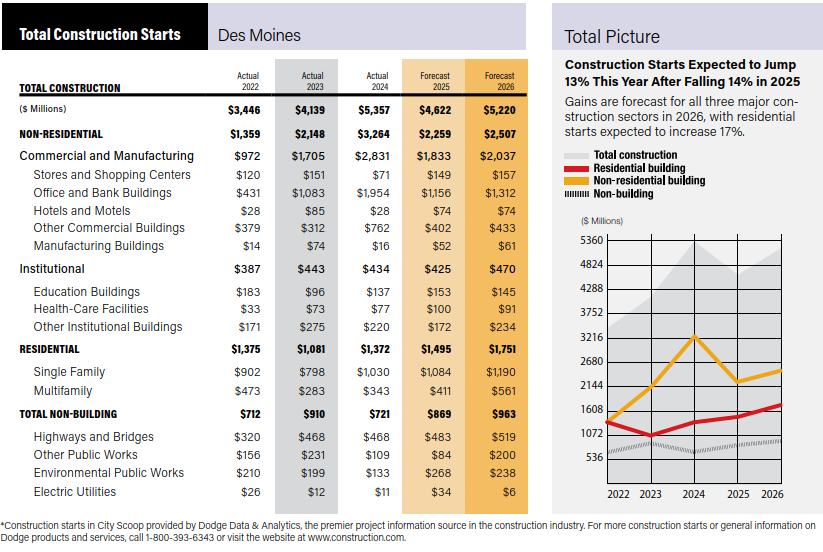
Data centers are another focus, Erickson adds.
“We are currently working on data centers and power infrastructure projects in the Des Moines area and throughout the country from New Jersey to Hawaii,” he says. “This work includes new construction for AI hyperscalers and additions/upgrades to existing co-location and Edge Computing data centers.”
Erickson says Shive-Hattery is also designing a variety of roadway and utility projects in Des Moines, Bondurant, West Des Moines, Waukee and Altoona.
“The market is shifting toward greater emphasis on precon-struction planning, risk management and certainty.”
—Craig Erickson, Managing Director, Shive Hattery
“These projects will fuel billions of dollars in private investment,” he notes.
An issue the development community is monitoring involves the future of tax increment financing (TIF) and how potential legislative changes could impact economic development projects.
“While there is still uncertainty around the long-term effects, many developers and municipal leaders are watching closely because TIF has historically played an important role in helping make complex redevelopment and infrastructure projects financially viable,” Hummel says. “Depending on how those changes unfold, some projects could be delayed while owners evaluate financing strategies and project feasibility.”
Workforce availability also remains a consistent topic, Hummel adds.
“The region continues to experience healthy growth, but competition for skilled craft professionals, engineers and technical talent remains strong across many industries,” he says.
“Rising costs, high interest rates and supply challenges are making projects harder to justify, so only well-structured, financially viable developments are moving forward while others stall,” Erickson says. “The market is shifting toward greater emphasis on preconstruction planning, risk management and certainty.”
He says clients are tackling these AEC industry challenges by prioritizing cost and schedule certainty through early collaboration, advanced planning and increased use of technology.


