Mountain States & Southwest Top Design Firms
Population Growth, Climate Demands Drive Mountain States & Southwest Projects in 2026
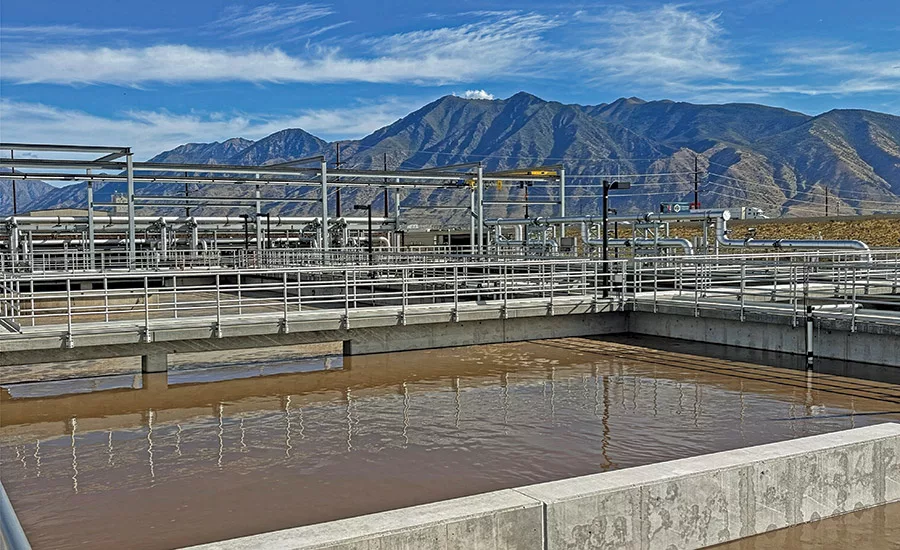
Utah’s 1950s Spanish Fork water facility has been updated by Stantec to protect waterways and support regional growth.
Related Link:
ENR Mountain States & Southwest Top Design Firms 2026
Population growth, infrastructure investments and economic development are driving long-term opportunity in the Mountain States and Southwest, making it one of the most dynamic regions in the country for design and construction, says Karen Doherty, WSP senior vice president. The international design firm takes the No. 1 spot on the region’s Top Design Firms list again this year with $661 million in reported revenue across its 26 regional offices.
Eighty-three firms from the eight-state region shared their revenue, key sectors and top projects with ENR during the magazine’s annual design survey. Rankings and sector breakouts appear on page MSSW12 of this issue.
For WSP, “Our growth has been driven by a diverse portfolio led by power and energy, transportation and environment/water services, supported by continued strength in mining, advanced manufacturing and community infrastructure,” Doherty says. In the power and energy sector, utilities are investing heavily in grid modernization, transmission expansion and resilience initiatives—particularly those tied to additional generation as well as wildfire mitigation. “These programs are creating sustained, multiyear opportunities across Arizona, New Mexico, Utah and Colorado,” she adds.
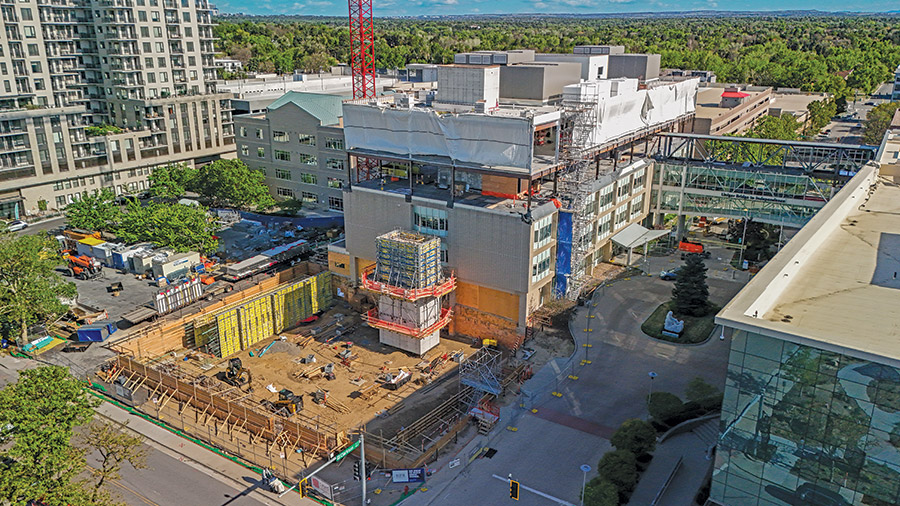
The $250-million Craig Hospital project designed by Davis Partnership will increase capacity at the renowned Denver neuro-rehabilitation hospital by about 15% with 26 new rooms for patients.
Image courtesy DPR Construction
Doherty says transportation continues to be a consistent backbone of the market, with state DOTs, transit agencies and municipal programs advancing highway rehabilitation, transit expansion and multimodal improvements, “and these efforts continue to drive demand for integrated planning, design and program delivery services. And we are seeing strong momentum in water, environment and resiliency-focused work, including watershed management, conservation programs and permitting/environmental services tied to major infrastructure projects.”
John Take, Stantec executive vice president, says that as the region transitions from its broad post-pandemic expansion, it is leaning into a more targeted growth cycle. “We see Arizona being the region’s dominant growth engine across nearly every construction category; heavy civil/infrastructure spending is surging to offset any weakness in traditional nonresidential building, while single-family residential remains the largest sector by value in every state with positive long-term growth. Industrial and workplace sectors face headwinds and data center expansions present massive opportunity, yet they carry water-scarcity risks that must be managed,” he says.
Stantec sits in sixth place on this year’s Top Design Firms list with $296 million in regional revenue for 2025, up from $253.9 million in 2024.

New Technologies Drive Design Trends
“Grid modernization and resilience efforts are driving more complex multidisciplinary transmission and substation design work,” Take says, “and utilities are prioritizing system reliability and integration of new generation sources.”
Design firms are increasingly delivering projects through integrated, multisector approaches, requiring coordination across transportation, water, energy and environmental disciplines, Take says. “We are seeing growing demand for early-stage advisory, planning and environment services, helping clients position projects for funding and successful delivery.”
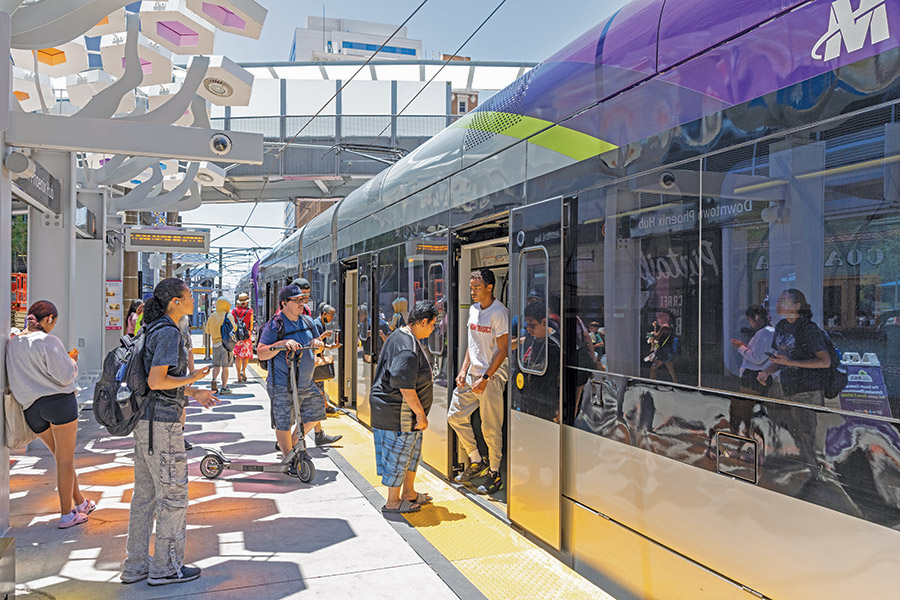
The AECOM-designed Downtown Hub East for Valley Metro is Arizona’s first transit mall, transforming an aging arterial into a vibrant transit plaza featuring illuminated art canopies and a curved segmented platform that allows for mid-station pedestrian crossings.
Image courtesy Valley Metro
Looking Ahead
Across sectors, digital delivery tools, advanced modeling and data-driven decision-making are improving efficiency and enabling better project outcomes, Take says. “We view emerging technologies like AI as enhancing our engineers’ and planners’ capabilities—augmenting human expertise rather than replacing it—and allowing our teams to deliver higher-value insights for clients,” he adds.
“We are seeing growing demand for early-stage advisory, planning and environment services, helping clients position projects for funding and successful delivery.”
—John Take, Executive Vice President, Stantec
Take predicts leading sectors for 2027 will include transportation and institutional markets such as education, health care, power/energy infrastructure and commercial office buildings.
“In addition to growing advanced manufacturing investments, the region also hosts 421 data centers [342 of which are operational, while 79 are in planning/construction] making this anticipated data center market the largest investment sector in the region,” he says.
“We anticipate the Mountain States and Southwest construction market will remain strong but selective over the next year, with growth concentrated in sectors aligned with long-term funding and policy priorities,” says Doherty.
“Energy and infrastructure modernization will continue to lead the market, particularly in transmission, grid reliability and new generation integration. Transportation and water programs supported by federal and state funding will sustain a steady pipeline, although project timing may remain variable,” she says. “At the same time, variability tied to funding cycles and permitting timelines and rising construction costs will require flexibility and strong collaboration between owners and delivery partners.