Digging Deeper | Cultural/Worship
Engineering Feat Provides Seismic Stabilization for Historic Salt Lake Temple
June 15, 2026.webp?height=334&t=1782209596&width=640)
Digging Deeper | Cultural/Worship
Engineering Feat Provides Seismic Stabilization for Historic Salt Lake Temple
June 15, 2026A massive seven-year restoration project nears completion on Salt Lake City’s historic temple.
For much of the past seven years, the historic Salt Lake City temple of the Utah-based The Church of Jesus Christ of Latter-day Saints (LDS) has been obscured from view by scaffolding and the surrounding grounds transformed from manicured gardens into a construction site as the building undergoes a full restoration, renovation and monumental seismic stabilization effort.
The 253,000-sq-ft Gothic Revival building constructed by early church members over a span of 40 years and first opened in 1893 is not only important to church members; Temple Square is also one of the most visited tourist sites in the state, drawing 3 to 5 million visitors each year.
“This temple is an important icon to members around the world,” says Andy Kirby, director of historic temple restoration for the LDS Church. “It’s a desire of many members to some day come to Utah and go to the Salt Lake Temple. It’s a bit like a pilgrimage.”
The Church temples are used by members to perform ceremonies such as weddings, baptisms and other rituals. They differ from a regular meeting house in that they are closed to the public and considered uniquely sacred spaces.
Ensuring the long-term serviceability and structural integrity of the building, which is in an active seismic zone near the Wasatch Fault, has been on the mind of church leaders for some time, Kirby says. Beginning in the early 2000s, church leaders considered an extensive renovation, but over the years, the focus narrowed to an upgrade of the mechanical, electrical and plumbing systems.
“Those systems were all nearing the end of their life and then a proposal was made to do the seismic upgrade at the same time,” he says. “We did some studies, and in 2014 we were asked to come up with some concepts for the entire project.”
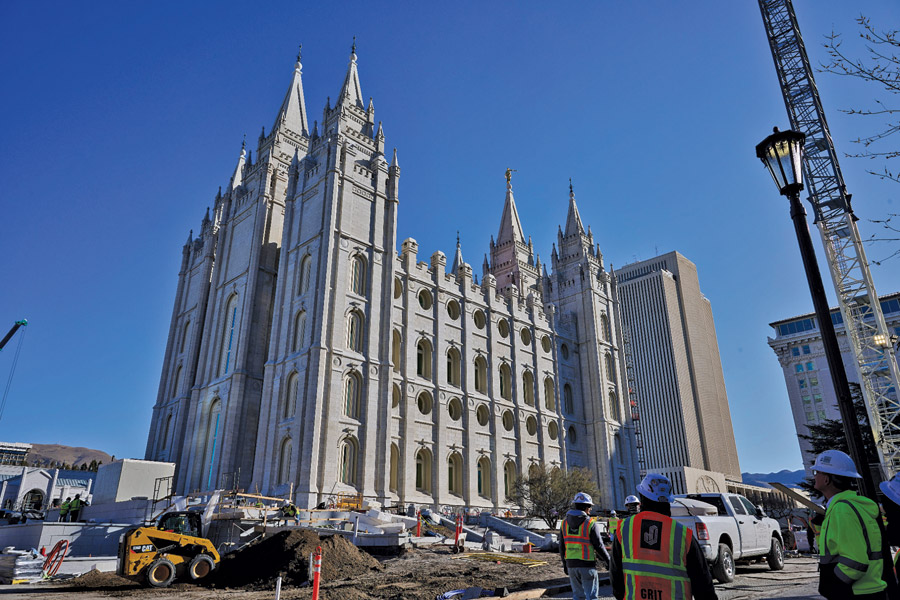
After nearly seven years, scaffolding around the temple came down this spring as the renovation and seismic stabilization project moves closer to completion.
Image courtesy of the Church of Jesus Christ of Latter-day Saints
Salt Lake City-based Jacobsen Construction was selected as a collaborate partner of the project. Jacobsen had previous experience with the church and seismic stabilization projects, completing the restoration and renovation of the historic tabernacle adjacent to the temple in 2007 and the seismic stabilization of the historic Utah State Capitol building in 2008.
Temple construction broke ground in 2020 and will be complete by the end of 2026. Church officials will not reveal the cost of the undertaking, but estimates by industry experts place it at around $2 billion.

Like the capitol project, the contractor partnered with Forell/Elsesser Engineers of San Francisco to lead the design of the seismic stabilization. Engineers from the church as well as Utah firms Reaveley Engineers and ARW Engineers were also involved in the design and review of the seismic stabilization program.
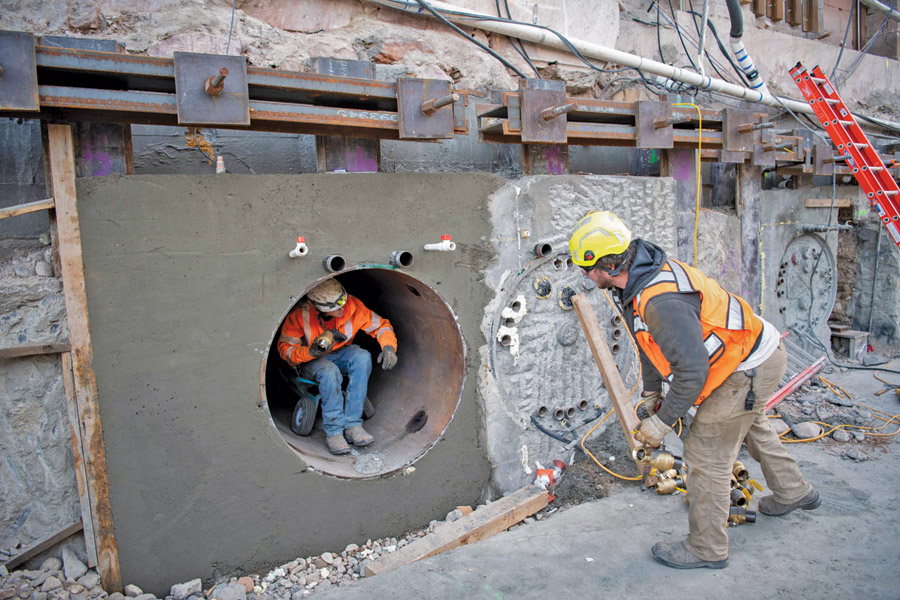
Workers check one of the 96 steel pipes jacked into place under the temple. A rebar cage will be placed into the pipe and then grouted.
Image courtesy of the Church of Jesus Christ of Latter-day Saints
Going Deep
Like the stabilization of the Utah State Capitol, Forell/Elsesser turned to a base isolation system for the temple but knew it would be much more complex, says Mason Walters, a lead design engineer. “We did learn a lot from the [Utah] State Capitol, and there are some similarities here. It was almost like training wheels for a project like this which is infinitely more complex,” he contends.
Early plans for the stabilization would have removed the historic sandstone foundation, but church leaders and other members of the engineering team pushed for other options.
“The original foundation is massive, and it would be a very big project just to remove that. We wanted to minimize time or duration of exposure where the structure would be suspended temporarily,” says Brent Maxfield, a structural engineer with the Church. Given the building’s estimated weight of 185 million lb and the brittle nature of the stone—the foundation is sandstone, while the building is made from granite-like quartz monzonite, both quarried from nearby canyons—keeping the foundation was the right approach, he says.
“The foundation also represents an unbelievable amount of effort by the pioneers who built it, and we didn’t want to waste that if we didn’t have to,” Walters says. “We wanted to transfer the load from the original foundation to a new one without the temple knowing it had been moved.”
The system the team developed placed shoring walls around the temple foundations and then installed horizontal reinforced steel pipes under the existing foundation. The soil was then excavated 17 ft below the existing foundation and new footings were placed to support the base isolators. Concrete transfer beams measuring 15 ft by 15 ft encase a section of the foundation and the reinforced pipe, which had post-tensioning cable threaded through it. The transfer beams then rest on base isolators on either side of the foundation. After the post-tension cables are tightened, the soil under the foundation is removed and the load transferred onto the base isolators.
The project uses a total of 98 base isolators that can each carry up to 8 million lb. They allow the building to move up to 5 ft in any direction in a seismic event.
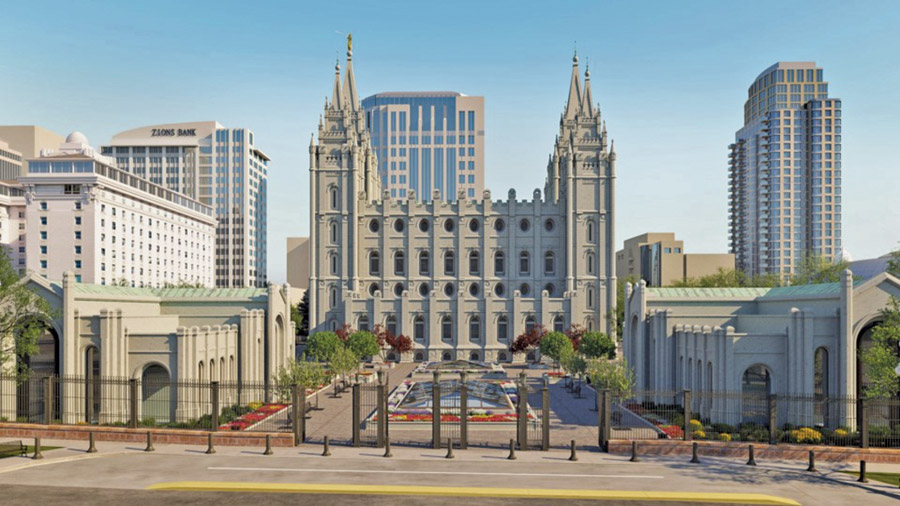
A rendering of the renovated Salt Lake City LDS Temple, additions and grounds. Church officials expect 3 to 5 million visitors to attend public open house events from April through October of 2027.
Image courtesy of the Church of Jesus Christ of Latter-day Saints
To compact the soils under the isolators, the team turned to a flat jack system with isolators, similar to the process used at the capitol project. “It’s a hydraulic device we can inflate, and it pushes the new footing with the base isolator down and compresses the soil before we make the load transfer,” Walters says.
One of the more difficult challenges came in placing the 96 horizontal steel pipes under the temple. The 4-ft-dia pipes are 20 ft to 40 ft long depending on their location. A rebar cage is inserted in the pipe, which has had post-tensioning cable threaded through it, and then it is grouted. The team used a jack and bore system to push the pipes under the foundation, but the auger used for boring kept hitting large stones and being pushed out of alignment.
Brad Bohne, general superintendent for Jacobsen Construction, says that given the extensive use of new technology on the project, the solution the team came up with was rather old fashioned.
“We wanted to transfer the load from the original foundation to a new one without the temple knowing it had been moved.”
—Mason Walters, Design Engineer, Forell/Elsesser Engineers
“We would send a worker into the pipe with a pick and shovel or air hammer and hand-mine a section, then we could jack it into that cleared area. We would shoot a laser each time to make sure we were still on target. It was time consuming, but it was really the only way,” Bohne says.
The accurate placement of the pipes was critical to the vertical stabilization portion of the project that involved post-tension cables threaded from the top of the temple walls to be removed between the horizontal pipes. The process was further complicated not only by the lengths of the boreholes, some over 150 ft, but drillers could not use water to lubricate and cool the drills as is typically done.
There was a fear that "water could get through the walls and damage the inside of the temple," says Bohne. Canadian-based specialty vertical drilling contractor West Coast Cutting and Coring injected a water mist into the bore hole to cool the drill and then vacuumed the water out. The water was then filtered and reused, so it never remained in the hole for long.
Once the vertical drilling began and progress was checked, it became clear that the process was going to take longer than expected. “We had to get more people, more drill rigs, more equipment, more everything up on that roof to avoid having this take four years,” says Bohne.
More equipment was moved to the roof along with a modular machine shop to repair drill bits quickly on site and keep the rigs running smoothly.
New steel trusses were also installed on the roof as part of the stabilizing system. The existing steel trusses were left in place and sandwiched between the new steel trusses.
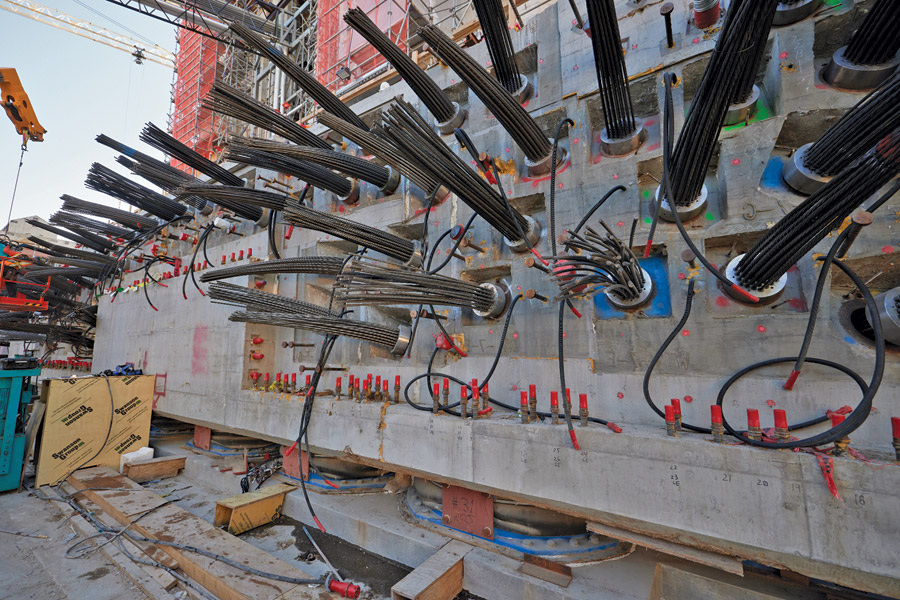
Some of the approximately 260 miles of post-tensioning cables sprout from the newly reinforced base of the temple.
Image courtesy of the Church of Jesus Christ of Latter-day Saints
Real World Test
Work on the temple had been underway for less than three months when a 5.7 earthquake hit the Salt Lake Valley in March of 2020. Some masonry on the temple spires was loosened, and the trumpet held by the statue of the angel Moroni atop the tallest center spire broke loose.
"[After a 5.7 earthquake a year into renovation work, ] I could see where grout was blowing out from the stones and things [were] twisting and turning. It showed us some places where we needed to rethink our plans and figure this out.”
—Brad Bohne, General Superintendent, Jacobsen
The earthquake “drove home how we are protecting this building; it wasn’t theoretical anymore,” Bohne says. “I got video from the security cameras, and I could see where grout was blowing out from the stones and things [were] twisting and turning. It showed us some places where we needed to rethink our plans and figure this out.”
Something that became apparent to the team after the earthquake was the need to reinforce the six spires.
“We realized the vertical accelerations were causing a lateral movement at the top of the spires, and that was something we’d not identified before,” Walters says.
Engineers designed reinforcing steel frames to fit inside the spires, which were then secured with post-tensioning cables to keep them from pulling up and away from the mass of the building in a seismic event.
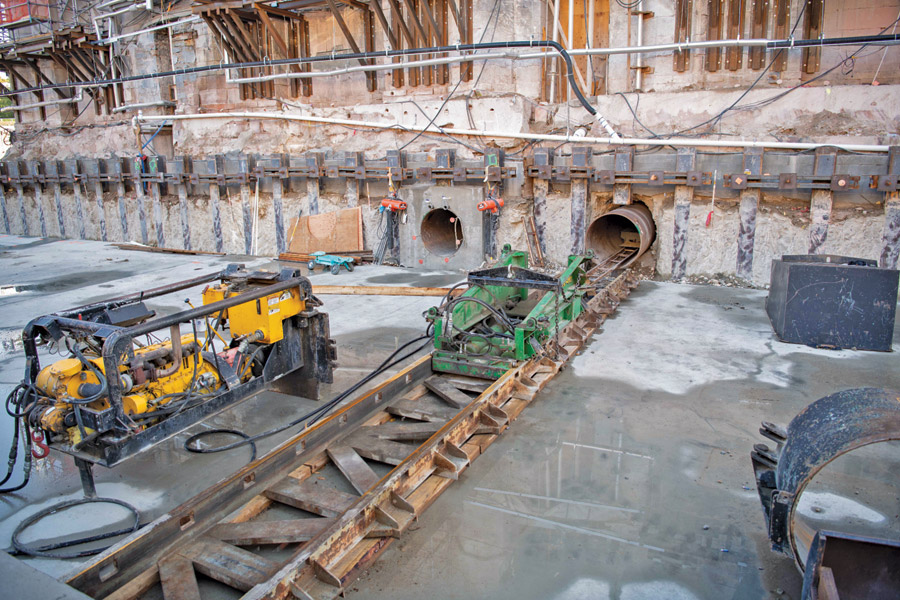
A jack and bore system was used to place 96 steel pipes under the temple. Workers entered the pipes to clear away rocky soil by hand.
Image courtesy of the Church of Jesus Christ of Latter-day Saints
Looking Back
While the seismic upgrade was underway, other teams were at work on the interior renovation and restoration. Bill Williams, director of design services for the church, says the purpose of the interior renovation was to restore rooms and finishes to their original look and feel as well as to create more space for more members to participate in temple ceremonies. As part of the current project, a 285,000-sq-ft addition was built on the north side of the temple to accommodate more rooms and a second baptistry font.
Church design teams worked with designers Josh Probert, David Rees, David Brenchley and Caley Park, specialists from Salt Lake City-based architectural firm FFKR on the interior restoration.
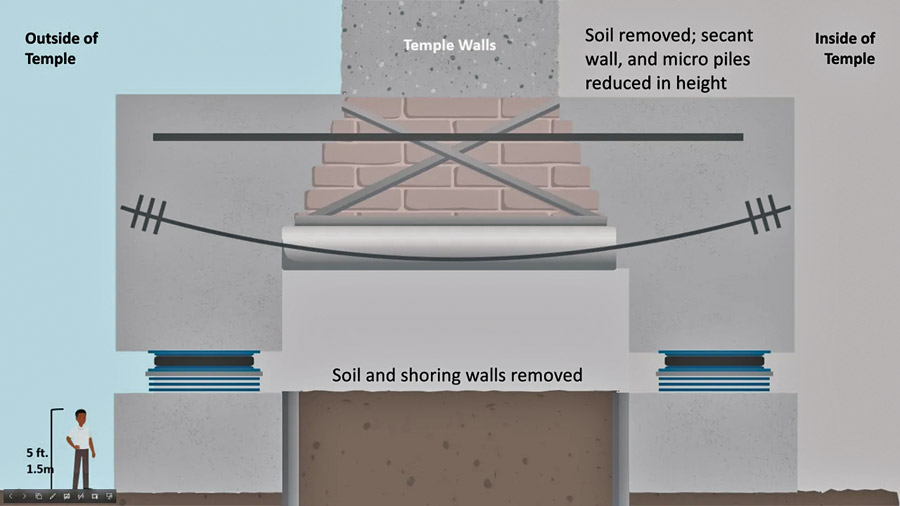
A rendering of the reinforced foundation, concrete transfer beams and base isolators under the temple.
Image courtesy of the Church of Jesus Christ of Latter-day Saints
Kirby says designers were able to take historic photographs as well as find old layers of paint to choose a color palate for the restoration work. Then the team would create models and present them to church leaders along with some history of what had been done to the finishes over the years.
“We gave them a range of interior design options that ranged from historic to more modern, and they decided on the designs that were closer to historic,” Probert says.
From historic photographs, Probert says the team was able to recreate pieces like wall sconces and other light fixtures that had been replaced or removed over the years. Other historic features such as Tiffany stained-glass screens and windows and hand-carved wall and ceiling details were restored.
“To be able to strengthen what the pioneers did here and make it usable for people hundreds of years into the future is really an honor.”
—Andy Kirby, Director of Historic Temple Restoration, LDS Church
“If we didn’t have original pieces, we tried to get craftpeople to create something reflective of what those original artisans would have done,” adds Williams.
Using new technology along with historic research to develop options has been very satisfying, Rees says. “I think that has been one of the real successes of the project,” he adds. We can develop different renderings and present them to the leadership and say, ‘How far do we want to go back? What are the true colors and what do we want to do?’”
Kirby was especially pleased to see restoration work of granite spiral staircases inside the corner spires of the building. “Each one has a stair from a half story below grade up to the seventh floor. It’s a true spiral, and each step is one solid stone,” he notes. “There is oak wood wainscotting, and we were able to use a new laser tool to strip off the varnish and paint and get it back to the original without having to use sanding or chemicals and lose the detail. It was amazing.”
“To be able to strengthen what the pioneers did here and make it usable for people hundreds of years into the future is really an honor,” he adds.