Hard Winter Blamed for Overpass Spalling Incidents Near NYC's George Washington Bridge
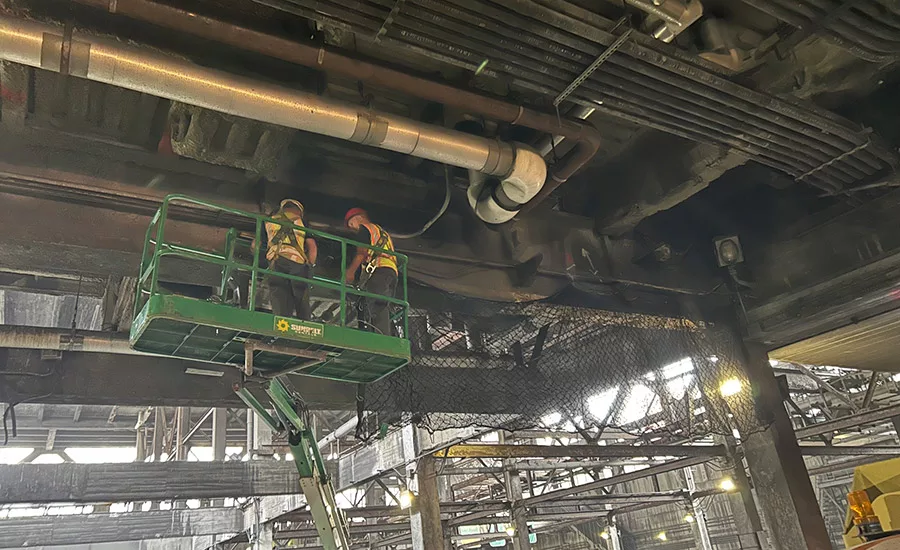
Workers installed 2,000 sq ft of construction-grade wire netting on all expansion joints in the lower level of the TransManhattan Expressway in upper Manhattan near the George Washington Bridge to catch falling debris until a long-term solution can be found.
Severe winter conditions with “extremely cold temperatures and significant snowfall” led to two incidents in May involving concrete and metal spalling on heavily traveled roadways leading to New York City’s George Washington Bridge, says Kathryn Garcia, director of its managing agency, the Port Authority of New York and New Jersey.
The mixture of snow and ice infiltrated the bridge plate system through its expansion joints, along with salt, which further corroded some concrete, she says.
Nearly a century old bridge, the bridge carries about 300,000 vehicles per day on 14 vehicular lanes on two levels between Manhattan and New Jersey, is one of the most critical transportation links in the country, says Port Authority. It has been undergoing restoration since 2015 as part of the Restoring the George program. Like many other highways and bridges in the region, the span's aging infrastructure is increasingly causing safety concerns for motorists.
The Trans-Manhattan Expressway connects the bridge between a busy section of Interstate 95 called the Cross Bronx Expressway and what becomes the New Jersey Turnpike and other roadways in New Jersey..
“We went in immediately and closed down those lanes and began doing sounding, which literally [means] tapping to make sure we don't hear any void in the concrete, and then chipping off anything that we did discover in those inspections,” Garcia said at a May 21 press conference that followed the authority’s board meeting after the second incident on May 13.
In addition, crews installed construction-grade wire netting as a precaution on all expansion joints near the one that failed, to catch additional falling debris "and now we’re going back and doing other areas,” Garcia said.

Construction-grade wire netting was installed outside of the expansion joints in the lower level of the TransManhattan Expressway, located below the GW Bridge Bus Terminal near the George Washington Bridge.
Photo courtesy of the NYNJ Port Authority
Port Authority crews installed 2,000 sq ft of netting after inspecting 72,000 sq ft of the overpass overhead structure, which included removing loose debris from overhead areas, the New York Times reported.
The most recent incident involved an injured passenger who needed hospital treatment after debris fell and struck a car on the approach to the Trans Manhattan Expressway, according to the New York City Fire Dept. An update on the condition of the driver transported to New York Presbyterian Hospital was unavailable, the Times said
Another earlier incident that involved concrete falling on a car was captured in a video clip and appears to have occurred near the same area, according to ABC 7 New York news.
The first incident in early May involved material that was “almost like a luminous metal” with dust atop, Garcia said at the press conference. “The second was a piece of concrete, so we have taken down any concrete, like when we hit it and hear noise. We have in some cases jack hammered it out to make sure we can safely move passengers,” she added.
Prior to the recent spalling incidents, Garcia noted that the authority already had plans underway for “a long-term capital replacement on several of these overpasses and we’re going to continue to work as we move forward in other areas, out of an abundance of caution outside the expansion joints.”
The Port Authority said it was still investigating the cause of the two incidents.
A $250-million project to rehabilitate the overpasses is based on the Port Authority’s 10-year capital plan approved last year.
In other news, Garcia said that after agency staff discovered a sinkhole on May 21 near a LaGuardia International Airport runway in Queens, N.Y., as part of its routine inspections, “We are continuing to use ground penetrating radar and coring samples to find any additional void.”