Colorado/Wyoming Owner of the Year
Denver's Cherry Creek North Woos Developers to Thriving Business Improvement District
The site of a vacant 1950s Sears store is being redeveloped into Cherry Lane, an upscale 9-acre mixed-use project.
While many neighborhoods strive to bring their live-work-play promises to life, along with the high occupancy rates needed to make the projects successful, the 16-block Cherry Creek North Business Improvement District has achieved theirs. With 10 large-scale infill projects either completed or in process since 2020, and five more currently in review, the mixed-use, pedestrian-focused neighborhood adjacent to downtown Denver is one of the busiest markets in the country.
Approximately 300,000 sq ft of office space and hundreds of residential units have recently been added to the already dense neighborhood, and Cherry Creek North consistently maintains some of the lowest office and retail vacancy rates in the region, says Nick LeMasters, president and CEO of the Cherry Creek North Business Improvement District (BID), the entity that sets the stage for developers to invest in the area.

PCL is constructing the eight-story 201 Fillmore building in Cherry Creek North. Designed by Goettsch Partners, the Class A office building features first-floor retail and an outdoor rooftop patio.
Image courtesy Goettsch Partners
“It’s the consummate mixed-use environment,” he contends. “And this may be one of a handful of places in America where you can still get an office building financed and leased and open at a time when nobody is building office. That in and of itself is just about as extraordinary as it can be.”
Established in 1989, the Cherry Creek North Business Improvement District was the first BID formed in Colorado. It was created to help guide the long-term success and vitality of the Cherry Creek North neighborhood, and it was structured as a public organization funded primarily by private commercial property taxpayers. Its boundaries encompass a 16-block area stretching from 1st Avenue to 3rd Avenue and from University Boulevard to Steele Street, approximately three miles from downtown Denver.

The Beck Group and Shears Adkins Rockmore are building apartments at 299 Milwaukee.
Photo courtesy Shears Atkins Rockmore
Flight to Quality
“What it boils down to is a flight to quality,” LeMasters says. “The kinds of tenants coming into the district represent a wide array of verticals,” from oil and gas to wealth management and finance. “We also see more and more family office operations making Cherry Creek their home. And on top of all that is layered this fantastic collection of local retail.”
The BID partnered with the city and neighbors in 2012 to develop the Cherry Creek Area Plan, which informs development, transit and future rezoning within the Cherry Creek area. The plan also helps to ensure that building design standards are met and that the pedestrian realm is at the forefront of every project.
Cherry Creek North was the first pedestrian priority zone in Denver, and walkability is a key element to any new construction, LeMasters notes.

The Beck Group is design-builder on the 250 Clayton St. Class A office tower project.
Image courtesy the Beck Group
Collaborative Effort
The district’s zoning code changed in 2014 to allow for greater density and encourage redevelopment of the older buildings, many of which did not have sidewalk-level storefronts due to old zoning provisions. The greater height and density near 1st Avenue tiers down on the 3rd Avenue neighborhood side. “It was this collaboration that made the zone code so palatable to everyone,” LeMasters explains.
“What’s great about the BID is that it’s a mini self-governing entity across Cherry Creek that has solely the interest of the businesses and landowners,” says Matt Joblon, CEO of BMC Investments.
“This may be one of a handful of places in America where you can still get an office building financed and leased and open at a time when nobody is building office.”
—Nick LeMasters, President & CEO, Cherry Creek North Business Improvement District
The BID is empowered to make decisions in the best interests of the stakeholders, with the neighborhood’s safety and cleanliness its top priority, Joblon adds. “You can’t sell anything if you don’t feel safe. The BID does an amazing job to ensure streetscapes are done right ... they cover all the best practices,” he contends.
The district’s design advisory board, one of just a few in Denver, meets monthly to analyze every project that comes on line. “From the front doors and signage on a building to a brand-new build,” this volunteer board of architects and developers looks at each project, LeMasters says. “Their colleagues and competitors make the presentations.… There’s a lot of collegiality, and their feedback is respected,” he adds.
The BID staff also partners with the city to ensure the Cherry Creek North construction projects are managed in a safe and efficient manner and are executed in a way that minimizes impacts on surrounding businesses. However, this is no easy task with the number of cranes and construction vehicles that have taken up residence in the neighborhood.
The largest project, BMC’s $500-million Cherry Lane development, will completely reimagine the west end of the neighborhood when it opens for business in 2028.
Tryba Architects designed the three buildings that will occupy the 9-acre site. The project features 379 market rate apartments and 59,063 sq ft of office space as well as 132,665 sq ft of high-end ground floor, second-floor mezzanine and rooftop retail and restaurant spaces.

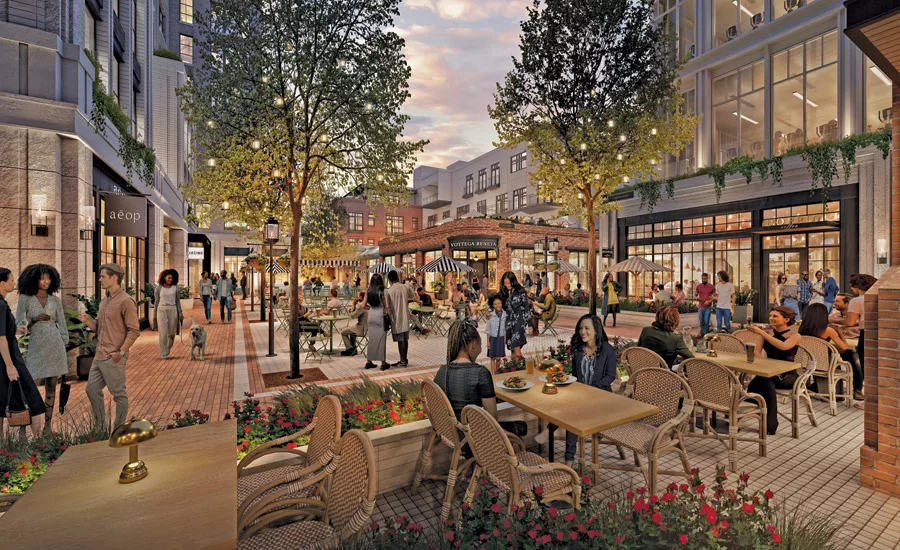
The 9-acre Cherry Lane development will provide new mixed-use connectivity to the Cherry Creek North neighborhood.
Rendering courtesy of Tryba Architects
PCL Construction began the extensive demolition of the old buildings in December 2024 and is currently running structure up through the existing parking garages to build on top of them to create a nine-story residential building with retail on the bottom. General superintendent Jeff Luedecker says 37 retailers will go into the three structures, which will include walkable roads between the buildings to access the storefronts and will also feature an outdoor bar.
The construction work is taking place adjacent to one of the busiest Whole Foods in country, he adds, and PCL is keeping the grocer’s existing parking garage active despite the fact that much of the work currently in progress is concealed within the garage, “bringing in a whole new level of complexity.”
“We have a great relationship with the BID and spend a lot of time coordinating with them,” Luedecker adds.
PCL is also constructing a project at 201 Fillmore. Designed by Goettsch Partners, the 140,000-sq-ft, eight-story Class A office building features first floor retail and a rooftop patio. Down the street, the Beck Group is the design-builder on the second phase of the $200-million Clayton Street redevelopment, an eight-story, 175,000-sq ft Class A office building with 10,000 sq ft of ground-floor retail.

An open-air pedestrian retail lane contributes to the area’s walkability, a key element of any construction in the district.
Rendering courtesy of Tryba Architects
Minimizing Disruption
With so much construction activity in a relatively tight footprint, the BID works to minimize the disruption by managing traffic flow. LeMasters says noise, trucks and the reduction of on-street parking are all issues, and the BID helps mitigate some of them by directing customers into available garages.
He says they also have the obligation to create “the best pedestrian public realm we possibly can,” and they spend a lot of time and effort on public safety and keeping the neighborhood clean.
Those efforts are paying off. Two large residential projects are currently rising from the ground. Hyder Construction broke ground last November on the Shears Adkins Rockmore-designed Waldorf Astoria condos, and 70% of those residences have already been sold. Shears Adkins Rockmore also designed Oasis Apartments, which will bring more than 400 luxury units to the neighborhood. Constructed by the Beck Group, the eight-story mixed-use project topped out in March.
“To have permanent ownership of residents in addition to hundreds of for-rent apartments is exciting,” says LeMasters, who adds that condo development in Colorado has been negligible for years, making these types of projects unique for the state.
“The Palm Beach area of Florida and the Century City neighborhood outside of L.A. are the only other two markets doing this well,” LeMasters continues. “There are companies paying attention to Denver.”

.webp?height=200&t=1773071229&width=200 "Cherry-Lane-01-Tryba-Architects")