New England Legacy Award Winner Robin Greenleaf: Steady Hand During Uncertain Times
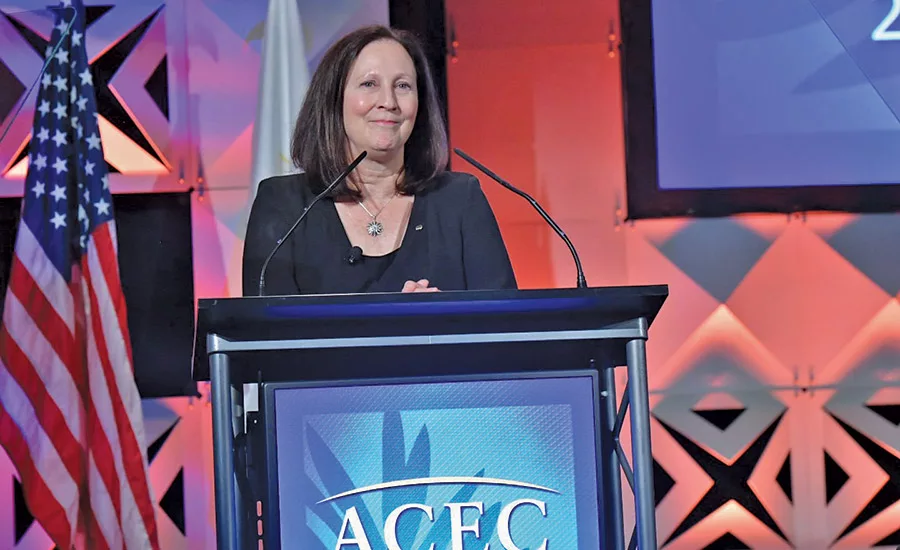
Taking over as chair of the American Council of Engineering Companies during the COVID-19 outbreak, Robin Greenleaf focused on rapid knowledge sharing.
When U.S. engineering firms and clients needed more than technical answers following the outbreak of COVID-19, Robin Greenleaf met the moment as elected chair of the U.S. advocacy group American Council of Engineering Companies. She represented ACEC membership through the pandemic and the social and political flash points that followed. “We learned quickly that if it’s not a clear business-related issue to the engineering community, we would have half of our members be happy and half of our members be angry no matter what we did,” says Greenleaf, the group’s first woman chair.
With travel halted and uncertainty rippling through project pipelines, Greenleaf helped ACEC pivot to rapid knowledge sharing. “We needed to provide our members as much information as possible about what was going on in the industry,” she says, which was accomplished by national surveys through the ACEC Research Institute and “monthly meetings for all of the leadership of all of our individual chapter organizations.”
The goal was to ensure firms that they were not “operating in a vacuum”—a posture that defined her career-long focus on collaboration, clarity and making engineering work better. Linda Darr, ACEC’s president and CEO, says Greenleaf “asked the right questions ... listened with a passion” and stayed “steady, grounded and calm.” In 2021, Architectural Engineers was acquired by IMEG. Greenleaf stayed on until October 2025 before retiring as executive vice president of architectural relations and strategic partnerships.

Working on the New Orleans Veterans Affairs Hospital after Hurricane Katrina in 2005 was the “project of a lifetime” for Greenleaf.
Photo courtesy NBBJ
Digging In
Greenleaf grew up in Newton, Mass., the daughter of a mechanical engineer. Her father, the late Sidney Greenleaf, taught at Harvard University’s Graduate School of Design. She dug pits and built retaining walls in the backyard and was at the table when her dad often brought colleagues to dinner. Greenleaf absorbed “talk about how architects and engineers are supposed to work together,” she says.
Her late mother, Carole Greenleaf, pushed her toward a profession and modeled civic engagement. “She always told me, ‘Be a professional,’” Greenleaf says, noting that her mother later moved from volunteer work into government and advocacy. That mix—technical curiosity and a sense of public purpose—showed up early. Greenleaf earned a civil engineering degree from Oregon State University, where she met her husband, Joel Goodmonson, a structural engineer. She later earned a master’s degree in structural engineering from Drexel University and worked for Bechtel. By the mid-1980s, the couple returned to Boston to launch a mechanical, electrical, plumbing and fire protection engineering business with her father. Architectural Engineers Inc. specialized in historic preservation. As it grew other business lines, Robin Greenleaf focused on business development and leadership. “I really liked the financial aspect of running a business,” she says.
In 1991, Greenleaf joined ACEC Massachusetts and “plugged” into a collegial network that helped her improve her management and strategic planning skills. She also enrolled in leadership training classes, including one where the instructor made everyone stand on a soapbox and say why they enrolled. “I was terrified,” Greenleaf says. “I said, ‘I want to change the way my industry does business.’”
At the time, architects and engineers fought for low-bid public projects with “unfair” contract terms “that didn’t allow for any creativity,” she says. Greenleaf started building coalitions through ACEC that partnered with agencies such as the Division of Capital Asset Management and Maintenance and Massachusetts Port Authority to foster collaboration. “Those relationships are still active to this day, which I’m proud of,” Greenleaf says.
“I said, ‘I want to change the way industry does business.’”
—Robin Greenleaf
Qualifying as a woman-owned business also helped Architectural Engineers grow. But the firm also used the strategy to serve as the prime engineer hiring other women- and minority-owned consultants without counting itself to fulfill MWBE goals. The tactic often helped win public work over larger firms. “It was satisfying to realize that we could get this kind of work by having a good strategy,” she says.
But working as a subconsultant on the New Orleans Veterans Affairs Hospital after Hurricane Katrina in 2005 still proved to be the “project of a lifetime” for Greenleaf, who designed plumbing and medical gas design for the $1-billion effort. The project took what at the time was a novel approach by installing critical mechanical infrastructure higher in the building to avoid ground floor flooding of systems. But it also required long-duration water and sanitary storage on a constrained site. “There was nowhere to put it,” she says.
The team installed a domestic 60,000-gallon underground water tank with a seven-day supply that had to be treated in a protected underground zone. Members also designed generators to run the system along with HVAC and electrical systems. “Everything ended up being underground and under a parking garage,” she says. “Nobody knew how to do it, but we figured out how. That’s been operating for years.”
When Sidney Greenleaf retired from the firm, his daughter became CEO and hired Susan Wisler, a mechanical engineer, who eventually became firm president. Greenleaf worried about neglecting company duties when becoming ACEC chair-elect in 2020. She served as chair for the following two years, with Wisler eagerly assuming more responsibility. “You get worked up thinking they can’t live without me, and then you find out they can’t wait to live without you,” Greenleaf jokes. “It’s all good. It’s probably the way it should be.”
Unable to hold the ACEC chair’s traditional in-person listening sessions due to COVID, Greenleaf led remotely, representing a diverse membership in an often turbulent period. ACEC’s research arm played a key role in providing members with as much information as possible, while links with ACEC’s international counterpart, FIDIC, helped Greenleaf widen her message. “We have to become part of a bigger solution to solve a big problem, and if we’re not using our technical skills for that, then why are we even here?” she says. Diversity committees Greenleaf created were among ACEC’s most active, the former chair adds.
In retirement, Greenleaf and Goodmonson funded an architectural and engineering program scholarship at Oregon State. Serving on a university steering committee has been “satisfying,” she says. Greenleaf remains connected to ACEC through a Research Institute board role she holds until April. She’s also serving in an advisory role for the board of design firm BL Cos. Greenleaf, who learned how to figure skate as an adult and was part of a team winning two national championships, is also a U.S. Figure Skating judge.