Stadiums
RFK Stadium Proposal Enters Federal Advisory Review
A Feb. 5 NCPC meeting brings early engineering constraints of the $3.7B campus redevelopment framework into focus
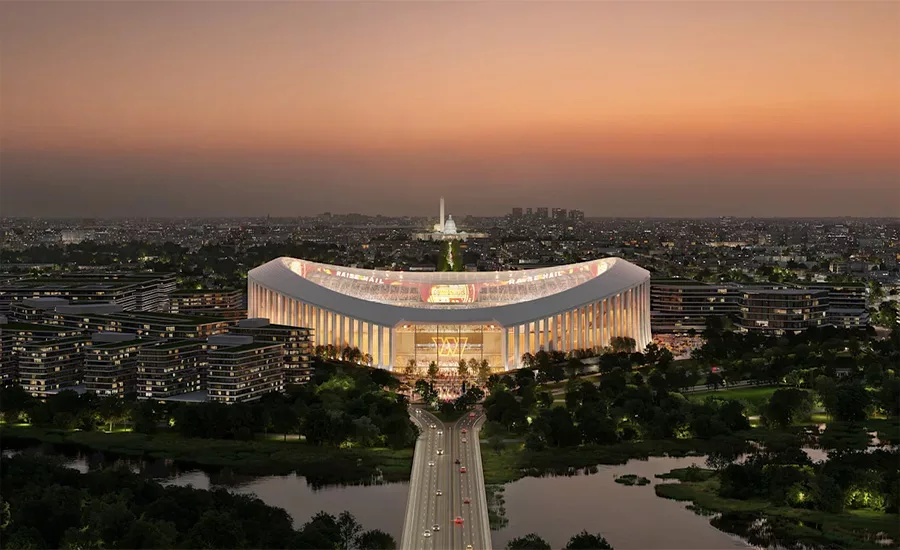
A rendering shows the Washington Commanders’ proposed enclosed stadium at the RFK site, which is scheduled for concept review at the National Capital Planning Commission on Feb. 5 as part of the project’s federal advisory process.
With the Washington Commanders’ proposed stadium slated for concept review at the National Capital Planning Commission’s Feb. 5 meeting, the project is entering its first federal advisory phase—one that will shape engineering scope, schedule and cost well before construction.
Materials submitted for the upcoming meeting reviewed by ENR show portions of the stadium district encroach into the FEMA Zone AE floodplain along the Anacostia River, prompting hydraulic analysis and coordination with District regulators.
RELATED
DC Gives Final OK to New NFL Stadium
Project engineer Kimley-Horn submitted a no-rise floodplain analysis to the D.C. Dept. of Energy and Environment in November 2025, demonstrating no increase to base flood elevations, receiving conditional approval later that month. Final approval is expected to accompany subsequent site plan submissions.
Designing within the floodplain pushes decisions on elevations, foundations, utilities and stormwater earlier in design, with early substructure choices often becoming schedule drivers if they change later, rippling through procurement and public infrastructure coordination.
That engineering context sharpens the significance of conceptual renderings released Jan. 15, which marked the first public articulation of the stadium’s massing. In a prepared statement, team President Mark Clouse called the images a development milestone toward a year-round venue tied to the District.

A site map from National Capital Planning Commission submission materials shows the RFK campus and surrounding parkland along the Anacostia River, illustrating the stadium district’s location within a broader, federally regulated landscape subject to floodplain and planning review.
Map courtesy of the National Capital Planning Commission.
Under rules governing the RFK campus, the stadium design is also subject to advisory review by the U.S. Commission of Fine Arts, alongside NCPC’s planning review, and their advisory comments can still drive design revisions affecting infrastructure, sequencing and scope.
Federal advisory review has materially shaped major projects along the Anacostia corridor before. The 11th Street Bridge replacement, completed in 2016, underwent multiple rounds of review by federal planning and design bodies, with agencies weighing in on profile, circulation, river crossings and visual impact near adjacent federal land.
While not a stadium project, the bridge provides an analog for how large-scale construction near the RFK campus has evolved during federal review, with design refinements influencing engineering scope and sequencing without altering the underlying project intent.
RELATED
HKS Named Architect for New DC Football Stadium
HKS, the project’s lead architect, has emphasized the significance of the RFK site in shaping the design approach. In a statement released with the renderings, HKS global venues director Mark A. Williams pointed to the site’s local and national history, underscoring the scrutiny that typically accompanies large-scale construction on federally sensitive land.
“Every design decision is guided by the significance of place—shaped by its local, regional and national history and generations of memories rooted in RFK Stadium,” Williams said.
D.C. has tied the stadium proposal to broader redevelopment goals for the RFK site, even as the project advances during the final year of Mayor Muriel Bowser’s administration. Bowser announced last November that she would not seek re-election in 2026, setting the stage for potential political scrutiny as the stadium moves through review during an election year.
“These renderings give D.C. a lot to look forward to—a beautiful and unique waterfront stadium and the return of our Commanders,” the mayor said after the images were made public. “Year-round events that are steps away from an entertainment district and public transportation; and, of course, jobs for D.C. residents and new opportunities for D.C. businesses.”
NCPC Submission Materials
RFK Complex | Concept Review
Even with the momentum created by the upcoming NCPC review, the project remains well short of being shovel-ready. NCPC materials indicate that demolition of the existing RFK Stadium is expected to continue through mid-2026. Vertical construction is optimistically targeted to begin in 2027, with completion projected around 2030, placing multiple years of design development, permitting and procurement between site clearance and stadium construction.
A $3.7-billion cost for overall redevelopment across the RFK campus has been cited, but not at a construction-ready level of detail. NCPC materials clarify that the Commanders’ construction scope is limited to the stadium itself, while the District is responsible for surrounding infrastructure and a broader, phased mixed-use redevelopment of the 180-acre RFK campus. No construction contract values or trade-level cost breakdowns have been released.
For now, the renderings serve more as a stress test than a start date. With the design soon before federal reviewers, the coming months will determine how architectural ambition is translated into a buildable scope shaped by floodplain constraints, infrastructure coordination and regulatory oversight.

Bryan Gottlieb is the online editor at Engineering News-Record (ENR).
Gottlieb is a five-time Society of Professional Journalists Excellence in Journalism award winner with more than a decade of experience covering business, construction and community issues, including finance, law and real estate. He has reported for Adweek and the San Diego Daily Transcript and led a community newsroom in Santa Monica, Calif. He served as editor-in-chief of the Detroit Metro Times and as managing editor at Roofing Contractor, where he helped shape national industry coverage. At Engineering News-Record, Gottlieb covers breaking news, large-scale infrastructure and megaprojects, regulatory developments and business trends across the U.S. and global construction sectors.
email: gottliebb@enr.com | office: (248) 786-1591