2025 West Best Projects
Best Residential/Hospitality: First Light
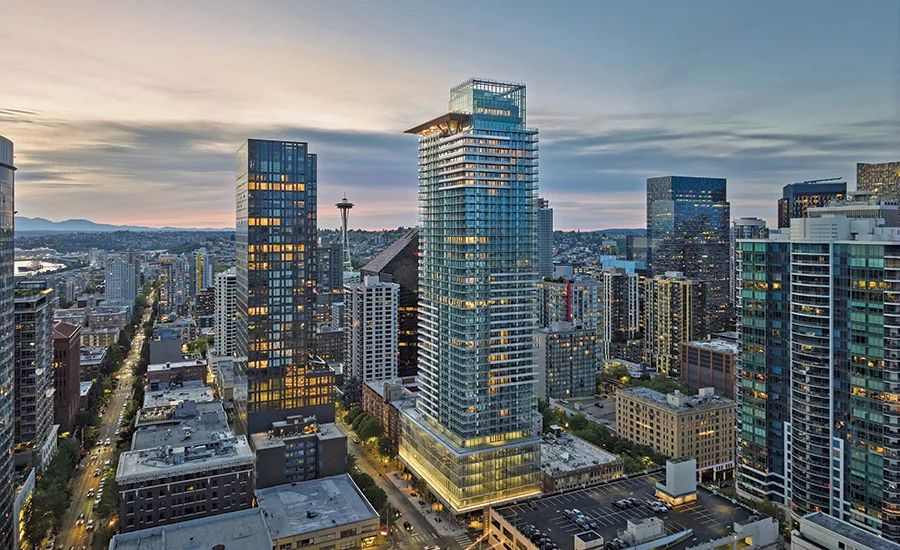
First Light
Seattle
BEST PROJECT
Submitted by MG2
Owner Westbank Corp.
Lead Design Firm James K.M. Cheng Architects
General Contractor Build Group
Executive Architect MG2
Civil Engineer KPFF Consulting Engineers
Structural Engineer Glotman Simpson
MEP Engineer Integral
Conceived as a building in the round, the $216-million, 48-story mixed-use tower called First Light features a facade composition that transforms as it rises, with white vertical bands wrapping around prominent corners.
A cantilevered pool on the 47th floor is Seattle’s highest and one of only a few such pools in the U.S. This feature required nearly two years of coordination, with castellated steel beams bolted to the concrete deck and prefabricated support systems minimizing high-altitude work. Due to the pool’s elevation and exposure, special consideration was given to wind loads, temperature changes and weather-related movement. Temporary support systems were prefabricated to minimize onsite work at height and reduce exposure over busy streets below. Castellated steel beams were bolted directly to the concrete deck to support the cantilever, with prefabricated working platforms anchored to these beams. All structural connections were coordinated precisely with in-slab MEP systems to avoid conflicts. Formwork was precambered to account for expected 3-in. deflection during concrete placement. The structure was placed in segments while survey teams actively monitored movement in real time.

Photo by Moris Moreno
Complex detailing was also required for corner units featuring floor-to-ceiling sliding glass doors that open without mullions or columns, creating uninterrupted transitions from indoor to outdoor living. Integrating utilities in-slab maximized ceiling heights but required meticulous sequencing and collaboration across trades.
A dual-layer safety net system was installed beneath the entire temporary assembly, including one mesh net for debris and one rated for personnel fall protection. A dedicated bracing system mitigated wind loads during construction, and the system underwent frequent inspections by third-party engineers.
Below ground, the project features Seattle’s deepest publicly accessible basement, which required advanced excavation, waterproofing strategies and structural engineering. Complex detailing allowed corner units to feature seamless floor-to-ceiling glass doors.


