West December 2025 Industry News: Calif. OKs Funds for Vincent Thomas Bridge Upgrades and Other Stories

A $706-million refurbishing project for the deck of the Vincent Thomas Bridge in the Port of Los Angeles is slated to begin next year.
The California Transportation Commission has approved $700 million for repairs and critical upgrades needed for the Vincent Thomas Bridge, a 60-year-old span in the Port of Los Angeles that will soon undergo a major deck refurbishment. The funding was part of $4.9 billion for statewide transportation initiatives that had been given the green light by the agency in October. The upcoming yearlong redecking project will also replace the bridge railings, fences and median barrier. Work is scheduled to begin in 2026 and is being conducted by Skanska and California Engineering Contractors. In a related development, a proposal by Gene Seroka, Port of Los Angeles executive director, to raise the Vincent Thomas Bridge by 26 ft in order to accommodate newer, larger container ships has been set aside. State officials determined that combining the $1.5-billion bridge-raising plan with Caltrans’ current refurbishment effort would be too complex.
STV has been selected by the San Mateo County Express Lanes Joint Powers Authority (SMCEL-JPA) to provide policy and program management for the 22-mile U.S. 101 Express Lanes corridor in San Mateo County. During the next five years, STV will support policy development, operations and long-term strategy to advance equity initiatives, guide reinvestment and bolster climate resilience. Operating since 2022, the lanes prioritize carpools and transit on one of the Bay Area’s busiest highways while reinvesting toll revenue into mobility and equity programs.
The Interstate Bridge Program has secured agreements with four river users affected by a proposed fixed-span replacement for the 108-year-old Interstate Bridge across the Columbia River between Washington and Oregon. The agreements enable ODOT and WSDOT to submit an updated navigation impact report to the U.S. Coast Guard proposing a 116-ft clearance fixed span. The $140 million in mitigation agreements are far more cost-effective than building a new movable span, which would cost about $500 million more and require higher annual maintenance. The Coast Guard will review the updated report, open a 30-day comment period and is expected to issue a revised decision in early 2026, allowing the project to advance toward construction.
Skanska has begun constructing a major new 95,000-sq-ft cargo building at San Francisco International Airport (SFO) that is part of the West Field development’s first phase. The Cargo Building 720.1 and GSE 742 includes 25,000 sq ft of mezzanine office space, plus a separate 17,000-sq-ft ground service equipment maintenance facility. The project, slated for completion in 2028, is being delivered via design-build with Woods Bagot as architect. The cargo building is one of two currently being developed for the West Field Campus in addition to a new employee parking garage.
The U.S. Army Corps of Engineers Portland District is seeking public comments on a draft supplemental environmental impact statement (SEIS) evaluating potential changes to operations at Willamette Valley dams in Oregon. The SEIS builds on a six-year study completed in April 2025 and addresses new requirements related to endangered fish passage and hydropower. It analyzes environmental, community and operational impacts, with information sessions planned during the comment period that runs through December. A new biological opinion from NOAA Fisheries calls for a deeper fall drawdown at Detroit Reservoir by 2026 to aid endangered fish, which the SEIS will assess. The study also considers an alternative mandated by the 2024 Water Resources Development Act that would remove hydropower as a purpose at eight dams.

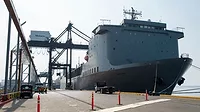
The historic vessel, the Falls of Clyde, was scuttled after efforts to restore it fell short.
Photo courtesy Hawaii Dept. of Transportation
The Hawaii Dept. of Transportation and contractor Shipwright LLC have completed the ocean disposal of the historic vessel Falls of Clyde. The ship had been the last surviving iron-hulled, four-masted full-rigged vessel in the world and the last surviving sail-driven oil tanker. HDOT was compelled to remove the badly decayed vessel to make way for the redevelopment of Pier 7 in Honolulu Harbor where it had been docked since 2008. Work will continue to memorialize the vessel in a permanent display that will feature key artifacts including the ship's name board, wheel and bell. Other artifacts removed from the vessel have been transferred to the National Park Service and will be displayed at the San Francisco Maritime National Historic Park.
Jacobs has received a five-year contract extension to continue serving as program management consultant for the multibillion-dollar Don Young Port of Alaska Modernization Program. Located in Anchorage, the port is Alaska’s primary inbound cargo hub. Upcoming phases will replace one of the port’s two main cargo berths with a modern, resilient structure. Jacobs, which has been part of the port’s modernization effort since 2014, will continue overseeing planning, design, procurement and construction to advance this long-term effort. Last spring, the municipality of Anchorage awarded the $807-million contract to build Terminal 1 of the port to a joint venture of Manson and Michels Corp.
The U.S. Army Corps of Engineers Los Angeles District, working with Ventura County, is resuming maintenance dredging at Channel Islands Harbor, a routine effort since the 1960s. Contractor Manson Construction will complete remaining work from the 2025 cycle, having previously dredged 900,000 of 1.6 million cu yd. The new phase aims to remove enough sediment to reach a total of 2.2–2.5 million cu yd. Dredged material will be pumped about a mile south to Hueneme Beach to enhance shoreline protection. Operations will run 24/7 from early October through February 2026.
The California Youth Apprenticeship Committee, convened by the Division of Apprenticeship Standards, has released The California Youth Apprenticeship Model, outlining recommendations to expand youth apprenticeship programs and strengthen the state’s workforce. With 32% of current apprentices aged 16–24, the report projects California’s system could grow to serve up to 650,000 apprentices. Key recommendations include creating a career apprenticeship bridge (CAB) program to let students begin paid apprenticeships in high school, expanding college-connected pathways through the California Apprenticeship Initiative, and increasing supportive services—such as mentorship and tutoring—for out-of-school and disconnected youth.