2025 Mountain States Best Projects
Best Energy/Industrial: Garnet Mesa Solar
Garnet Mesa Solar
Delta, Colo.
BEST PROJECT
Submitted by Primoris Renewable Energy
Owner/developer Alluvial Power
Lead Design Firm & Civil/Structural Engineer Kimley-Horn
General Contractor (PV Scope) Primoris Renewable Energy (Primoris Services Corp.)
MEP Engineer Stellavise Solar Engineering
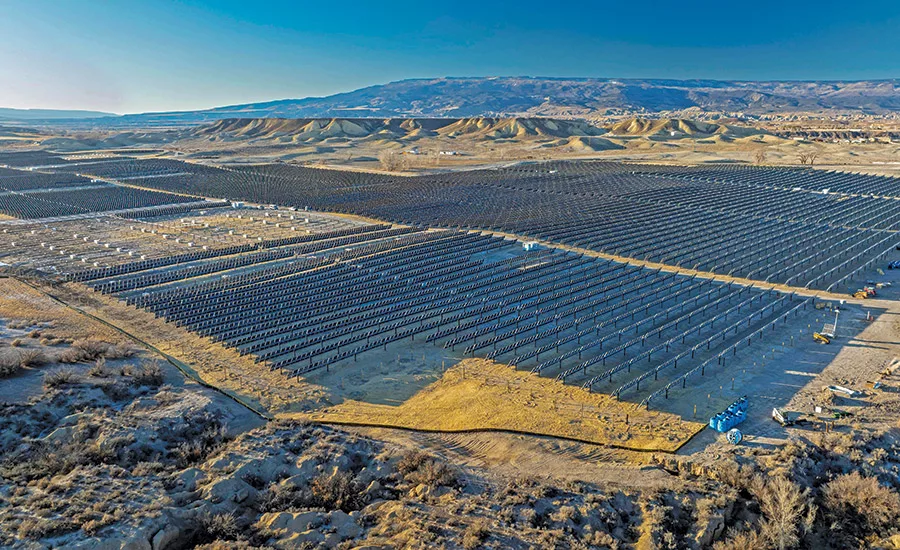
This utility-scale solar facility blends renewable energy generation with active agricultural use. Once fully operational, the site will seasonally host approximately 600 sheep grazing beneath and around the solar panels. This dual-use approach maximizes land productivity, supports local agriculture and reduces long-term vegetation management costs.
With 176,850 solar panels across the site, Garnet Mesa is one of the largest agrivoltaic installations in Colorado. Scope also included planting more than 2,000 trees and shrubs along the fence line to enhance the site’s integration with the surrounding landscape.
Although integrating a cost-effective and efficient sprinkler irrigation system into a utility-scale solar project is highly uncommon, it was necessary with this effort. After evaluating multiple irrigation technologies, a robust system was chosen that could be installed with minimal disruption to the solar infrastructure while ensuring consistent water delivery to support pasture growth. It features more than 455,000 ft of above- and below-ground irrigation lines and more than 13,000 sprinklers.

Photo courtesy Garnet Mesa Team
Significant survey inconsistencies arose early in construction that required reverification of all boundaries and layout adjustments. Several challenges also arose during ground work. When unexpected water inflow from neighboring properties created challenges with site drainage and trenching, the team quickly mobilized to install temporary dewatering solutions and regrade affected areas to maintain progress.
Challenging ground and subsurface conditions also significantly slowed the installation of PD10-driven piles. By adjusting the installation technique, optimizing equipment usage and coordinating with geotechnical experts, crews minimized schedule impacts.
To optimize the site layout to support both energy and livestock farming, the team modeled various panel configurations, adjusting spacing, height and orientation to ensure adequate sunlight for vegetation while maintaining energy performance. Elevated panel structures and thoughtfully spaced rows now support both optimal solar production and healthy vegetation growth for grazing.