2025 Midwest Best Projects
Award of Merit, Water/Environment: Kokomo Peak Excess Flow Treatment Facility (PEFTF)
-01.webp?t=1762299112)
Kokomo Peak Excess Flow Treatment Facility (PEFTF)
Kokomo, Ind.
Award of Merit
Submitted by Lochmueller Group
Owner: The City of Kokomo, Ind.
Lead Design Firm/Civil: Lochmueller Group Inc.
General Contractor: Kokosing Industrial
Structural Engineer: VPS Architecture
MEP Engineer: Sims/Durkin Associates Engineering
Thanks to proactive planning, strategic design adjustments and close collaboration, the team on the city of Kokomo’s Peak Excess Flow Treatment Facility (PEFTF) completed the project two months ahead of schedule and $558,037 under budget.
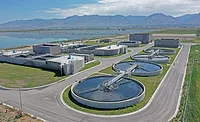
As part of the next phase in the city’s Combined Sewer Overflow Long-Term Control Plan and to comply with Indiana Dept. of Environmental Management requirements, the PEFTF expanded the wet weather treatment capacity at Kokomo’s Wastewater Treatment Plant (WWTP) along Wildcat Creek to 117 million gallons per day.
The facility features a chemically enhanced high-rate clarification (CEHRC) system that utilizes hydrodynamic separation technology and chemical disinfection. This offers a more streamlined, cost-effective and low-maintenance solution compared with traditional systems and relies on minimal mechanical components and underflow pumps for operation.
Initial plans were to have two separate wet weather treatment facilities, but during planning, the team identified an opportunity to consolidate both into a single treatment facility at the existing plant. This decision simplified design and operations; reduced construction and long-term maintenance costs; and eliminated the need for chemical deliveries through residential neighborhoods.
However, the project also faced environmental and structural challenges. Crews encountered polychlorinated biphenyl (PCB)-impacted soils that required careful remediation and complex underground utility networks, which both required specialized excavation and shoring methods to maintain the integrity of adjacent infrastructure.
One of the team’s biggest challenges was integrating the new system with an existing, underperforming PEFTF. To do that, the team developed and implemented advanced instrumentation and control systems to dynamically route flows between new and existing treatment components.
Decades of prior expansions resulted in a congested and overly complex piping network at the WWTP. The design team streamlined this system, eliminating hydraulic bottlenecks, improving overall flow, and reducing the risk of untreated discharges to Wildcat Creek.