2025 Midwest Best Projects
Project of the Year Finalist, Best Renovation/Restoration, Award of Merit, Safety: Lawson House Renovation
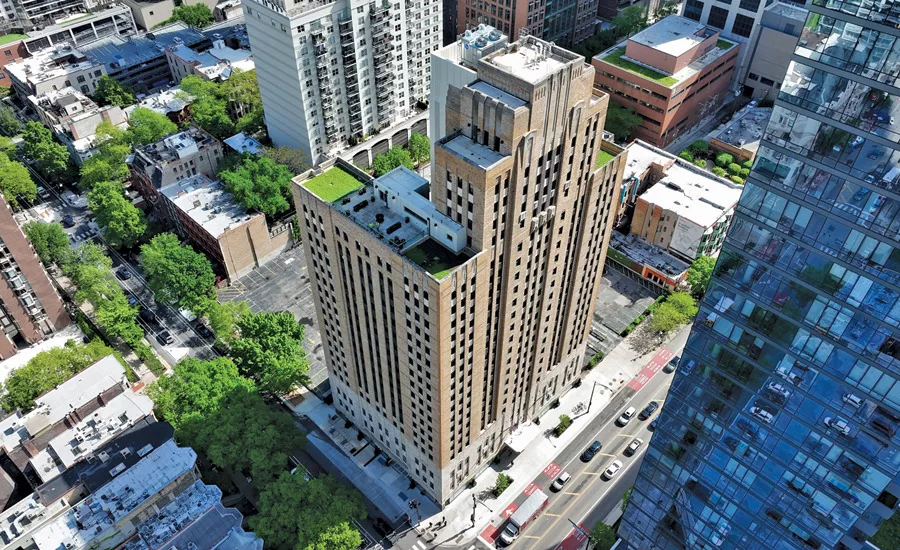
Lawson House Renovation
Chicago
PROJECT OF THE YEAR FINALIST, BEST PROJECT, RENOVATION/RESTORATION, and Award of Merit, Sustainability
Submitted by The Walsh Group
Owner: Holsten Real Estate Development Corp.
Lead Design Firm: Farr Associates Architecture & Urban Design
General Contractor: The Walsh Group
Civil Engineer: Terra Engineering
Structural Engineer: C.E. Anderson & Associates
MEP Engineer: dbHMS
The historic Lawson House, once the world’s largest YMCA residential building, has reclaimed its place as a cornerstone of community and inclusion in Chicago’s Gold Coast. Built in 1931, the 24-story Art Deco landmark was envisioned as a place where people could live, work and thrive under one roof. After decades of wear, the building’s recent $128-million rehabilitation has transformed it into one of the nation’s most ambitious affordable housing preservation efforts, blending history, innovation and social purpose.
For years, Lawson House served as a refuge for low-income and formerly homeless residents, but aging systems and outdated infrastructure made dignified living impossible. When the project began, every floor revealed new challenges: deteriorated concrete, antiquated wiring and a labyrinth of tight spaces that complicated modern upgrades.
The 28-month restoration required surgical precision to fit new plumbing, electrical and HVAC systems within the structure’s confines, all while preserving historic ornamentation.
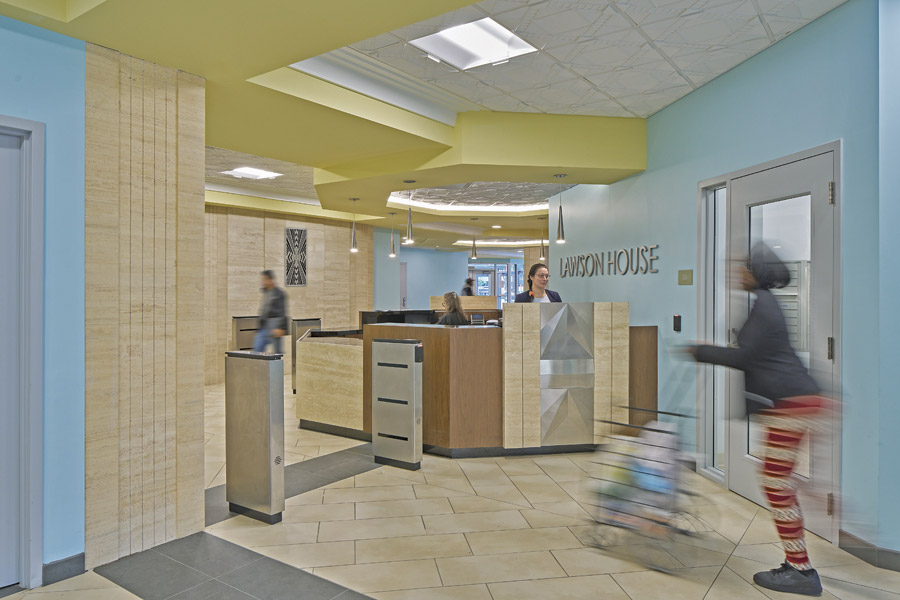
Photo by Ross Floyd Photography
Each of the 409 new single-room occupancy (SRO) units was designed with durability and comfort in mind. Floor drains were added to prevent water damage from overflows, tamper-resistant fixtures ensured safety and calming pastel color palettes replaced the institutional tones of the past.
Innovation became essential as the project navigated global and local challenges. When lead times for critical components, like the sub-basement’s 480-V transformer, stretched into years, the team rapidly evaluated alternative equipment without compromising on LEED Platinum and historic preservation goals.
A particularly inventive solution arose when constructing new stair and elevator towers in the building’s cramped courtyard. With space for only one derrick crane, the team pre-assembled three floors of steel stair towers in a nearby alley before lifting them into place.
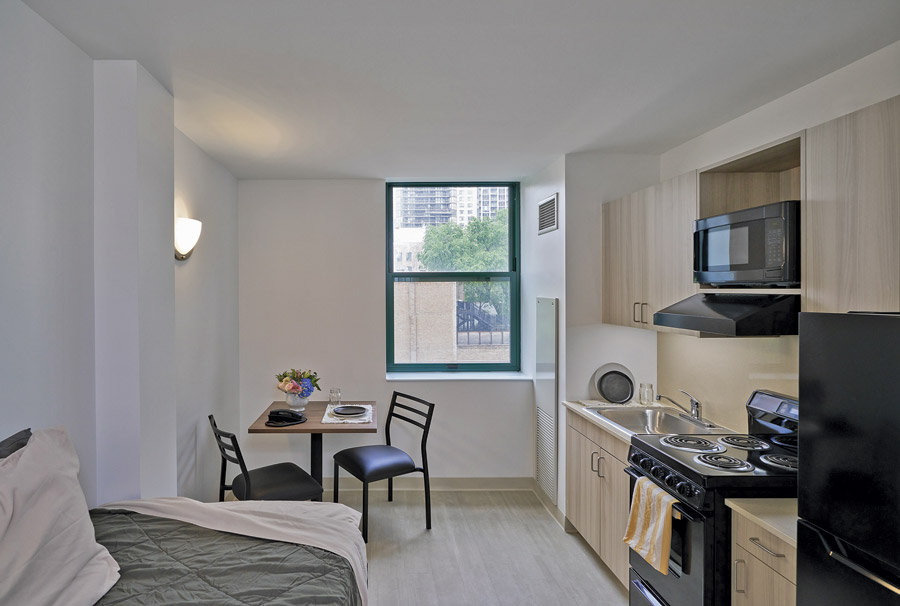
Photo by Ross Floyd Photography
“Adding new structural components to a 100-year-old building while maintaining its architectural integrity was a challenge that required an immense amount of coordination between the design team and construction teams,” notes Steve Krygowski, project manager for The Walsh Group. “Numerous construction meetings were held to formulate our plan, then we had a series of safety meetings with all applicable parties who would be installing the structural steel.
“We had a complete buy-in from the teams,” he says. “This started with the development by Holsten Real Estate Development Corp., architecture by Farr Associates Architecture & Urban Design and construction by the Walsh team, but it also worked its way into our subcontractor partners and their workforces. We all understood the importance of this project, and what it stood for, providing dignified housing to a vulnerable population.”
The complexity of the site demanded a proactive safety culture. Walsh implemented creative programs to ensure engagement at every level. Through innovation, what began as a crumbling Art Deco relic is now a model for sustainable, inclusive redevelopment and a beacon of opportunity.