Analysis
Contractor Compliance Risk Mounts for Firms in White House East Wing Demolition
Executive branch retains tight grip on regulatory agencies as funding plan seemingly sidelines Congress

Demolition of the East Wing began in late October, sparking concerns over regulatory compliance. Now, contractor accountability is in the spotlight as members of Congress assert their oversight role.
Demolition of the White House East Wing—launched before any formal design review—continues reverberating as the debate widens over regulation of privately financed construction on federal property and whether companies involved face regulatory or legal exposure.
Architect Neil Flanagan, a Washington, D.C.–based designer and critic—who authored a recent piece in The Atlantic examining how President Donald Trump’s East Wing demolition was so easily accomplished despite the action’s gravity—described the process as having “shattered a culture of consultation with experts that has shaped Washington’s architecture for 125 years.”
The pivotal takeaway, he asserts, is how “a system in which power is constrained primarily by norms is easy to change.”
Flanagan, who is writing a book on federal design governance, said in an interview with ENR that the demolition exposes “a system once bound by consultation now operating by declaration.”
The president’s evolving descriptions of a donor-funded, 90,000-sq-ft presidential ballroom—and how it will connect to the existing complex—have drawn scrutiny from lawmakers and preservation groups.
RELATED
White House East Wing Razed for $300M Ballroom
The administration’s decision to raze the East Wing before revealing replacement plans has shifted the focus beyond White House process to the contractors executing the work. What remains uncertain is not only what the “public’s house” will eventually look like, but whether any responsibility for project actions extends beyond the executive branch to firms performing them.

Neil Flanagan, a Washington, D.C.-based architect and public historian, is a humanities scholar in residence at the Heurich House Museum and is working on a book about how the founders of American urban planning experimented on Washington’s neighborhoods. His Nov. 1 article in The Atlantic addresses how norms, instead of statutes, enabled the White House East Wing to be demolished without oversight.
Image courtesy of the Heurich House Museum
ACECO LLC, the East Wing Maryland demolition contractor, has faced the most immediate scrutiny. Multiple news outlets reported that public backlash following the demolition prompted the company to take its website offline. Lawmakers are also examining whether ACECO’s Washington, D.C., asbestos-abatement license, which was revoked in 2022 as reported by The Washington Post, could affect compliance.
White House Press Secretary Karoline Leavitt told reporters Oct. 24 that “a very extensive abatement and remediation assessment was followed, complying with all applicable federal standards,” and that all hazardous-material work was completed before demolition began.
But no documentation has been released to show how mitigation was carried out or which firm performed it or whether ACECO had proper licensure.
The questions have apparently not stopped the project from moving forward. Flanigan sent a video clip to ENR on Nov. 5 showing a flatbed truck carrying underground pipes heading toward what the architect believed to be the White House, indicating foundational work may be underway.
Other companies involved in the project, namely Clark Construction Group and AECOM, which are responsible for its overall delivery and engineering, respectively, also share accountability for site safety and environmental compliance. ENR requested comment from each company ahead of press time, but has received no reply.
If any federal labor, equipment or services were used in the demolition, the project could fall under Federal Acquisition Regulation (FAR) rules. Under U.S. Occupational Safety and Health Administration mandates, general contractors may be cited for subcontractor violations if they controlled the site or had knowledge of hazards.
McCrery Architects’ design role currently has less potential regulatory or legal exposure but still poses possible risk if project specifications omitted required hazardous material surveys or indicated awareness of asbestos conditions.
The ballroom financing plan Trump described—where private donors and the former president will fund the now-$300-million project—adds another complication. Bloomberg Law found that several donors are executives or entities with active federal contracts, blurring lines between private philanthropy and public procurement and raising conflict-of-interest questions.
Congress Steps In
Congressional scrutiny intensified in the final week of October as two Senate committees launched separate inquiries into contractor conduct and the legality of privately financed work on federal property.

Corporate and Individual Contributors as of Oct. 23, 2025
On Oct. 28, Sen. Richard Blumenthal (D-Conn.), a member of the Judiciary and Homeland Security and Governmental Affairs committees, sent letters to Clark Construction Group, AECOM and McCrery Architects requesting contracts, selection criteria and documentation explaining how the firms were chosen.
The following day, his office confirmed outreach to more than 30 donors, seeking details on contribution amounts and any agreements tied to project access or influence. Staff said the responses would help determine whether to pursue hearings or subpoena authority.
The inquiry widened again on Oct. 30, when Sen. Edward J. Markey (D-Mass.), who chairs the Senate Environment and Public Works Subcommittee on Clean Air, Climate and Nuclear Safety, directed a separate request to the demolition contractor.
Markey asked ACECO to provide asbestos survey data, air monitoring results and worker training records. His subcommittee oversees the U.S. Environmental Protection Agency and enforces asbestos-abatement standards under the federal Clean Air Act, giving his request direct regulatory weight.
“If asbestos was handled without proper oversight,” Markey wrote, “that would violate both public-health law and the public trust.”
RELATED
ENR Article Repository – “Federal Construction”
Together, the senators’ actions mark the first formal congressional response to the East Wing project. Both have stated that if the documentation remains incomplete, their committees could compel testimony from senior White House officials, contractors and regulators.
Jurisdiction and Governance
Oversight for construction on White House grounds is divided among several agencies, creating conditions that allowed demolition to proceed before any design review.
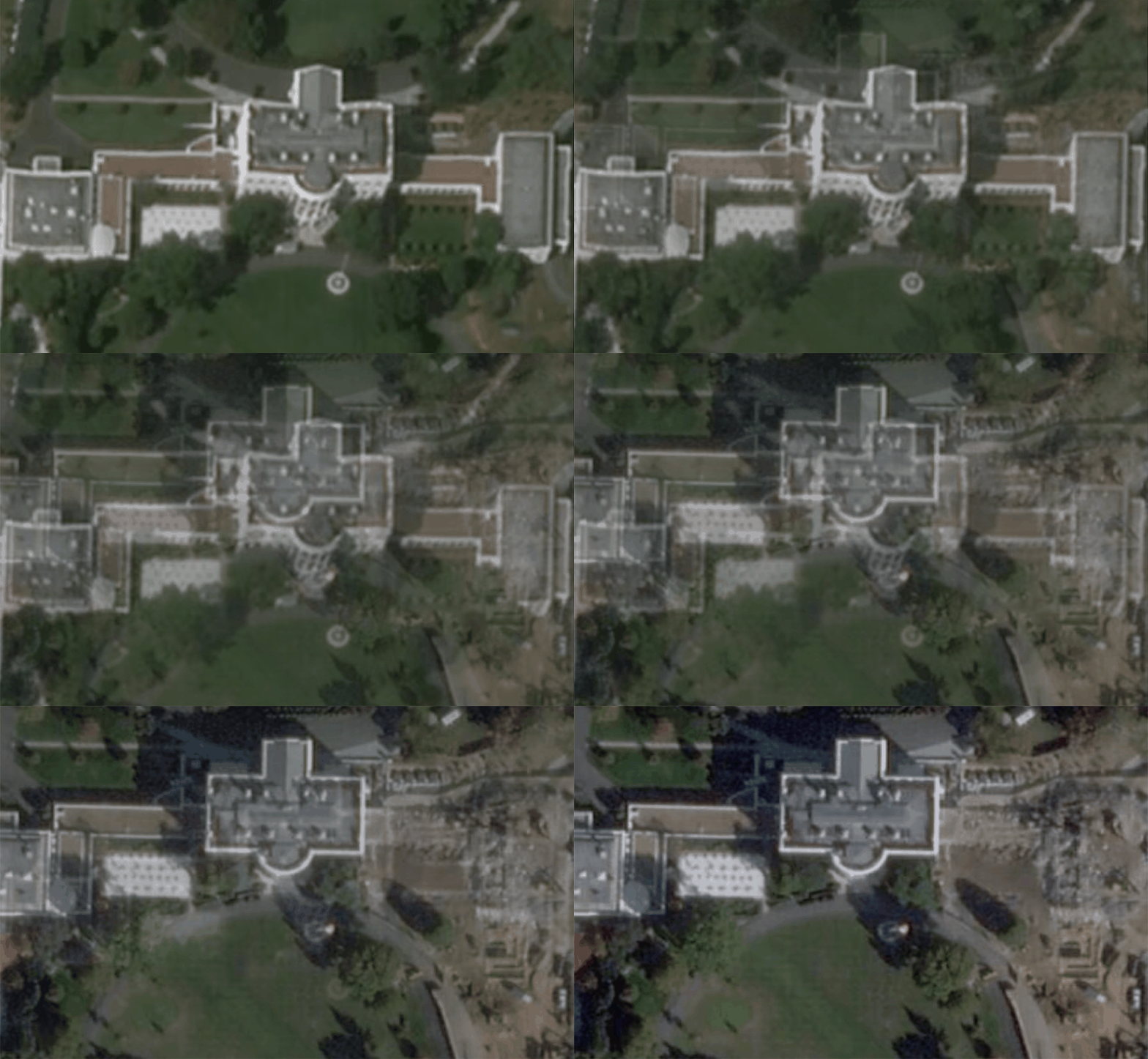
Two U.S. senators have demanded answers from ACECO LLC, the demolition contractor, about asbestos mitigation, raising the stakes for contractors that have signed on to construct President Donald Trump’s 90,000-sq-ft ballroom, which will replace what was the East Wing of the White House. Images courtesy Google Earth
The National Capital Planning Commission, chaired by Will Scharf—who also serves as White House staff secretary—maintains that its jurisdiction begins only with “vertical build.” ENR previously reported that Scharf confirmed demolition did not require commission approval—a position preservation advocates say represents a conflict of interest given his dual role.
That vacuum widened Oct. 29 when Trump dismissed all six members of the U.S. Commission of Fine Arts, the advisory body that traditionally reviews the design and aesthetics of major federal projects in Washington.
The White House said it would appoint new members, according to NBC News and The Washington Post, but no updated roster or meeting notices had been published as of early November.
The National Trust for Historic Preservation notes that the White House, managed by the National Park Service, typically coordinates design review and mitigation across agencies. The Trust has offered to assist with developing alternatives and documentation, suggesting that standard interagency procedures may have been bypassed.
Flanagan told ENR that the traditional checks—federal NEPA review, Section 106 consultation and fine arts commission design oversight—all failed simultaneously.
“Alterations to the White House happen so infrequently that we’re in uncharted territory,” he said. “It’s really about whether those norms still function when power becomes unilateral.”
Potential Legal Exposure
Possible violations span environmental, labor, procurement and preservation laws. They include improper asbestos abatement under federal EPA and OSHA standards, procurement irregularities under the FAR and failure to follow historic-preservation review requirements.
Flanagan said the case “is less a question of compliance than of ethics in the gray area between public authority and private financing.”
He added that compliance frameworks should still prioritize asbestos abatement, NEPA documentation and public-record transparency—areas where lapses most often cascade into legal trouble.
An interactive reference below details each statute and penalty range—EPA, OSHA, FAR/GSA and NPS/NCPC—outlining how jurisdiction might apply to the East Wing project.
Explore how federal laws and regulations could apply to the White House East Wing demolition. Click a category below for a detailed breakdown of agency jurisdiction, violations and penalties.

 OSHA – Worker Safety and Asbestos Exposure
 FAR/GSA – Procurement and Contract Integrity
 NPS/NCPC – Historic Preservation and Review
Sources: EPA, OSHA, GSA, NPS, NCPC | Graphic by ENR
Legal experts caution that sweeping enforcement remains unlikely in the near term.
Construction-law specialist Trent Cotney, partner and leader of the construction practice team at Adams & Reese LLP, who also serves as general counsel to major trade associations, including the National Roofing Contractors Association, said that contractors’ legal exposure is possible.
“[They] could face exposure if they knowingly participated in conduct that violated federal law,” he wrote in an email. However, absent evidence of fraud or conspiracy, Cotney added, “Practical exposure is remote provided they adhered to contract terms, documented instructions and maintained compliance with federal procurement protocols.”
Congress or the U.S. Justice Dept. could revisit the matter under statutes including the False Claims Act or Anti-Deficiency Act, but both require proof of intent or misrepresentation—thresholds rarely met in politically charged investigations.
As Cotney noted, any future review “would likely focus on the decision-making and authorization process at the executive level, not the contractors executing the work.”
EPA and OSHA could still open limited inquiries into asbestos handling or worker protection, while procurement officials assess whether federal resources triggered contracting clauses. Even without findings, a pending review can temporarily bar firms from bidding on federal work until cleared.
RELATED
Federal Builders Miss in Contract Change Oversight
For the construction sector, the East Wing project underscores that privately financed work on federal property still carries full compliance obligations. Documentation and transparency remain essential safeguards.
ACECO’s website idling underscores how reputational risk can compound legal exposure. Clark and AECOM, both major federal contractors, could face additional scrutiny from contracting officers if oversight expands.
The episode illustrates how donor-driven or politically sensitive projects can expose teams to overlapping legal, regulatory and reputational risks long after completion.
Ultimately, the East Wing demolition reaffirms an industry truth: on federal ground, compliance follows the contractor—but enforcement, as Cotney and others note, is more theoretical than imminent.

Bryan Gottlieb is the online editor at Engineering News-Record (ENR).
Gottlieb is a five-time Society of Professional Journalists Excellence in Journalism award winner with more than a decade of experience covering business, construction and community issues, including finance, law and real estate. He has reported for Adweek and the San Diego Daily Transcript and led a community newsroom in Santa Monica, Calif. He served as editor-in-chief of the Detroit Metro Times and as managing editor at Roofing Contractor, where he helped shape national industry coverage. At Engineering News-Record, Gottlieb covers breaking news, large-scale infrastructure and megaprojects, regulatory developments and business trends across the U.S. and global construction sectors.
email: gottliebb@enr.com | office: (248) 786-1591