Government
Michigan’s New Fuel Tax Model Commits Every Cent to Transportation
Revision cuts fuel sales tax, increases per-gallon excise rate and dedicates revenue for DOT use
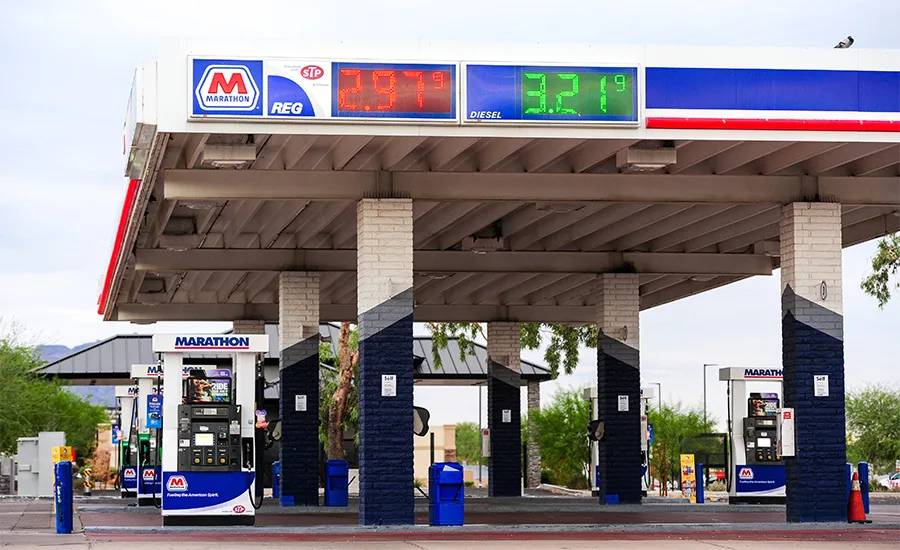
Motorists in Michigan will soon see higher pump prices as the state shifts from a 6% fuel sales tax to a 51¢-per-gallon indexed excise tax under legislation signed in October. Marathon Petroleum operates extensive refining and retail operations across the state.
Michigan’s latest infrastructure funding overhaul positions it among the few states directing every dollar paid at the pump exclusively to transportation.
Gov. Gretchen Whitmer (D) signed a four-bill package in early October—now Public Acts 17 through 20 of 2025—that replaces the state’s 6% sales tax on motor fuel with a higher, inflation-indexed excise tax.
Beginning Jan. 1, the rate rises from 31¢ to 51¢, indexed to inflation, and ends the diversion of fuel sales-tax revenue to schools and local revenue sharing.
Under the new structure, all revenue will flow through the Michigan Transportation Fund and related subaccounts managed by the Michigan Dept. of Transportation, counties and municipalities for road, bridge and transit work.
“Every cent you pay at the pump will go back into Michigan’s roads and bridges,” Whitmer said in a statement when signing the measures Oct. 7.
Legislative and Fiscal Details
The key statutory pivot lies in Public Act 18 of 2025, which removes the 6% fuel-related sales and use taxes applied to interstate motor carriers and redefines “motor fuel” under the Motor Fuel Tax Act.
The act’s enacting clause tied its effectiveness to three companion measures that repealed sales tax on retail fuel sales, removed the use tax on motor and aviation fuels and raised the per-gallon excise rate to 51¢ with annual inflation indexing—conditions satisfied after the legislative package was signed into law.
Read More
BDO | Michigan Budget Bills Analysis
According to an October 2025 analysis by accounting firm BDO USA, the legislation also establishes transitional requirements for licensed fuel suppliers and importers.
They must now calculate and remit the rate differential between the former 31¢ and the new 51¢ per-gallon excise by Feb. 20, 2026. BDO described the measures as “one of the most extensive overhauls of Michigan’s tax system in decades” and advised fuel-tax filers to review internal processes to avoid overpayment.
Collectively, the legislative package stabilizes transportation funding and aligns Michigan’s fuel tax structure with the International Fuel Tax Agreement, which most states use for truck fuel tax reporting, supporters say.

A campaign image of Michigan Gov. Gretchen Whitmer from her “Finish the Job” road-infrastructure message, reinforcing her long-standing pledge to prioritize highway and bridge investment—a central theme in the state’s new fuel-tax overhaul.
Image courtesy of the Democratic Governors Association
Whitmer’s signature marks a political culmination nearly a decade in the making. Her 2018 campaign slogan, “Fix the damn roads,” appealed to voters frustrated by deteriorating pavement and years of gridlock.
Reelected in 2022, she expanded the Rebuilding Michigan bond program and pushed for a permanent, inflation-linked revenue mechanism to close maintenance backlogs.
The new package fulfills that pledge by embedding road repair in the state’s tax code rather than relying on short-term appropriations or borrowing.
According to the Michigan Dept. of Treasury’s Revenue Sharing and Grants Division, the fiscal realignment occurs alongside modest municipal funding adjustments enacted under Public Act 22 of 2025.
Its fiscal year 2025 Actuals and fiscal year 2026 Projected Revenue Sharing tables, reviewed by ENR, show slight across-the-board declines—typically 1.7% to 2.0%—in formula-based payments to counties and cities, indicating that the excise-tax revenue stream will supplement existing local funding channels.
The treasury data confirm fiscal year 2026 allocations remain governed by Act 51 formulas for taxable value, weighted population and yield, signaling that the new excise receipts will bolster the Michigan Transportation Fund rather than redistribute existing revenue.
While the administration and local officials have broadly supported the change, education groups have voiced concern about redirecting fuel sales tax revenue that previously supported K-12 schools.
“Michigan’s students cannot afford to sacrifice their education to pave our roads,” the Michigan Education Association and allied groups said in a joint memo to lawmakers before the vote.
Roughly 60% of new fuel-tax revenue is expected to fund state-managed projects through the state DOT, with the remaining 40% distributed to county and municipal road agencies under Act 51 formulas.
Whitmer’s office projects the shift will generate about $2 billion annually in new transportation funding once fully implemented, roughly doubling the annual capital available to the DOT and local road agencies.
Market Outlook
The Michigan County Road Association and local agencies expect higher letting volumes beginning in the fiscal 2027 capital cycle, when the first full year of excise-tax revenue reaches the Michigan Transportation Fund.
Contractors should anticipate increased resurfacing, reconstruction and bridge work statewide as Michigan DOT accelerates deferred maintenance and resumes several multiyear corridor programs paused since 2020.

Projected annual transportation revenue under Michigan’s fuel-tax overhaul. Baseline reflects FY 2024–25 Michigan Transportation Fund receipts (~$3.9 billion) from the Michigan Dept. of Treasury and House Fiscal Agency; “after reform” adds the governor’s estimated $2 billion in new revenue from the 51¢-per-gallon indexed excise tax. All figures are nominal estimates and exclude future inflation adjustments.
Graphic by ENR/Sources: MDOT Receipts and Distributions (FY 2025); House Fiscal Agency Fiscal Briefs (Feb. 2025)
Michigan DOT, which manages more than 10,000 centerline miles of state highways, is also expected to expand design-build and CM/GC delivery methods to expedite project delivery under its Rebuilding Michigan initiative.
Officials see potential benefits in secondary and gravel-road improvements, long underfunded in past budgets.
Dennis Kolar, managing director at the Road Commission for Oakland County—one of the state’s wealthiest districts—is bullish on the new revenue-generating plan.
“We were at a critical point, and the Legislature and Governor came through,” he said. “We know it is never easy for the Legislature to increase revenue for any need, and we appreciate that the legislators were able to set aside partisan differences and come together to make this package happen."
State Senate Majority Leader Winnie Brinks (D-Grand Rapids) said Michiganders deserve a budget that makes their lives better, which includes improved roads.
“The framework we have agreed to reflects the priorities of Michiganders from every region, and while no budget will be a perfect product, I am confident that the final result … will have features that benefit every resident,” she said in a statement ahead of the legislative package being signed into law.
At the federal level, gasoline and diesel excise taxes—unchanged since 1993 at 18.4¢ and 24.4¢ per gallon, respectively—flow to the Highway Trust Fund. Michigan’s approach now mirrors that structure but, by pegging rates to inflation, allows regular anticipated adjustments.
State Treasury officials will finalize rulemaking by early 2026 to implement quarterly inflation adjustments and revise reporting protocols for distributors and interstate carriers.
The state DOT plans to publish updated fiscal 2026–27 Michigan Transportation Fund projections in the spring budget cycle, identifying priority corridors and bridge bundles eligible for the new funding stream.
“We were encouraged to see that the Governor’s transportation funding proposal included a $250-million net increase for public transit … We look forward to continued negotiations around transportation funding,” said Ross Gavin, urban land-use and transportation policy director for the Michigan Environmental Council.

Bryan Gottlieb is the online editor at Engineering News-Record (ENR).
Gottlieb is a five-time Society of Professional Journalists Excellence in Journalism award winner with more than a decade of experience covering business, construction and community issues, including finance, law and real estate. He has reported for Adweek and the San Diego Daily Transcript and led a community newsroom in Santa Monica, Calif. He served as editor-in-chief of the Detroit Metro Times and as managing editor at Roofing Contractor, where he helped shape national industry coverage. At Engineering News-Record, Gottlieb covers breaking news, large-scale infrastructure and megaprojects, regulatory developments and business trends across the U.S. and global construction sectors.
email: gottliebb@enr.com | office: (248) 786-1591