Resilience
Brooklyn Resilience Project Shields Against 10-Year Storms
Designs prompted by Hurricane Sandy flooding are leading to flood walls, gates, and street elevation changes in the Red Hook neighborhood

The Red Hook Coastal Resiliency Project will spend $218 million knitting flood walls, raised street grades, and two kinds of gates into a perimeter around the neighborhood of the same name.
New York City has broken ground on another initiative meant to protect a neighborhood from storm surges. The Red Hook Coastal Resilience Project will spend $218 million knitting flood walls, raised street grades and two kinds of gates into a perimeter around the Brooklyn neighborhood of the same name. When flood gates are active, the continuous border will sit 10 ft above sea level.
Bringing the edge of Red Hook up to this height should shield against the kinds of once-every-10-year storm surges the area could see today—as well as the bigger 10-year storms that could hit Brooklyn around 2050 thanks to sea level rise, says Bobby Issac, assistant commissioner for construction for the NYC Dept. of Design and Construction.
The design process was led by NV5 Engineering along with 12 other firms and consultants. Construction so far has amounted to test pits, soil samples, and the insertion of new water mains, though the department has signed a nearly $158 million contract with Perfetto Contracting Corp. for work on site. Funding comes from the city itself, nearly $80 million from the FEMA Hazard Mitigation Grant Program, and the New York State Dept. of Emergency and Homeland Security Services.
New York City has broken ground on a project to protect a Brooklyn neighborhood from storm surges. Video courtesy Red Hook Coastal Resiliency Project
The city started investigating how to protect this pocket of Brooklyn from storm surges in 2014. Two years earlier, Hurricane Sandy had badly flooded the neighborhood, which juts out the side of the borough into the New York Bay and sits as low as four feet above sea level . To figure out what could protect Red Hook from different storm surge intensities, the city turned to data including sea level rise predictions by the New York City Panel on Climate Change, an advisory group that suggests how the city can protect itself from a changing environment.
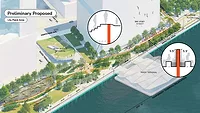
The final design calls for more than a mile and a half of sea wall up to five feet tall, along with eight roller gates and two flip up designs. Near the Atlantic Basin, an inlet hosting the Brooklyn Cruise Terminal and a NYC Ferry stop, street raising and flood walls will overlap for a permanent flood structure. Vehicles will come in and out via a permanent ramp, Issac said.
The 10-foot elevation perimeter requires that the defense structure be four to five times longer than a version that’s only eight feet above sea level, Issac said. That’s because flood wall systems have to reach tie-in points, or spots in the natural landscape already at the target elevation. “As you raise the level of protection, the length of the system kind of increases exponentially.” Isaac said.
The height of the walls is also limited by the waterfront properties being privately owned. Across the water in Manhattan’s East Side Coastal Resiliency project, the walls can reach at least 16.5 feet above elevation because the city owns and maintains infrastructure on the relevant parcels, Issac said.
According to the DDC, more than 99% of the storms Red Hook has experienced in the last century would have been protected against with the 10-foot elevation barrier. One of the two exceptions is Hurricane Sandy.
The 2012 storm is what prompted the local nonprofit Resilient Red Hook to begin petitioning the city for adequate flooding protection infrastructure, says interim executive director Benjamin Werner. The decade-plus of requests came with infrequent updates, Werner said. It’s hard for Resilient Red Hook to know if the project will address any of its concerns about design choices because information was so sparse over the years. “It informs the overall disregard for Red Hook, even though this is a plan for Red Hook,” he said.
In 2024, Resilient Red Hook sent a letter to the Red Hook Coastal Resiliency Team, asking about particular concerns that the organization still thinks weren’t adequately answered. One major worry is about flood walls potentially causing other flooding issues by holding in rain, including runoff from other neighborhoods in Brooklyn sitting at higher elevations. Any increased rain-related flooding risks could also up the odds of a combined sewer overflow, too.
Borough President Antonio Reynoso expressed similar concerns in his Uniform Land Use Review Procedure Application. Ultimately, the document said, “the Borough President understands that RHCR’s funding and purview are limited to coastal flooding.” The DDC is also working on a separate project in the area called Columbia Street Phase 2 that should start construction in 2027 and will upsize sewers by 20 to 25%.
Instead of sea wall use, Resilient Red Hook had wanted to see more soft infrastructure, like rain gardens, or mitigation in the water itself, like the oyster breakwater project off Staten Island. Any major infrastructure investment in the neighborhood should also investigate whether Red Hook is coping with contamination related to the Gowanus Canal, Werner said. The Superfund site sits upstream of Red Hook.