2025 Southwest Best Projects
Best Project, Sports/Entertainment: Player 15 Group HQ and Phoenix Mercury Practice Facility

Player 15 Group HQ and Phoenix Mercury Practice Facility
Ariz.
BEST PROJECT
Submitted by Okland Construction
Owner ISH Phoenix Real Estate LLC
Lead Design Firm Gensler
General Contractor Okland Construction
Civil Engineer Dibble Engineering
Structural Engineer PK Associates
MEP Engineer Henderson Cos.
Architect Von Staden Architects
Owner's Project Manager Transwestern
Totaling 123,000 sq ft, the new sports campus features a practice facility for the Phoenix Mercury WNBA team and an administrative complex for the Phoenix Suns of the NBA. Additional amenities include an indoor arcade, pickleball court, putting green and a fully equipped kitchen with a professional chef, all complemented by sustainable features such as parking area solar canopies that produce 750,000 kW of energy to offset building power usage.
This fast-track, budget-sensitive project demanded close coordination from the outset, including evaluation of nine site layout options that yielded a final plan optimizing program efficiency, circulation and parking capacity, all within budget. To meet the owner’s request to accelerate the timeline by three months, the project team worked around the clock, sourced alternative materials with shorter lead times and maintained rigorous quality control via close teamwide communication.
Rather than work with national locker manufacturers to meet the owner’s desire for bespoke, high-end locker designs resembling custom closets, the team partnered with a local millwork contractor to provide greater control over pricing, manufacturing quality and timeline. The local firm also built mock-ups on site, enabling hands-on collaboration to refine details and ensure the highest level of craftsmanship and player experience.
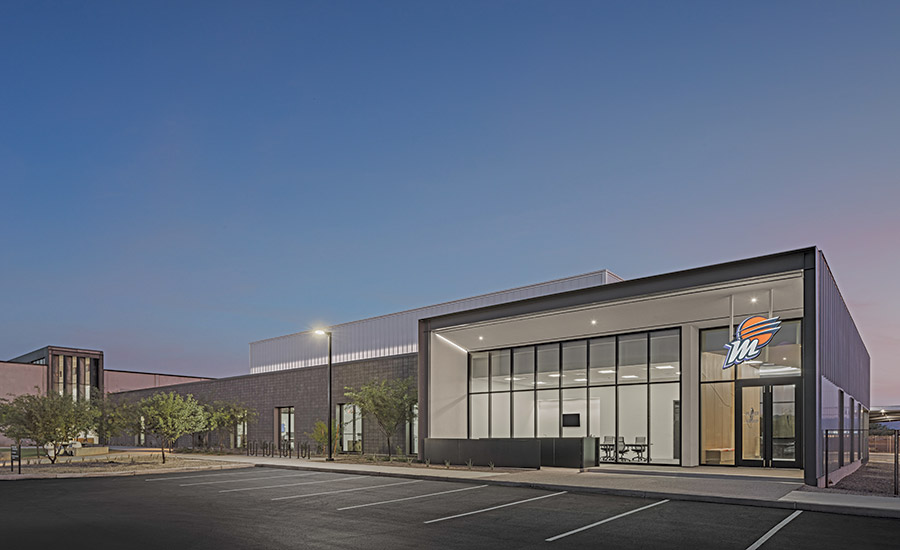
Photo courtesy Jason Roehner
The presence of high-voltage power lines just 10 ft away from the new practice facility threatened to complicate steel erection and installation of exterior metal and polycarbonate panels. Rather than install scaffolding, which would have prolonged worker exposure to hazardous conditions, the project team collaborated with the power utility to install outriggers on the existing poles. This innovative approach allowed the utility to push the energized lines an additional 10 ft away from the work zone, providing a sufficiently large enough buffer for workers to safely complete construction using boom and scissor lifts. Despite the demands of the aggressive schedule, the project was completed ahead of schedule and below budget, with no injuries or recordable incidents over 164,000 work hours.


