Federal Funding
Feds Freeze $18B for NYC Subway, Hudson Tunnel Projects

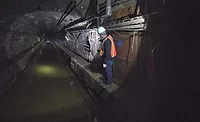
A construction worker died after falling 60 ft through an opening on the site of a Hudson Yards Amtrak tunnel project in New York City.
With nearly $18 billion still due for the federal share of two major infrastructure projects in New York City, the U.S. Dept. of Transportation said on Oct. 1 that it will withhold project reimbursements as it conducts a review over disadvantaged business enterprise practices.
The review includes both the Metropolitan Transportation Authority’s $7.7-billion Second Avenue Subway Phase 2 and the Gateway Development Commission’s $16-billion Hudson Tunnel Project. DOT sent letters to New York officials stating that the projects “are under administrative review to determine whether any unconstitutional practices are occurring,” according to its announcement.
The withheld funds include a $300-million disbursement already due for the Second Avenue subway extension, according to DOT.
Despite freezing funds, DOT said in its statement, “The department is focusing on these projects because they are arguably the largest infrastructure initiatives in the Western Hemisphere, and the American people want to see them completed quickly and efficiently.”
John McCarthy, MTA chief of policy and external relations, said in a statement that the federal government is “just inventing excuses to delay one of the most important infrastructure projects in America.” MTA representatives did not immediately say whether the project schedule would be impacted by the funding freeze.
The Gateway Development Commission aims to keep its tunnel project on scope, schedule and budget, CEO Thomas Prendergast said in a statement.
The commission "has received notification from [the Federal Transit Administration] regarding a pause in disbursements for the Hudson Tunnel Project,” Prendergast said. It "complies with all federal laws and regulations, and will continue to do so throughout the project. We look forward to continuing our productive relationship with the administration, [Federal Transit Administration], [Federal Railroad Administration] and the U.S. Department of Transportation.”
Construction industry experts had expected transportation projects to remain relatively unhindered by the government shutdown since they are not funded through the annual appropriations process.
New Rule, Immediate Review
The review is based on a DBE-related interim final rule DOT posted on its website Oct. 1, although it has not yet appeared in the Federal Register. The rule would bar race- and sex-based contracting requirements from federal grants, apparently even for ones previously awarded.
“The federal government wants to immediately ‘review’ our compliance with rules they told us about moments ago,” McCarthy said in a statement released early afternoon on Oct. 1.
The rule is focused on “unconstitutional presumptions and reliance in whole or in part on claims of disadvantage based on race or sex.” It requires state DBE certification programs to review any currently certified firms and decertify any that do not meet the new standards.
While DBE programs were created with the goal of addressing discrimination by giving small businesses a step up into government contracting, the new standards remove race- and sex-based provisions from DOT’s definition of a “socially and economically disadvantaged individual.” The rule also removes consultation requirements for minority and women’s contractor groups.
The rule has not been subject to a public comment period. DOT said it should not have to seek public comment because it claimed the existing programs are unconstitutional. DOT is still waiting on the request it made in May to have a federal judge declare its own DBE program unconstitutional.
Shutdown Retribution
DOT’s statement made it clear the move is also retribution after Congress failed to pass a stopgap budget bill before the Oct. 1 deadline to prevent the federal government from shutting down. The agency placed blame on New York lawmakers Senate Democratic Leader Chuck Schumer and House Democratic Leader Hakeem Jeffries, who led their party’s effort to include health care subsidy extensions in the bill.
“This is another unfortunate casualty of radical Democrats’ reckless decision to hold the federal government hostage,” DOT said in a statement. While members of both parties blamed the other for the shutdown, the Senate again voted down stopgap bills proposed by both Republicans and Democrats on Oct. 1.
New York Gov. Kathy Hochul (D) called DOT’s move “political payback and an attack on New York and its residents.” She said the state would “use every tool available” to restore the funding for the projects, as well as counterterrorism funding that the U.S. Dept. of Homeland Security cut from New York state one day earlier.
“Every New Yorker should be outraged,” Hochul continued. “From the construction worker who could lose [a] job, to the commuter stuck on a delayed train, to the families who rely on brave law enforcement officers to keep them safe.”
Staff Furloughed
It is not clear how long the funding freeze may last. With the federal government now shut down, DOT said its civil rights staff responsible for the review have been furloughed.
The White House has also threatened mass firings of federal workers in addition to the typical furloughs during a shutdown. The Office of Management and Budget sent a memo to agencies last month directing them to lay off employees of programs that are “not consistent with the president’s priorities” during a funding lapse.
"Two canceled project awards alone, the Pacific Northwest Hydrogen Hub and California’s ARCHES Hub, would have created more than 135,000 construction jobs. Unlike members of Congress, building trades workers only get paid when they show up to work. We cannot do our job unless Congress and the White House do theirs. It is time for Washington to have a sense of urgency."
—Sean McGarvey, President, North America’s Building Trades Unions
OMB Director Russel Vought told House Republicans on an Oct. 1 call that mass firings would start “in a day or two,” Politico reported, citing unnamed sources. Earlier in the day, House Speaker Mike Johnson (R-La.) told reporters that “the longer this [shutdown] goes on, the more pain will be inflicted.”
Two unions representing federal workers, the American Federation of Government Employees and the American Federation of State, County and Municipal Employees, filed a lawsuit on Sept. 30 seeking to prevent OMB from carrying out its firing directive.
Billions for Energy Projects Also Cut
More projects also face funding freezes. Vought, who tweeted about the DOT funding freeze before the department announced it, also tweeted that the U.S. Dept. of Energy targeted for cancellation $8 billion in funding for projects in California, Colorado, Connecticut, Delaware, Hawaii, Illinois, Maryland, Massachusetts, Minnesota, New Hampshire, New Jersey, New Mexico, New York, Oregon, Vermont and Washington.
DOE soon after announced termination of 321 financial awards totaling $7.56 billion made by the Biden administration supporting 223 energy projects, including those for transmission and battery storage, claiming they "did not meet economic, national security or energy security standards necessary to justify continued investment."
Project types and locations were not identified, but media reported they were mostly in Democratic-led states that supported Kamala Harris' presidential bid. According to an analysis released by congressional Democrats, some canceled funds are for projects in states that did support Harris: Tennessee, South Carolina, North Dakota Iowa and Florida.
The cancelled projects include hydrogen hubs in California and in the Pacific Northwest states of Washington, Oregon and part of Montana that were awarded a total of $2.2 billion. The status of more than $5 billion awarded to five other hydrogen hubs in 2023 across the country is unclear. DOE speculated last spring that Midwest and Mid-Atlantic hubs could also have funding cancelled, but those in Appalachia, the Gulf Coast and upper Midwest are not likely at risk.
The two canceled project awards alone "would have created more than 135,000 construction jobs," said Sean McGarvey, President of North America’s Building Trades Unions. "Unlike members of Congress, building trades workers only get paid when they show up to work. We cannot do our job unless Congress and the White House do theirs. It is time for Washington to have a sense of urgency."
Click here for list of recipients of cancelled energy project funding awards.
Officials of California's ARCHES hydrogen hub, based in Irvine, were told in a letter to stop all project activities after Oct. 1 related to its cancelled $1.2 million in federal funding. It also is barred from incurring new project costs and ordered to "cancel as many outstanding obligations as possible,” according to Politico. The hub would produce hydrogen exclusively from renewable energy and biomass to be used to decarbonize public transportation, heavy-duty trucking and port operations.
The funding halt “ignores the critical benefits our projects will deliver,” ARCHES CEO Angelina Galiteva said in a website statement but added that projects would continue with support from the state and private sector. The cancellation "forgoes an agreement that garnered over $10 billion in primarily private sector cost share," said California Gov. Gavin Newsom in his website statement.
Project partners include Amazon, SoCalGas, Air Products and University of California, as well as industry firms Jacobs, AECOM, WSP, STV, Veolia and Arup.
Pacific Northwest hub partners include Air Liquide, Atlas Agro, Pacific Northwest National Lab, Puget Sound Energy and Lewis County Transit, with AtkinsRealis named to support projects and AECOM selected in February to manage project environmental compliance.
“Regardless of the political fighting in Washington, D.C., hydrogen remains a viable product for energy dominance and represents a market worth hundreds of billions of dollars," said a Pacific Northwest hub spokeswoman. "The future of hydrogen is still being written by states, communities and industries across the country."
The DOE cancelled awards were issued by the agency's Offices of Clean Energy Demonstrations, Energy Efficiency and Renewable Energy, Grid Deployment, Manufacturing and Energy Supply Chains, Advanced Research Projects Agency-Energy (ARPA-E) and Fossil Energy.
Award recipients have 30 days to appeal the decisions, DOE said.
Story updated Oct. 2 to include detail on cancelled U.S. Energy Dept. project funding.