Transportation
COWI to Lead Design on MTA $1.97B Second Ave. Subway Extension
MTA greenlights tunneling and station shell work, extending the Q Line north to 125th Street under a federally backed $7.7B program

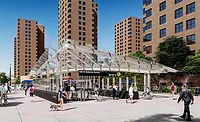
Rendering shows the planned 125th Street Station entrance for the Second Avenue Subway Phase 2, part of the $1.97-billion contract that will extend the Q Line into East Harlem.
COWI will lead design on the Metropolitan Transportation Authority’s $1.97-billion Second Avenue Subway Phase 2 contract, a design-build award to Connect Plus Partners that marks the first major construction step for the long-delayed East Harlem extension.
The MTA board approved the award Sept. 25 (Contract C26202), covering tunneling and structural shells between 120th Street and Park Avenue. Connect Plus Partners is a joint venture of Halmar International LLC and FCC Construction S.A.

Saqib Rizwan, senior vice president and project CEO for the MTA’s Second Avenue Subway Phase 2, addresses ENR’s NY/NJ Infrastructure Forum in New York City on Sept. 15.
Phase 2 extends the Q Line 1.5 miles north from 96th Street to a new terminal at 125th Street, where riders will have access to direct transfers to Metro-North Railroad and MTA buses. The project timeline anticipates construction to begin following issuance of the notice to proceed, with tunnel boring operations scheduled to launch in 2027. COWI’s release projects substantial completion in 2030.
The extension adds ADA-accessible stations at 106th, 116th and 125th streets, restoring subway service to East Harlem after more than eight decades while absorbing demand now crushing the Lexington Avenue corridor.
Thomas Dahlgren, executive vice president of COWI North America, assured stakeholders—namely, New York’s Upper East Side straphangers—that extending the line to 125th Street will improve daily mobility for more than 100,000 riders and “reduce crowding on the current subway line under Lexington Avenue.”
RELATED
NY Region Sees Progress and Challenge in Long-Term Infrastructure Spend
Gov. Kathy Hochul (D) said in a Sept. 25 statement that the award represents “a critical investment in equity and mobility for East Harlem residents,” underscoring the project’s community dimension.
MTA officials emphasized that the Phase 2 contract is the second of four planned packages, each covering different portions of the extension.
Design Leadership, Technical Challenges and Financing
COWI, appointed lead designer by Connect Plus Partners, will guide all aspects of design for the tunneling and structural shell work.
“Phase 2 of the Second Avenue Subway is one of the most significant infrastructure projects in the country,” Dahlgren said in the company’s announcement. He pointed to the complexity of tunneling beneath Manhattan and said COWI’s global team of 450 tunnel design professionals would “ensure constructability, safety, and efficiency” are embedded in each delivery stage.
The Denmark-based consultant has extensive U.S. transit rehabilitation experience, in addition to international tunneling expertise, in order to manage constructability.
The MTA’s board documents, reviewed by ENR, provide a more detailed description of the project’s technical approach. Alongside 1.5 miles of twin-bored tunnels, the contract calls for rehabilitating the 1970s-built segment between 106th and 120th streets to capture cost savings.
The scope also includes seven shafts that will serve both as future station entrances and as ancillary structures housing ventilation, electrical, and mechanical systems, with potential for community or retail uses at street level.
The procurement process incorporated Alternative Technical Concepts proposed by Connect Plus Partners, which MTA officials said helped reduce risk and improve constructability. The award sets a 1,471-day performance period and requires a 15% Disadvantaged Business Enterprise goal and local workforce participation.
RELATED
$1.97B Phase 2 Contract Awarded for New York City's Second Avenue Subway
The Phase 2 program carries a $7.70-billion budget, with $3.41 billion secured through a 2023 federal full funding grant agreement, which covers nearly half of project costs; state and local sources cover the balance.
MTA officials say the agreement ensures stable cash flow, allowing tunneling and excavation to proceed without funding gaps that slowed earlier phases.
Officials expect the project to transform East Harlem’s transit landscape, with reduced travel times, improved access for riders with disabilities and economic development opportunities tied to station-area improvements.
“The scale of this project and the expertise required to deliver it underscore its national significance,” Dahlgren said in the COWI statement.
With funding secured and the design-build team in place, the MTA says Phase 2 of the Second Avenue Subway is poised to enter active construction for the first time in decades. At the same time, pre-construction sitework—namely, utility relocation and property procurement—continues.
The expansion addresses a promise made nearly a century earlier, after the elevated IRT train that once served the northeast section of Manhattan was dismantled beginning in the late 1930s, during the lead-up to World War II.

Bryan Gottlieb is the online editor at Engineering News-Record (ENR).
Gottlieb is a five-time Society of Professional Journalists Excellence in Journalism award winner with more than a decade of experience covering business, construction and community issues, including finance, law and real estate. He has reported for Adweek and the San Diego Daily Transcript and led a community newsroom in Santa Monica, Calif. He served as editor-in-chief of the Detroit Metro Times and as managing editor at Roofing Contractor, where he helped shape national industry coverage. At Engineering News-Record, Gottlieb covers breaking news, large-scale infrastructure and megaprojects, regulatory developments and business trends across the U.S. and global construction sectors.
email: gottliebb@enr.com | office: (248) 786-1591