Transportation
Skanska-Flatiron JV Wins $323M Roadway Contract at LAX
The joint venture will rebuild bridges, ramps, and utilities.
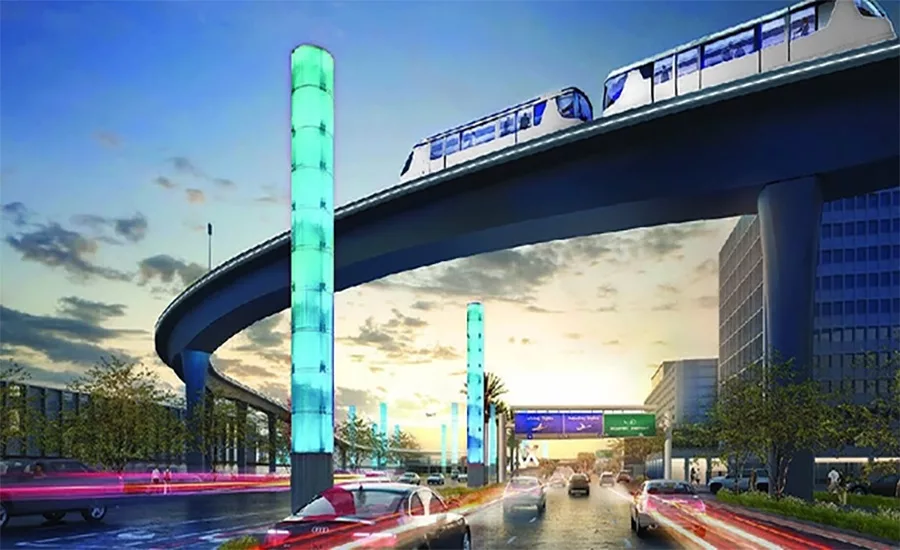
A rendering of Los Angeles International Airport’s Automated People Mover shows the elevated guideway crossing Century Boulevard. The transit project, now delayed until 2026, must integrate with major roadway improvements being delivered under a $323-million progressive design-build contract led by the Skanska-Flatiron joint venture.
Updated 1:21 PM ET, Oct. 1, 2025
Los Angeles World Airports (LAWA) has awarded a $323-million progressive design-build contract to a joint venture of Skanska USA Civil West and Flatiron West for roadway improvements at Los Angeles International Airport (LAX).
The project, which Skanska announced Sept. 24, is a major element of the airport’s approximately $6-billion Airfield and Terminal Modernization Program.
Skanska holds a 55% majority share valued at $178 million. The contract covers demolition, relocation of conflicting utilities, construction of bridges and ramps, intersection reconfigurations, new drainage infrastructure, signage and lighting. HNTB is serving as lead designer.
The contract carries a 15% disadvantaged business enterprise participation goal and requires 30% of craft workers to be hired locally under LAWA’s project labor agreement. Skanska said more than 20 subcontractors are already engaged, including small, women-owned, veteran-owned and local business firms.
RELATED
Los Angeles Mobility Advocates Eye 2028 Olympics and Beyond
Although LAWA introduced a $5-billion Multiple Award Task Order Contract program this year to simplify procurement, Skanska has clarified that this award is not associated with that framework.
“This is a progressive design-build project that was solicited by LAWA prior to the creation of the MATOC program,” the firm said in an email.
The joint venture is structured as an integrated partnership, with both firms sharing all tasks in proportion to their ownership stakes. “It is an integrated joint venture … all tasks are shared, and there is no scope split between the JV partners,” Skanska confirmed.
Company officials note that the fourth-quarter 2026 date applies only to the first construction contract, with LAWA anticipating the overall roadway program to extend into 2031.
According to LAWA’s December 2024 Environmental Impact Report addendum, the roadway work requires relocating underground and aboveground facilities—including pipelines, conduits, duct banks, vaults and poles—along with demolition of existing roadways and structures.
Planned changes include realigning the inbound ramp from southbound Sepulveda Boulevard at 96th Street and removing the traffic signal at Sepulveda and 96th in favor of grade-separated pedestrian bridges.
The addendum also specifies installation of storm drain piping, manholes, junction structures, upgraded traffic controls and street lighting. LAWA determined that these refinements did not create new environmental impacts beyond those studied in the original EIR.
The roadway improvements are intended to reconfigure 4.4 miles of airport access and exit routes to separate local and airport traffic, particularly along Sepulveda Boulevard. LAWA has previously stated that new elevated ingress lanes are scheduled to be in place by May 2028, with the full roadway program targeted for completion by 2030.
People Mover Delay Raises Coordination Risk
The success of the roadway project depends heavily on integration with the LAX Automated People Mover (APM), an approximately $3-billion, 2.25-mile elevated transit system under construction to connect the airport’s Central Terminal Area with parking, a consolidated rental car facility and Metro transit lines.

LAX’s People Mover, now delayed until 2026, must align with major roadway improvements being delivered to avoid limiting traffic benefits. Image courtesy of LAWA/ATMP report.
The APM includes six stations—three within the terminal area and three external—and is designed to carry an estimated 30 million passengers annually, reducing about 42 million vehicle miles traveled each year, according to LAWA.
The Board of Airport Commissioners has set a construction completion date of Dec. 8, 2025, with operations expected to begin in January 2026. The original completion date was 2023.
During peak hours, trains are expected every two minutes, offering a 10-minute end-to-end trip with top speeds up to 47 mph. LAWA began clearance testing of the APM guideway through the Central Terminal Area in late 2024.
If the first phase of roadway work concludes before the APM begins service, the full benefits of the new access routes may be limited until the train opens—introducing a timing risk for the broader modernization program.
LAWA did not respond to a request for comment by ENR by press time.

Bryan Gottlieb is the online editor at Engineering News-Record (ENR).
Gottlieb is a five-time Society of Professional Journalists Excellence in Journalism award winner with more than a decade of experience covering business, construction and community issues, including finance, law and real estate. He has reported for Adweek and the San Diego Daily Transcript and led a community newsroom in Santa Monica, Calif. He served as editor-in-chief of the Detroit Metro Times and as managing editor at Roofing Contractor, where he helped shape national industry coverage. At Engineering News-Record, Gottlieb covers breaking news, large-scale infrastructure and megaprojects, regulatory developments and business trends across the U.S. and global construction sectors.
email: gottliebb@enr.com | office: (248) 786-1591