ENR Southwest Contractor of the Year: Southwest Strength Puts Layton on Top
ENR Southwest Contractor of the Year Layton Construction lands the No. 1 ranking in the seven-state region with $2.4B in revenue
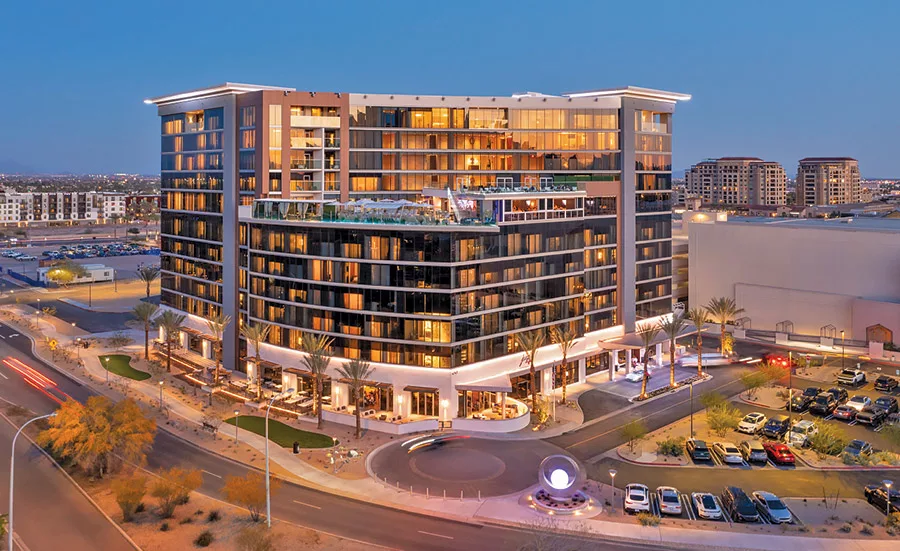
The Caesars Republic luxury hotel in Scottdale, Ariz., includes 264 rooms on 11 floors with an elevated pool, lounge and restaurant.
Founded in Sandy, Utah, by Alan W. Layton in 1953, Layton Construction has been led since 2004 by Alan’s son David and has expanded to include offices in 16 locations across the country.
In 1987, Layton opened a Southwest office in Phoenix, its first outside Utah. The contractor’s work in the region spans all project types with industrial, high-end tenant improvement and hospitality among the leading sectors in recent years.
In 2019, Layton merged with New York-based STO Building Group as part of an effort to expand the scale of projects the company could take on and increase the stock ownership pool for employees. After the sale, the leadership team remained in place and Layton family members are among the top shareholders.
Layton’s reported revenue of $2.4 billion in 2024 puts the firm in the No. 1 spot on this year’s Top Contractors list, which ranks the largest construction firms in the seven-state region.
The contractor’s Southwest operations are led by Andrew Geier and Jimmy Tometich, executive vice presidents. ENR spoke with them about the firm’s work in the Arizona market. This Q&A has been edited and condensed.
Recent Layton Projects at a Glance
Caesars Republic
This 265-room luxury hotel in Scottsdale, Ariz., has an elevated pool lounge and restaurant and is located near the Scottdale Fashion Square Mall.
The Rambler Tempe
A 15 story, mixed-use high-rise near the Arizona State University campus, the project is targeted to meet the needs of college students.
Astria Tempe
This 27-story high-rise residential tower is located adjacent to the Arizona State campus in downtown Tempe. The project is slated for completion in 2027.
AC Marriott & Element Hotel Phoenix
The dual-branded hotel located near the new Taiwan Semiconductor plant will feature 179 rooms. The hotel is scheduled to open later this year.
What has contributed to Layton’s success in the Southwest region?
Geier: From the beginning, our focus has always been making our clients’ goals our own. We seek to build true partnerships that go beyond each project—not just in hopes to work with them again (which we often do), but because it’s the right thing to do. In short, alignment with the client transcends every element of a project. From starting early in preconstruction to understand their vision to ensuring the space meets their needs long after construction, we remain committed to our clients and their projects. It’s a multifaceted approach we continue to hone and one we’re proud to offer each and every one of our partners.
“We seek to build true partnerships that go beyond each project ... because it’s the right thing to do.”
—Andrew Geier, Executive Vice President, Layton Construction
Ultimately, we’ve built a diverse portfolio that serves millions daily and transforms how communities live, work, play and heal—a reflection of our relationship-first approach.
Jimmy and I manage the Southwest operations, so within this business unit we have two executives. It’s a management style [that David Layton, CEO and president,] learned years ago called two-in-a-box. Someone may have some strengths and also some blind spots and then you have a second executive who can hopefully fill those blind spots. When we’re presented with an opportunity or challenge, one person doesn’t have to make the decision on their own. We get together and try and make the best decision for the unit. We’ve had a lot of success with the strategy.
What type of projects have been driving your workload in recent years?
Overall, I would say the leaders for us are high-rise multifamily and hospitality, mission critical projects like data centers and industrial.
When I came to [the Phoenix metro area] 20 years ago, it was boom and bust and very dependent on residential construction. There were a lot of new people moving here. Now the city has really matured, and the construction industry is more diverse.
Today, the tenant improvement market is very active with high-end type office work. There is a rush to quality for high-end office, but the lower levels of the office markets are still pretty quiet. We are also backfilling a lot of industrial projects where we might have built just a shell before and now owners are starting to fit them out for warehouse or manufacturing or both. Our interiors group is busy. Hospitality is also steady. The high-end resort folks are building, and business travel accommodations are doing well.
What does the future hold?
Tometich: Our backlog is strong right now; however, many projects are contingent on financing either from a debt or equity standpoint, and improvement in interest rates would help as well. With a little assistance, many projects are on the cusp of achieving lift.
I think the amount of work available in our region right now is probably less than the appetite in the general construction community, but we’re fortunate to have a diverse portfolio that helps absorb changes in one area.
For example, the industrial market has been great the last four or five years, but it’s hit its peak and is slowing down. The office market has really been dead since the COVID-19 pandemic, but we have a few office projects now that are starting to come together—all at high-quality locations. We’ve successfully redeployed resources toward high-rise residential, mission critical and tenant improvement projects where there is greater opportunity. With the maturation of the [Phoenix] Valley in general, the future is looking bright.

-03.webp?height=200&t=1782576952&width=200 "Fab 52 (Project Eagle)-03.jpg")