Transportation
FlatironDragados–Herzog JV Lands $414M Contract for Virginia Rail Bypass
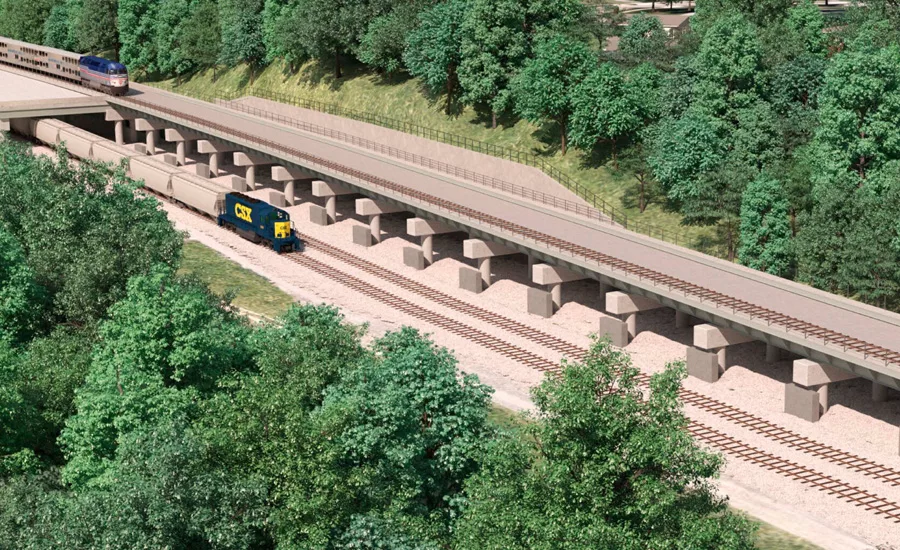
A rendering shows the planned Franconia–Springfield Bypass flyover, a 0.6-mile structure designed to separate passenger and freight rail traffic south of Washington, D.C.
Image courtesy of Herzog
The Virginia Passenger Rail Authority has awarded a $414 million design-build contract to a joint venture of FlatironDragados and Herzog for the Franconia–Springfield rail bypass, a grade-separated project designed to improve reliability for both passenger and freight rail through one of Virginia’s busiest corridors.
According to a FlatironDragados release June 22 announcing the win, the project will realign 1.4 miles of passenger track and includes a 0.6-mile flyover bridge that will initially carry a single track but is engineered to support a future second mainline.
The agency’s February 2025 fact sheet notes the bypass design is about 90% complete, with construction expected to begin this month and finish by 2029.
Jim Schneiderman, FlatironDragados executive vice president, said in a statement the project “will provide safer, more efficient rail service by reducing congestion and improving reliability.” He said the team “will continue to collaborate to ... identify innovative solutions to challenges.”
Agency technical documents show the flyover design uses concrete column piers supporting transverse steel floor beams with cast-in-place composite decks over the CSX freight mainline. The approach spans are designed with longitudinal steel plate girders and steel deck plating.
RELATED
Skanska-FlatironDragados JV Lands $1B Long Bridge North Contract
This hybrid configuration was selected over deeper longitudinal girder systems to reduce the structure's vertical profile, maintain clearance over freight operations and simplify construction sequencing in a live rail corridor, according to the agency's January 2023 construction industry request for information.
Plans show that the bypass alignment will require approximately 400,000 cu yd of earthwork, embankments, and retaining walls to minimize impacts on nearby neighborhoods. Temporary shoofly tracks will be installed to keep freight and passenger trains running through the corridor during the multi-year build.
Dewatering systems, underground detention facilities and jack-and-bore culverts are planned to manage challenging subsurface conditions, as described in the authority's November 2024 roll maps.
Environmental assessments conducted under NEPA found no significant community impacts, the agency reported; a noise study performed determined post-construction sound levels at nearby homes will remain below 66 decibels, roughly equivalent to conversational noise. The agency stated it coordinated with the U.S. Army Corps of Engineers, U.S. Fish and Wildlife Service and Virginia Dept. of Environmental Quality to address wetland and wildlife considerations.
Multiple Funding Sources
The project is funded through federal, state and local sources, including a $100- million Federal Railroad Administration Consolidated Rail Infrastructure and Safety Improvements grant, Northern Virginia Transportation Authority contributions and Amtrak funds.
The bypass forms part of the rail agency's Transforming Rail in Virginia initiative, which also includes the Franconia–Lorton third track and Long Bridge North projects.
Scott Norman, executive vice president of Herzog, said the joint venture “looks forward to bringing this project in on time and on budget.”

Bryan Gottlieb is the online editor at Engineering News-Record (ENR).
Gottlieb is a five-time Society of Professional Journalists Excellence in Journalism award winner with more than a decade of experience covering business, construction and community issues, including finance, law and real estate. He has reported for Adweek and the San Diego Daily Transcript and led a community newsroom in Santa Monica, Calif. He served as editor-in-chief of the Detroit Metro Times and as managing editor at Roofing Contractor, where he helped shape national industry coverage. At Engineering News-Record, Gottlieb covers breaking news, large-scale infrastructure and megaprojects, regulatory developments and business trends across the U.S. and global construction sectors.
email: gottliebb@enr.com | office: (248) 786-1591