Pipelines
Great Lakes Tunnel Project in Michigan Secures Needed Permits
Costs for oil-gas pipeline project, estimated at $500M in 2018, have risen to at least $750M and likely much more, one study notes
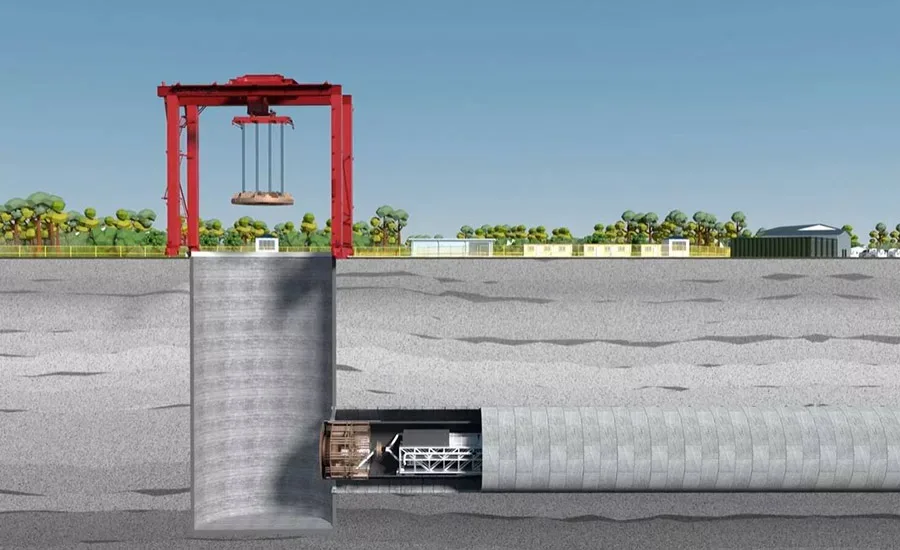
Two Michigan state agencies approved permits needed to build Great Lakes Tunnel project, a 4-mile-long structure that would enclose twin oil and gas pipelines along the bottom of the Straits of Mackinac,
The Michigan Dept. of Natural Resources and its Dept. of Environment, Great Lakes and Energy each approved permits July 15 for the Great Lakes Tunnel Project, a 4-mile-long structure that would enclose twin oil and gas pipelines that Canadian energy firm Enbridge seeks to build along the bottom of the Straits of Mackinac.
The latter department had issued a permit in 2021 for the project planned by the energy giant that is intended to replace the existing 73-year-old Line 5 dual pipeline that traverses the lakebed. The previous permit expired earlier this year as the project has been tied up in years-long, complicated legal battles at the state and federal levels.
The pipeline cost was originally estimated at $500 million in 2018 but ballooned to at least $750- or $800-million by 2022, according to a report by the Canada-based Institute for Energy Economics and Financial Analysis. Enbridge spokesperson Ryan Duffy declined to provide an updated project cost.
The Dept. of Environment, Great Lakes and Energy says in a press release that it conducted a 16-month review covering Enbridge’s bottomlands and wetlands permit application and concluded that “the public and private need for the proposed activity outweighed other public interest criteria.”
The permit comes with conditions. Enbridge must submit an improved wetland mitigation plan to address wetland impacts, with new conditions designed to mitigate impacts to cultural resources in the area.
The Dept. of Natural Resources permit requires Enbridge to reduce impacts on rare plants and animals that are federally and state-listed as threatened. The agency says Enbridge must maintain topsoil and collect seeds to be used to restore part of Houghton’s goldenrod and dwarf lake iris plant populations after construction, clear trees only during winter months to avoid disturbing bats, and set construction zones to avoid damaging sensitive plant areas.
Duffy called the Dept. of Environment, Great Lakes and Energy renewal of permits “an important step forward for a project designed to further protect the Great Lakes while helping ensure the uninterrupted flow of energy that supports Michigan and the region.” He added: “We are reviewing the new permit conditions issued today to assess any impacts on tunnel construction,”
The Michigan League of Conservation Voters says on its website that it condemns the decision by Gov. Gretchen Whitmer (D) and her administration to approve permits for the tunnel.
“Rather than doing everything she can to safeguard the Great Lakes, Gov. Whitmer is enabling a Canadian oil company to saddle Michigan taxpayers with billions of dollars in financial liability if something goes wrong,” says League CEO and President Lisa Wozniak.
It asserts that the proposed tunnel threatens the rights of tribal nations that are protected under the 1836 Treaty of Washington. "Tribal governments have consistently opposed the project, warning that an oil spill or construction-related damage could irreparably harm sacred waters, fisheries, and culturally significant sites," the league states.
As ENR reported previously, preconstruction on the tunnel started in 2019 when samples of sediment and rock were studied to learn about the geology of the straits and to inform the tunnel’s design. Arup is lead design engineer.
Enbridge named a joint venture partnership between two tunneling companies, Barnard Construction Co. and Civil and Building North America in 2024 to lead construction of the tunnel, but workstill has not started
The project will entail construction of an entry point for the 500-ft-long tunnel boring machine on the south side of the straits where there will also be a slurry plant to separate rock, clay, pebbles and water that will be pumped out of the tunnel. Once separated, the water will be reused in the tunneling process.
The project tunnel boring machine, with thousands of components, will take three to four months to assemble.
The machine will be required to excavate through limestone, rock and shale as it lifts 1-ft segments of reinforced concrete liner into place and seals them. The machine will be required to move up to 40 ft per day, five days a week. A vertical shaft is planned to be constructed on the north side of the straits for retrieving and dismantling the machine.
During construction, saturation divers will need to perform regular inspections and maintenance. They will be required to live in pressure chambers on the water's surface for weeks at a time and the plan is to transport them down in a pressurized habitat at the head of the tunnel boring machine to do their work.
The project still requires several other permits and requirements, including a federal permit from the U.S. Army Corps of Engineers.