Energy/Industrial
Boston Taps Salas O'Brien to Explore Waterway Clean Thermal Energy
Five other firms also will work on the city Green Ribbon Commission's pilot project
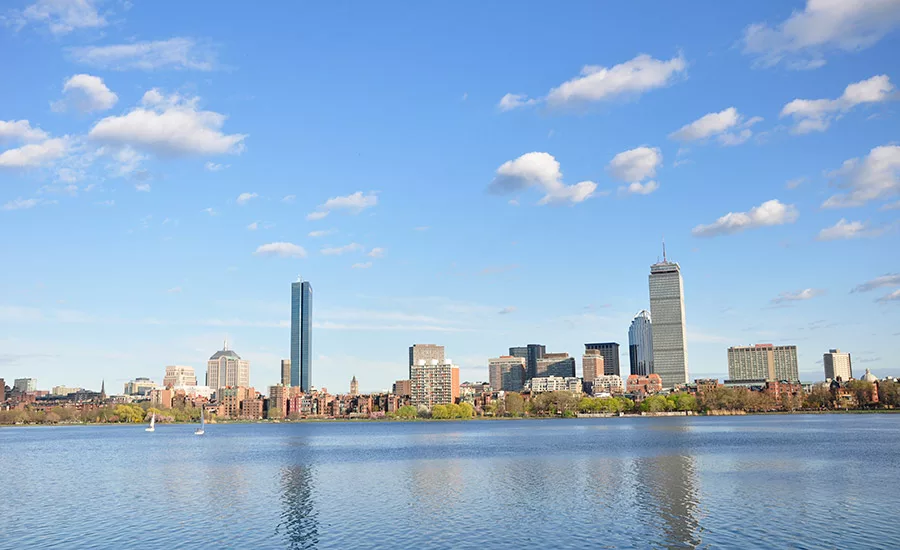
Thermal energy from bedrock beneath the Charles and Mystic Rivers, Boston Harbor and Fort Point Channel would be harnessed in a closed system that circulates heat through sealed infrastructure without drawing water from waterways.
The Boston Green Ribbon Commission has taken a major step toward exploring the use of Boston Harbor and other local waterways as sources of affordable, clean and reliable thermal energy by selecting Salas O’Brien, a decarbonization and energy master planning firm, to lead the $500,000 analysis.
Supporting the firm are five sub consultants—Sherwood Design Engineers, Synapse Energy Economics, Sasaki, GeoSource, and VHB—to analyze feasibility of the project, which includes creating a thermal network to distribute the energy. “With this robust team of technical experts led by Salas O’Brien, we can advance a revolutionary plan to decarbonize large buildings with a clean, renewable, all-local energy source,’’ said commission Executive Director Lindsey Butler in a statement.
Salas O'Brien has 5,000 employees, work on more than 500 geothermal projects across the U.S. and Canada, and roughly a dozen thermal energy network projects in the design phase or fully implemented, according to Brian Urlaub, a company principal and director of geothermal operations.
“We're one of very few firms that has our own on-staff hydrogeologists, so we dive deep into the subsurface geothermal aspects of projects without having to subcontract that work,” said Urlaub.
The technology, intended to capture thermal energy from the Charles and Mystic Rivers, Boston Harbor, Fort Point Channel and bedrock beneath, would be a closed system that circulates heat through sealed infrastructure without drawing water from waterways. One aspect of the study will be to determine if the bedrock can become a thermal storage battery “to increase the capacity of those resources versus trying to take [the energy] at the time that it's needed, which would be very diminished.”
Thermal energy networks are a “multi-tiered problem-solving technology that can help a multitude of issues across the city of Boston,” said Urlaub. “If you look at the Boston Harbor and the studies that have been done [related to] how lobsters have all gone north because the water temperatures just are not conducive for their habita t… we need to remove the thermal heat that's being put into these bodies of water. It's readily available, useful heat.”
Urlaub anticipates that project challenges will be similar to others that the firm has worked on, such as related to building stock. “How do you retrofit the building stock to a clean thermal technology? Also … associated with that is really the cost and how that gets funded.”
Beyond technical considerations and cost is the issue of who will own the energy delivery system, whether it’s a public-private partnership, utility, or municipality. “There's a lot of different nuances to an energy transition that are not just about the technical feasibility, and that's really also what we're diving into.”