The U.S. 250th Anniversary
D-Day Bravery Honored at Lifelike Illinois Memorial Assembled by Tarlton
A dozen bronze statues replicating U.S. Army Rangers in World War II are affixed to a 50-ft-tall limestone bluff in Grafton, Ill.
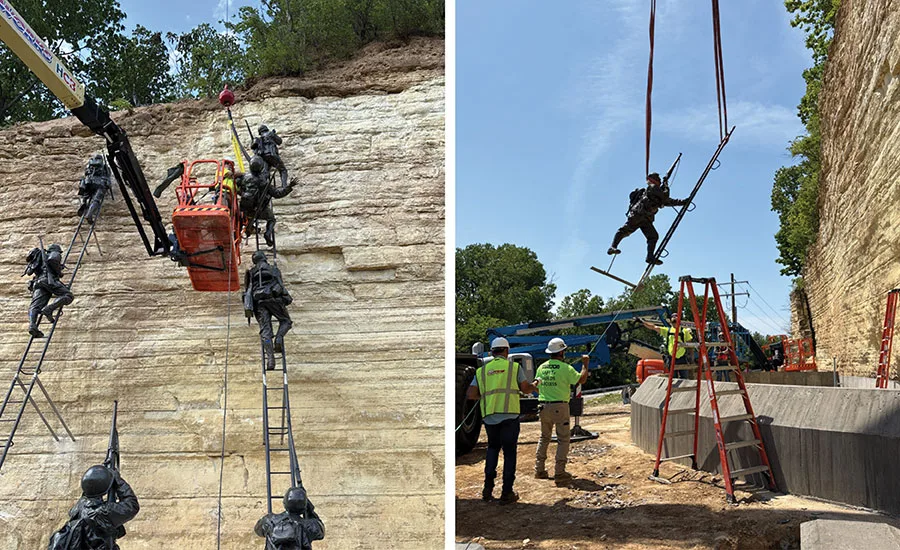
Under a rain of enemy fire by German howitzers, U.S. Army Rangers on June 6, 1944, scaled limestone cliffs rising 100 feet over the English Channel, neutralizing guns capable of targeting both Omaha and Utah beaches in France, and which threatened to thwart the Allied forces massive and crucial World War II D-Day invasion of Normandy.
The assault at Pointe Du Hoc on France’s northwestern coast opened a major front against Nazi Germany and eventually led to the end of the war. It is being memorialized in Grafton, Ill., a town of about 750 people in southwestern Illinois, nestled along scenic limestone bluffs where the Illinois and Mississippi rivers meet.
Mayor Michael Morrow, a retired U.S. Army Corps of Engineers colonel who has visited Normandy Beach several times, was inspired in 2022 to establish a Veteran’s Commission and raise funds to create the National Memorial of Military Ascent—an exhibit featuring 12 life-size bronze replicas of the rangers climbing a 50-ft-tall natural limestone bluff that resembles the Pointe Du Hoc cliffs.
“We have these beautiful limestone cliffs in Grafton and, once, when we passed by, my wife pointed to them and said, look, ‘Pointe Du Hoc,’ and I said “Yeah. It looks like it,” he says.
That interaction planted the seed in Morrow's mind for the $3.5-million memorial.
It is the first phase of a project that included installation of a plaza with five limestone pillars to recognize the individuals, committees and groups who provided funding for the project that is planned to have a second phase focused on constructing a new 2,500-sq-ft interactive museum to honor those who served in the Vietnam War.
Veterans make up about 17.5% of Grafton’s adult population, which is more than double the national average of around 6.2% and triple the Illinois state average of 4.8%, according to the U.S. Census Bureau. The plan is to eventually also recognize Grafton’s key role as the manufacturing site of Navy Seal Team Assault Boats during the Vietnam War era.
The Ascent memorial is located on land donated by a private owner to the town.
Installing the bronze figures, which each weigh between 500 and 800 lbs., was no easy feat, says Mike Jones, project manager for St. Louis-based Tarlton, which constructed the memorial designed by Henderson Associates Architects in Edwardsville, Ill. The bronze statues were created by Carolina Bronze of Sea Grove, N.C.
“We 3D scanned actual ranger reenactors who basically positioned themselves on the cliff,” Jones says. ”We had the guys stand in particular positions, scanned them and were able to sculpt their likenesses.”
The figures include one ranger on the ground using a radio and another actually tumbling from the cliff as would have occurred during the actual invasion.
“That represents the ones that didn't make it,” Jones says.
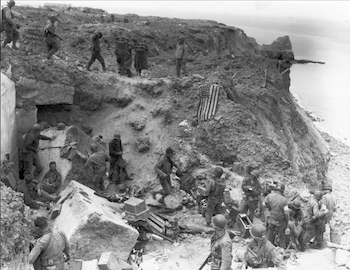
D-Day photo of U.S. Army and German prisoners at Pointe du Hoc. Photo: U.S. National Archives.
Of the 225 U.S. Army Rangers who began the assault, 135 were killed during the operation and the subsequent two-day defense.
Morrow is fascinated by the details of the statues.
“They were [created] down to the exact detail of the bayonets, the little wrinkles in the uniforms, the patches on the shoulders, the expressions on their faces, the fingernails, everything,” he says.
To be in time for a D-Day celebration, the task of installing the figures took place over a rainy weekend in May.
"Our team anchored the heavy bronze statues by excavating the limestone bedrock and pouring concrete. We conducted rigorous pull tests to verify the cliff's structural integrity and ensure the statues were securely and permanently attached,” Jones says.
The pull tests involved installing epoxy anchors into drilled holes in the limestone bluff—similar to how epoxy rods are set in concrete. Epoxy was injected into each hole, about two ft of a threadless stainless steel rod was inserted, and then a hydraulic pull test was performed to apply a specified load. The anchors were tested to 5,000 psi to confirm they met performance requirements. All tests were successful, with no pullouts, cracking, or other issues observed, Jones says.
A large crane was used to place the statues.
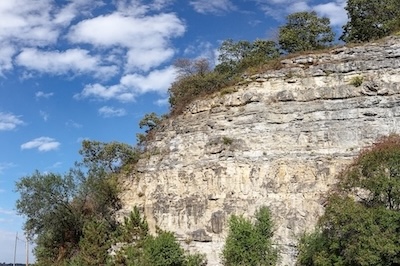
Limestone cliffs in Grafton, Ill. Photo: Curioustiger/Getty Images
“Because of how the site sits along the cliff, we needed a larger crane with enough reach to extend out and safely lift the pieces into place,” Jone says.
A crane was also used to place the limestone pillars, each measuring about 8 ft tall by 4 ft wide, in the concrete plaza that sits beneath the memorial. All total, about 50 people—some of them volunteers—worked on the project.
“The sheer scale and weight of these elements made the entire operation pretty remarkable,” Jones says.
The team worked under a tight schedule to complete the installation over the three-day time frame for the memorial that also features ladders on which the rangers are positioned.
““We only got two mounted the first day,” Morrow says. “So we knew Saturday would be the tough one. We had to line everything up with lasers to get the ladders set at the correct 12° angle up to the top where they would hook in."
Noticing that rain could hamper the work, Phil Halliday, owner of JEN Mechanical, based in nearby Godfrey, Ill., and which partners with Tarlton on other jobs, stepped in to help.
“We had a couple rainstorms so I sent a few guys up there to help,” he says. “I just think the whole thing is a good cause. History is important. It should be preserved.”
The region is known for attracting migratory birds, including hundreds of bald eagles that fly north every winter to hunt for fish in the Mississippi.
Tarlton kept wildlife safety in mind when it installed exterior lighting on the memorial.
“We've dimmed the lighting to about 35% to be mindful of migratory birds. Even at that level, it creates a really cool atmosphere,” Jones notes.
Visitors from Texas and Norway
The team, motivated to honor veterans and the sacrifices the Rangers made, worked through the night and finished substantial installation on June 28. As day became evening, Morrow recalls one worker telling him he would not quit until the work was done.
“He walks up to me and he says, ‘Mayor, I just want to tell you one thing. If this were any other project, the only thing you'd see right now is my tail lights. But because of what this is. Let's get it done.’”
Morrow says the memorial has already attracted visitors from as far away as Texas and Norway.
As the country celebrates its 250th anniversary, Jones views the memorial that so closely replicates the real-life threat that the Rangers faced, with a sense of “reverence—just gravitas. It’s very compelling.”