Digging Deeper | Cultural
Minnesota Zoo Project Makes Nature the Focus
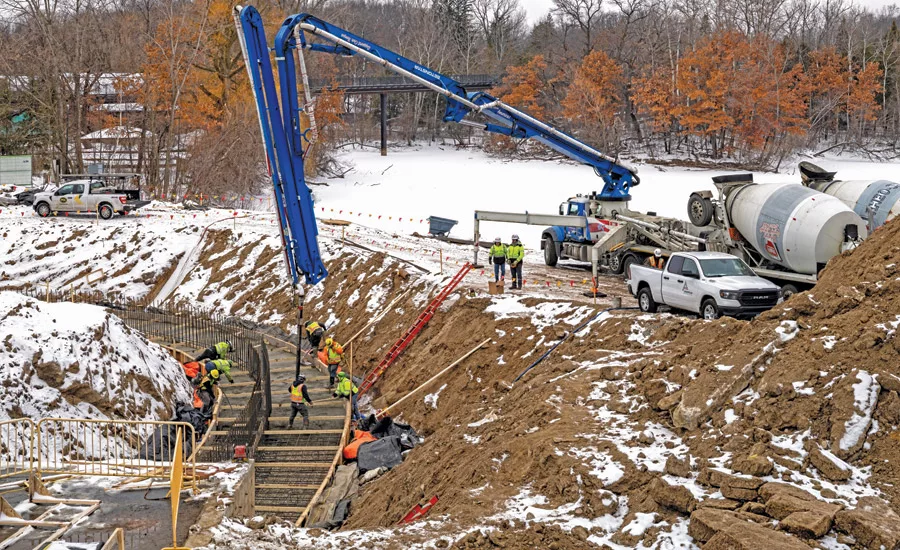
A 50-year-old concrete structure that had blocked views of the zoo has been demolished as part of the $14.2-million project.
The Minnesota Zoo is doing away with the old—a massive concrete arrival area near the entrance—and bringing in the new: an airy outdoor plaza, exhibit space and waterfront restoration project built over hidden functional infrastructure. The $14.2-million project, which started in 2025 and is slated for completion in 2026, entails removing the 50-year-old structure that had blocked views of the zoo and bringing in a more natural, welcoming landscape softened by new plantings, earthwork and a spiral steel ramp.
Matthew Keenan, associate and project director with Leo A. Daly, which designed the replacement structure, describes the demolished concrete structure as a “big Brutalist ramp” with extensive retaining walls and a hard-edged, heavily structured approach built directly on a lakefront/wetland area known as Main Lake. These design features didn’t allow visitors to view the snow monkey exhibit it overlooked or see beyond it to appreciate the other exhibits and natural beauty the zoo offers.
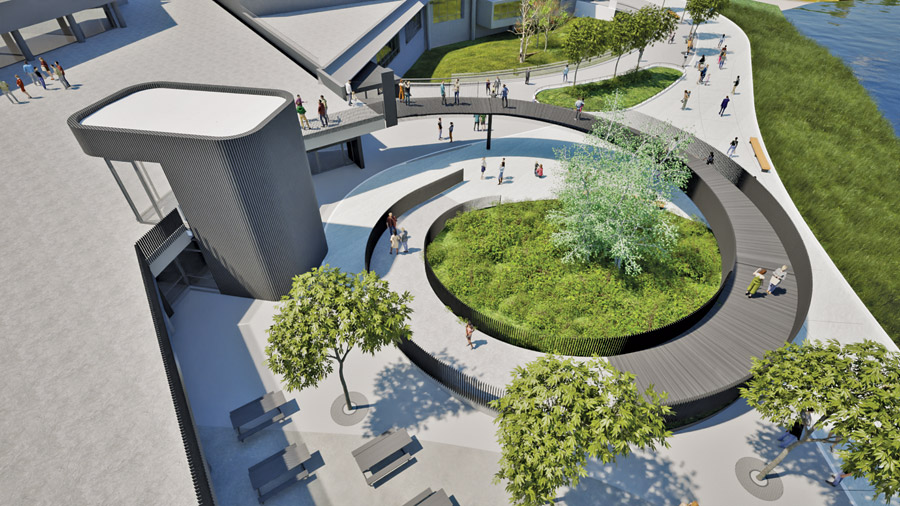
A spiral steel ramp connecting two levels of the plaza is a signature element of the project.
Image courtesy of PCL Construction
The ramp also no longer reflected the experience that zoo leaders wanted visitors to have upon arrival. Thomas Root, director of planning and construction for the Minnesota Zoo, located just outside Minneapolis, says the new facilities cannot be described as a traditional visitor center.
“We’re not calling it a visitor center,” Root says. “I don’t even think there’s even a lot of indoor space to this facility. It’s an outdoor plaza, an exhibit and a waterfront restoration—so, a whole bunch of things.”
The plaza was designed as an arrival experience. Root says it functions as the zoo’s main exhibit; when visitors come through the front door, this is what they first encounter. The design needed to create a memorable first impression while also responding to the realities of the site, which included infrastructure demands that most visitors will never see. Major functional systems are located beneath the plaza, including big lift stations and stormwater management equipment. This required the design and construction teams to solve visible and nonvisible problems while creating a space that feels open, natural and inviting.
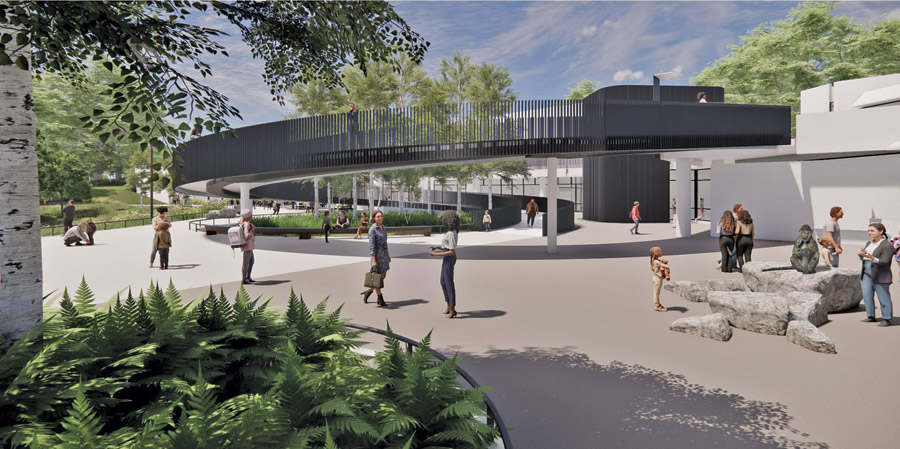
A new plaza incorporates greenery and rock formations to create an airy, natural atmosphere.
Image courtesy of PCL Construction
“The main challenge was installing the lift station tank 8 feet below the existing water table elevation as well as keeping all the existing stormwater lines from the zoo open and draining during installation,” says Paul Krienke, superintendent for PCL Construction. “A temporary stormwater management plan was essential and had to be well thought out—and a backup plan in place should there be any issues.”
The project also created 1,000 lineal ft of new shoreline along Main Lake.
“All of the concrete debris that was generated from the project, we processed on site.”
—Paul Krienke, Superintendent, PCL Construction
“We were able to kind of adjust that water body to create more shoreline and do more of a natural grade project—which they could have done years ago, but I think they were just thinking that we’re going to fit [the previous structure] within just what our constraints are. And they just built it that way,” Krienke says.
The new plaza was created by filling in roughly 75 ft of shoreline, creating a space in which endangered Blanding’s turtles and other animals, reptiles and insects can thrive. The environment aligns with the zoo’s conservation efforts.
“Where we restore the shoreline, there will be some upland grasses that will go down into emergent vegetation in the water—all planted with some deadfall and some boulders to make a good nesting place for turtles,” Root says. “We also get some trumpeter swans in there. It’s a big conservation project for us. We’re trying to make it inviting for the native animals.”
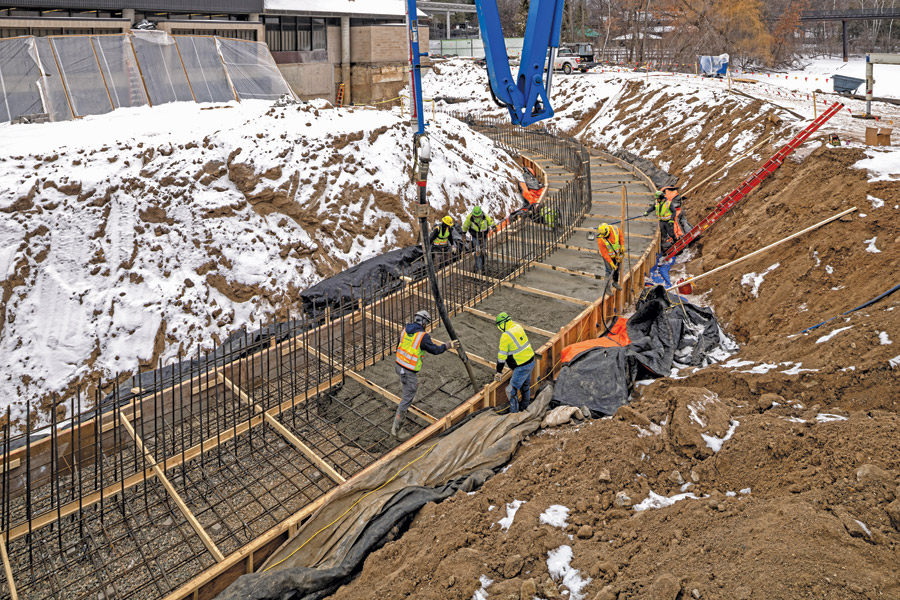
Crews place cast-in-place concrete for the exhibit’s foundation under challenging winter conditions.
Photo courtesy of Steve Silverman for Be Remarkable Photography
The team used fill as well as concrete from the demolished ramp to create the new lakefront, recycling all of the concrete—1,600 cu yd—and 162 tons of rebar.
“All of the concrete debris that was generated from the project, we processed on site,” Krienke says. “We took out the rebar, and then we used all that material as additional fill so we didn’t have to bring in a whole bunch of material and haul out a whole bunch of concrete demolition material.
“Now it’s going to be a moment to stop and pause, see the monkeys hang out and enjoy the beauty of the waterfront.”
—Thomas Root, Director of Planning and Construction, Minnesota Zoo
“They used an excavator called a muncher,” Krienke adds. “They’d take all the concrete [and] crush it piece by piece into small pieces. And then they would take out the rebar. And then it would be in small enough pieces that a skid loader could take it and layer it out, compact it with sand and other materials to use it as fill.”
Work in areas where it could impact endangered species took place from mid-September to mid-April. The limited work window to protect native animals required close coordination with the zoo.
“It was just an ongoing sharing of knowledge of what [type] the turtles were and making sure none of them came into our construction zone and that none were harmed during our construction process,” Krienke says.
Access to the site—bordered by the two-level plaza on one side, the lake and by primary pedestrian access to the zoo—was a major challenge. This spurred the team to build a new roadway following the contour of the plaza edge; it is now a permanent feature.
The spiral steel ramp connecting the plaza’s two levels emerged as one of the signature elements of the redesign—an important visual and spatial feature of the project. Instead of a stark concrete ramp, the new design introduces a sculptural element set within a more natural environment. Keenan says the team incorporated trees “in the middle of that ramp, for example, and trees and plantings elsewhere.”
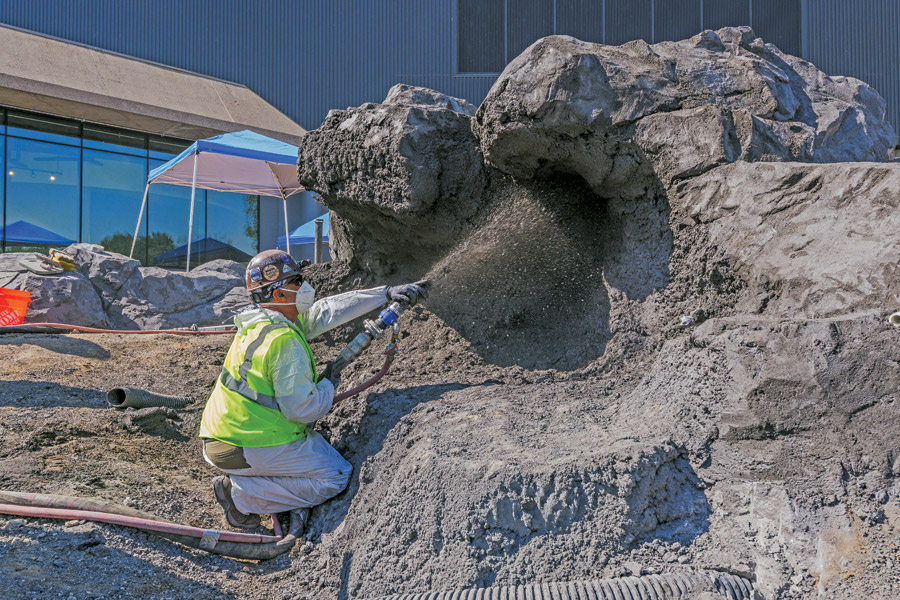
A worker applies shotcrete for the structural rockwork at the snow monkey habitat.
Photo courtesy of Steve Silverman for Be Remarkable Photography
The steel ramp provides a more naturalistic look than concrete, Keenan says.
“We made the conscious decision to shift from heavy concrete to light frame steel to achieve that light touch,” Keenan says.
The new plaza provides a 360-degree view of the snow monkey exhibit, which is surrounded by the plaza and is only 15 ft away from the waterfront area.
“The entire exhibit area was demoed and was enlarged in size with new 15-foot-tall curved concrete walls,” Krienke says. “The interior grade of the exhibit was brought up so that guests will now have a straight and level view of the monkeys and will not even need to look up to see them in the trees.”
The exhibit was redesigned to feel more like home to its inhabitants.
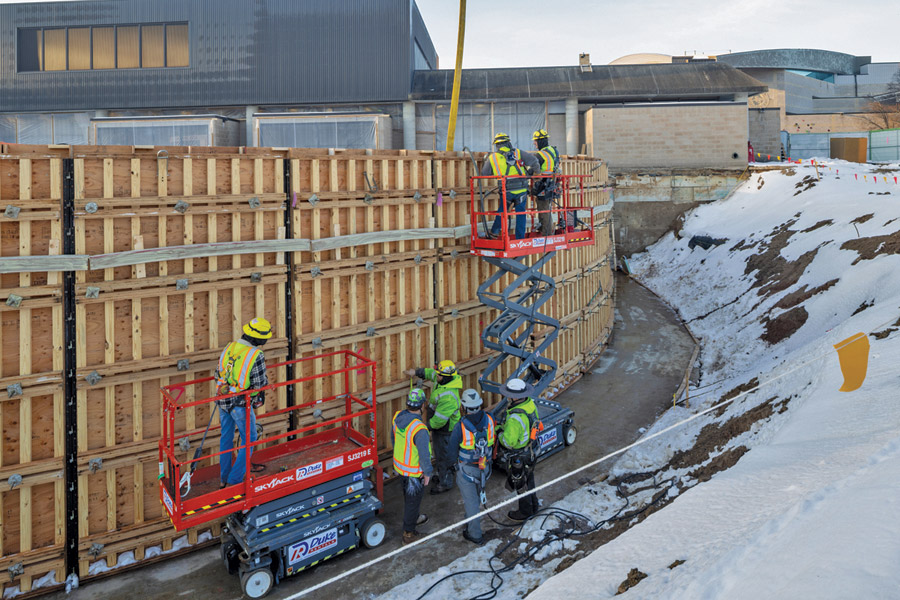
Crews install formwork for a curved cast-in-place concrete wall within a sloped excavation.
Photo courtesy of Steve Silverman for Be Remarkable Photography
“A new water feature pond and stream and rock shelter were added for a more natural feel for the exhibit—four large artificial trees and 30 natural trees also were added to create more green space in the exhibit,” Krienke says.
The interior of the exhibit space was also renovated, with new layouts for shelter space, animal husbandry access and upgrades to HVAC and lighting systems to mimic more natural environments, he says.
Unlike the previous concrete structure, the new plaza, monkey exhibit and waterfront are intended to be more inviting to humans and the animals.
“It felt [previously] more like a pass-through, a bit of a corridor that you would walk through,” Root says. “Now it is going to be a moment to stop and pause, see the monkeys hang out and enjoy the beauty of the waterfront.”