Top Design Firms | Northwest Design Firm of the Year
PAE’s Mission Drives Growth
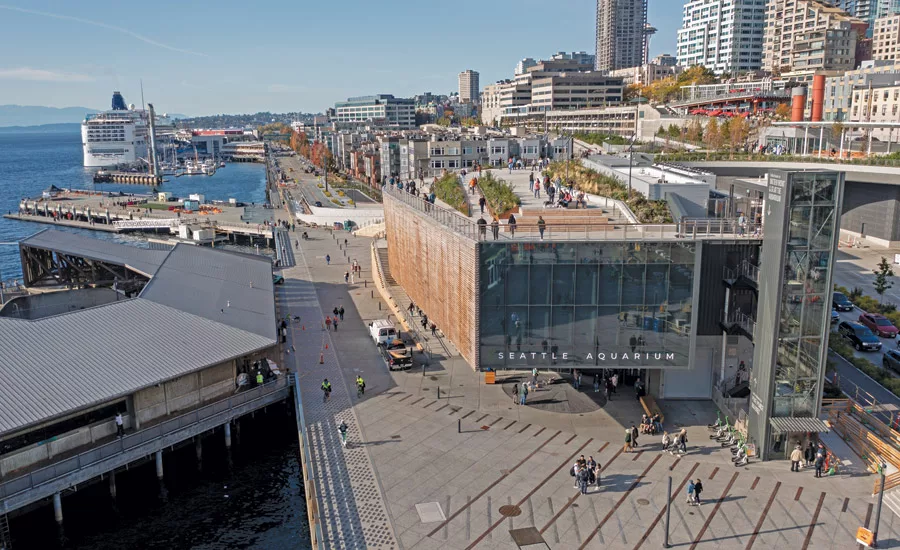
PAE helped design a 350,000-gallon main exhibit for the Seattle Aquarium Ocean Pavilion that targets Living Building certification.
As PAE Consulting Engineers expands its footprint across the country, its roots remain firmly in the Pacific Northwest, where the firm was founded in 1967 in Portland. PAE brings that PNW feel throughout the region, to offices in Seattle, Eugene, Bend and elsewhere thanks to PAE’s history, but also by becoming a national leading engineering firm on the most aggressively sustainable projects.
PAE shifted decisively toward sustainable design as lead engineers on the Bullitt Center in Seattle, the first Living Building Challenge design to set the benchmark for commercial building sustainability. That led to additional LBC projects around the country and helped PAE cement its vision of creating “clean air, energy and water for all” while giving the firm a triple bottom line with a focus on “people, planet and profit.”
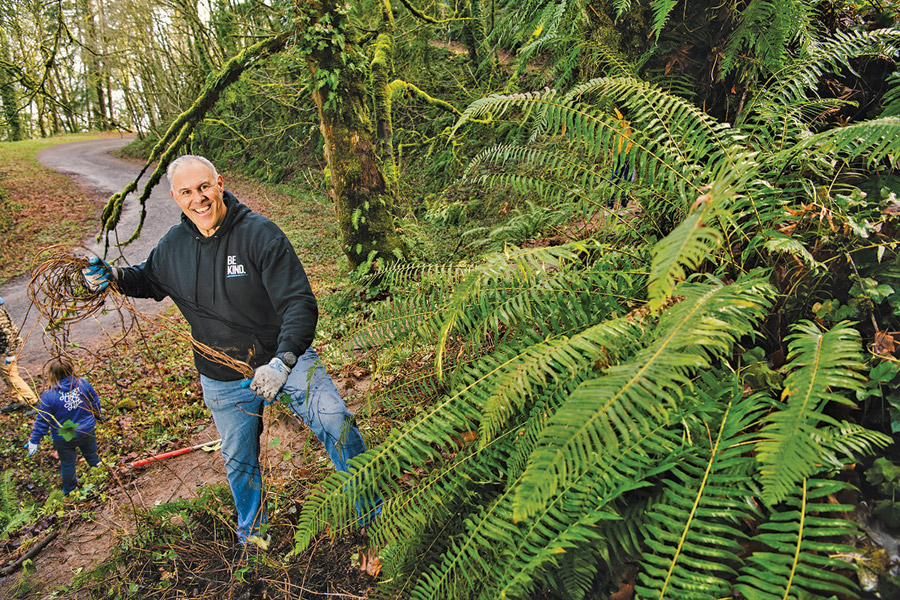
Christian Agulles, president and CEO of PAE, taking part in a community service day.
Photo by Kim Nguyen
Mission-Driven Vision
Christian Agulles, president and CEO, says that focus has PAE’s roughly 425 nationwide employees pursuing technical and operational excellence to accelerate the firm’s impact. But really, he says, everything beyond the engineering is about the people, employees and clients. “Consulting and what we do is a people business,” he says. “The reason we are growing is we are able to attract the best people, and they are attracted to our mission, vision and values.”
PAE promotes a mission-driven vision, which helps draw employees. “When you hire great people, you give them opportunities,” Agulles says. Those opportunities come in the work and the business. Using pool staffing—even though it is more complicated to operate—puts people on multiple projects to create well-rounded and diverse engineers. And with more than 135 members of staff as owners at PAE, the firm creates opportunities that give people a “sense of ownership and entrepreneurship,” he says. “It is different when you have a piece of what you are building in the way we treat each other and the way we treat our clients. It is authentic.
What sets PAE apart is the people, says Christian Castillo, senior account executive at McKinstry. “It’s one thing to have the expertise and experience, but there is the other side of the coin which is: Is the experience of working with your team enjoyable? I have not had a bad experience with anyone on their team,” he says, “and that makes it easy to want to come back and work with them again.”
“Consulting and what we do is a people business.”
— Christian Agulles, President & CEO, PAE Consulting Engineers
Justin Chitwood, an architect with Mahlum Architects in Seattle, says his firm has worked with PAE on a variety of project types, and he’s had a positive experience with the people and how easily he can access the team. He says that access shows both reliability and care.
Agulles says clients appreciate the firm’s rigorous engineering expertise and the investment PAE has in each project, caring about the results as much as the client. “We care as much about what you’re trying to do as you, and are searching for solutions,” he says.
Shiloh Butterworth, chief operating officer, says the focus on delivering for clients breeds success. “Our culture helps add to why we can do that,” he says.
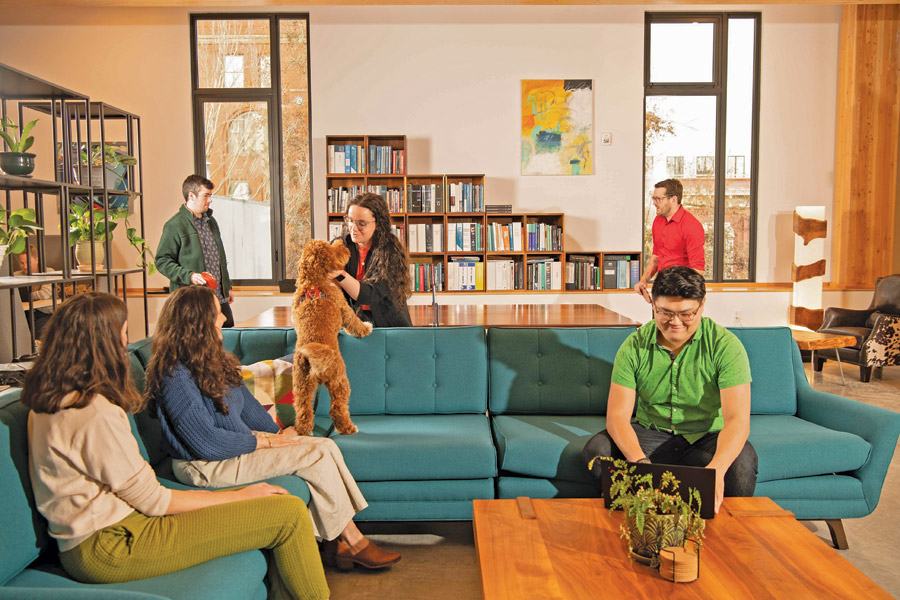
PAE Living Building offices in Portland set the standard for sustainability.
Photo by Kim Nguyen
Wide-Ranging Portfolio
Great relationships don’t complete projects. PAE enjoys roughly 75% of their business from repeat clients, branching into a wide cross section of sectors, everything from aviation and education to health care and even data centers. Agulles says ensuring a wide portfolio of projects not only keeps people engaged but really allows the firm to focus on technical solutions across a range of sectors.
Castillo says that PAE takes an active role in projects and doesn’t wait for direction. “Each time I have worked with the PAE team it has felt like a true partnership,” he says. “In our world, it’s easy for the financial side of the business to take center stage and make a relationship feel transactional. That has not been the case with my work with PAE. Their goal is to come together as a team to face the project challenges.”
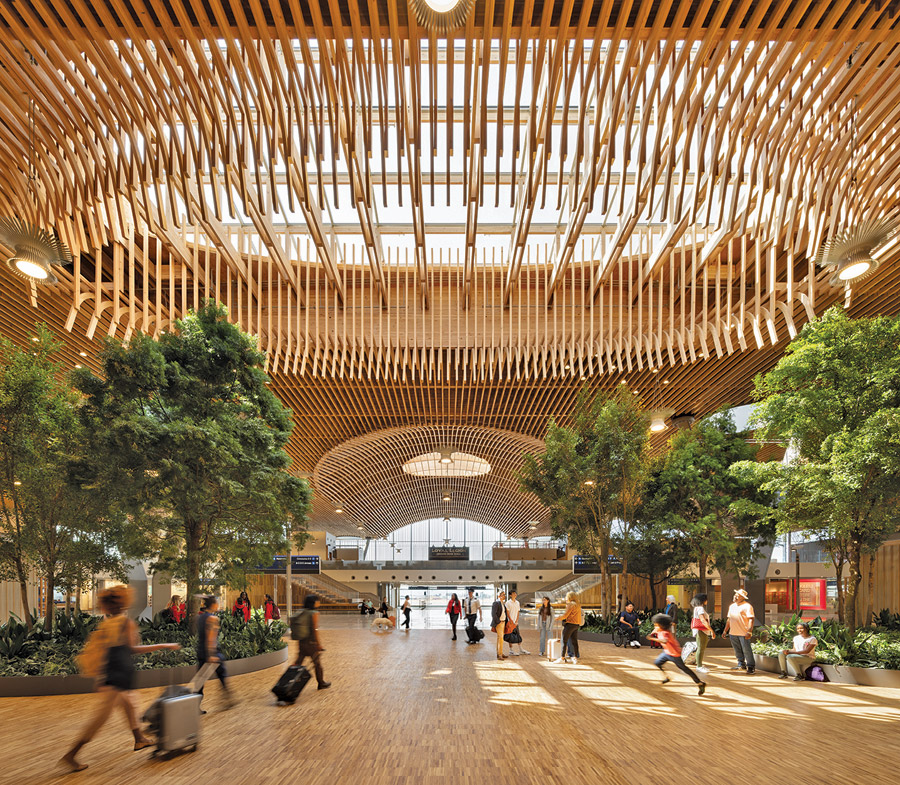
A major reconstruction of the main terminal of the Portland International Airport allowed PAE to help the airport showcase the value of wood.
Photo by Emma Peters
Sustainability Goals
PAE also made a commitment to demonstrate its dedication to its values by building its Portland headquarters as a Living Building. “We developed that project, designed it, are equity partners in it and the anchor tenant,” Agulles says. “We are as in it as you can be.”
“I appreciate PAE’s sustainability goals and that they use their work environment as a testing ground to showcase what is possible with new technologies and existing buildings,” Chitwood says, adding PAE is always offering fresh technological opportunities. “PAE brings these ideas into our health care projects as options—the owner may not be ready or willing to adopt them, but PAE has offered the more forward-thinking solutions to the owner team.”
PAE ties its growth to the strategic plan to accelerate the firm’s impact. “We can have more impact if we are on the cutting edge of sustainability,” Agulles says. PAE is part of the MEP 2040 Challenge led by the Carbon Leadership Forum and features an internal Embodied Carbon Tool to help projects quantify and reduce whole-life carbon.
Recent successes include the Portland International Airport (PDX) main terminal, which allowed PAE to work on a mass timber project focused on embodied carbon. PAE also helped convert a central plant at PDX to 95% fossil-fuel-free, all while keeping the airport operating. PAE has a constant presence at the University of Washington and recently completed the Bush School’s Upper Campus in Washington with a passive cooling design. The Seattle Aquarium Ocean Pavilion, featuring a 350,000-gallon main exhibit, targets Living Building certification and cuts energy use by 70% and carbon emissions by 95% while running 100% fossil-fuel-free.
“Clients come to us with our unique résumé in respect to sustainability or ability to push the boundaries on how sustainable a project can go.”
—Shiloh Butterworth, Chief Operating Officer, PAE Consulting Engineers
Daniella Wahler, PAE principal and Seattle office director, says the Bush School offers a unique story. Not only did PAE help craft the passive house for the K-12 private school—an “elegant, stunning solution”—but next door PAE also completed a historic renovation of a 1903-built mansion that now serves the school. Getting the mansion fitted with two-pipe mechanical cooling was challenging, so the new Upper School now contains all the equipment that serves the mansion. “The most sustainable building is the one you already have,” Wahler says.
Each project gives the firm the experience needed to work on the next, whether Living Building Challenge designs or even data centers. Agulles says the tension between data center energy demands and PAE’s sustainability mission isn’t lost on the firm, and it is something the team discusses extensively. “But if we are not involved in the process and if we don’t have the relationships with those developing the data centers, then we lose our influence,” he says. “As we work on data centers, we are on a parallel track studying and thinking of ways to help reduce their impact. That is the way we sleep at night, to be completely honest.”
After PAE’s work on PDX, it is now focused on the new Aspen airport and its goal of making it the most sustainable airport in the world. “Our clients come to us with our unique résumé in respect to sustainability, our ability to push the boundaries on how sustainable a project can go,” Butterworth says. “Ultimately, they come because they know they can trust us to deliver on time, on budget and with great quality.”
National Presence
Growth areas abound, from health care (especially in California) to aviation and education and data centers. PAE is willing to work on a multibillion project over a decade, such as PDX, or a small, niche project important for a client. West Coast revenue reached nearly $70 million in 2025—a roughly 10% bump from the year prior—and the Pacific Northwest still constitutes more than two-thirds of the company’s regional revenue, consistent with the 225 employees in the greater Portland region.
PAE now operates 12 offices across six time zones, with employees in almost every state, from Alaska and Hawaii to the East Coast. “We have hired a lot of really good people over the last decade,” Butterworth says, noting the attractiveness of the firm’s mission. “It doesn’t just resonate with engineers, it resonates with our clients and the people who want to have their buildings go as far as they can with sustainability.” Butterworth says PAE draws employees because of the culture and mission. The firm's high retention rate helps demonstrate it is doing the right things.
Wahler says much of the PAE growth comes from clients asking the firm to be available. “The architectural community on the West Coast is extraordinary and doing work across the country,” she says. “They want to use us. We knew there would be a limit to national projects without a national presence.”