Mountain States Design Firm of the Year
Focus on Safety, Mobility Drives Growth for RS&H
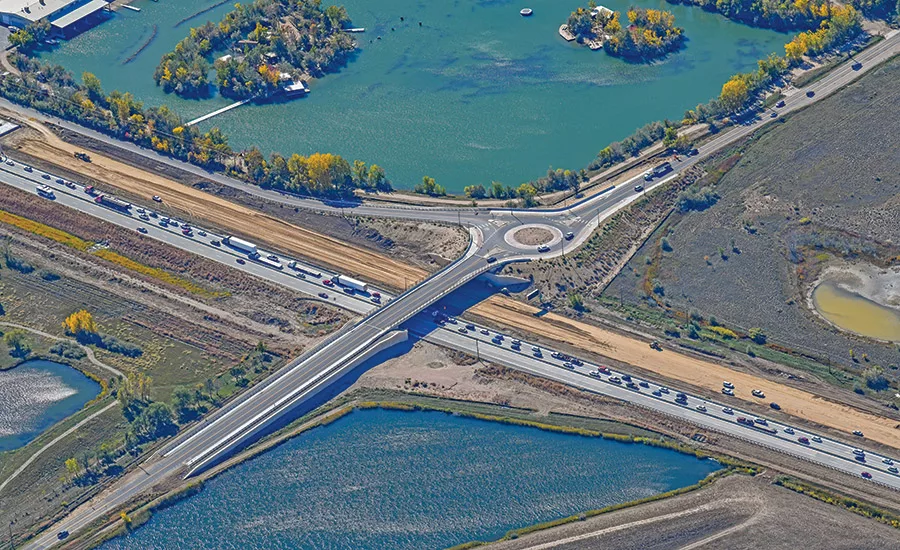
The $600-million I-25 design-build express lanes project in Northern Colorado features a 14.5-mile corridor expansion with 19 new bridges, the state’s first median-loading bus rapid transit (BRT) hub, new port-of-entry buildings and key infrastructure upgrades.
With regional offices in Colorado and Utah, and with projects reaching into Wyoming, Idaho and Montana, RS&H has steadily expanded its footprint across the Mountain States. The architecture, engineering and consulting firm provides services for transportation, aviation, federal, health and science, aerospace and corporate projects across the country; however, its regional focus is primarily on the aviation and transportation sectors, which are both experiencing tremendous growth. The firm’s regional footprint has grown thanks to the acquisitions of Colorado-based firms Tsiouvaras Simmons Holderness (TSH) in 2018 and HB&A in 2024, which both have brought local, specialized capabilities to RS&H.
Lisa Robert, the firm’s Denver-based CEO, discussed recent projects and opportunities with ENR Senior Editor Jennifer Seward. This Q&A has been edited and condensed.
What projects are driving your success?
The work we’re doing at Bozeman International Airport is the story of longevity.... We’re proud that the work we’re doing now is the third part of expansion efforts that we’ve been working with Bozeman on for a decade.
The Salt Lake City CREX, a planning and environmental contract, is an extension of an existing airport runway that will be completed in time for the 2034 Olympics. We are also the lead designer on the West Vail Pass Auxiliary Lanes project with the Colorado Dept. of Transportation.
We have increased our number of employees over the last five years by 35% in the Mountain States, and our gross revenue has increased by 45%. Behind the employees that sit in the Mountain region, we have more than 1,900 employees nationwide.

Bozeman Yellowstone International Airport is designed to take in Montana’s mountain views.
Image courtesy RS&H
How are you managing that growth?
We have incredible employees that have a strong commitment to the relationships they form with clients, partners, our subconsultants and our contracting partners. We rolled out our strategic plan last July and feel we can double in size over the next five-year period. That creates an inflection point for us to contemplate how to support that growth and maintain customer quality, strong employee experience and discipline in what we do. We are improving our onboarding experience because, as we bring people on, that is their first experience with us, and a positive onboarding experience is an indicator of [retention]. We listen to feedback through our employee engagement surveys, then pivot to address any areas of tension; that’s a necessary practice as any organization grows.
In and around our project delivery, we’ve put in place scalable solutions that create context and understanding about what our minimum level of expectations are, regardless of the client’s expectations. We also have very focused plans related to our market growth—whether in our major markets or in a geographic area.
Key Projects at a Glance
Boise Airport Runway 10L-28R Rehabilitation includes advanced engineering solutions while maintaining seamless operations for commercial, military and general aviation users.
Bozeman Yellowstone International Airport East Terminal Expansion, Belgrade, Mont., is the third piece of the airport’s expansion efforts undertaken by RS&H over the last decade.
Salt Lake City International Airport, Taxiways U-V enhancements will promote connectivity and sustainability, helping SLC reduce costs and secure FAA funding.
North I-25 Express Lanes, Johnstown to Fort Collins, Colo., features a $600-million, 14.5-mile design-build corridor expansion with 19 bridges and the state’s first median-loading bus rapid transit (BRT) hub.
“We are leaning into how to harness and deploy AI in an appropriate and human-centered manner.”
—Lisa Robert, CEO, RS&H
What about new technologies?
We are leaning into how to harness and deploy AI in an appropriate and human-centered manner. Whether for research, internal processes within the organization or in contemplation of what we deliver to our clients, we firmly believe [AI is] a tool we leverage and not a replacement for that need for human interaction and oversight. Although models are becoming more powerful every single day, there’s no replacement within our profession nor should there be from a fiduciary responsibility and a stewardship responsibility for that to be replacing the engineering and architectural capabilities that protect public health and safety. It is a part of our strategic plan to continue to evolve that in a responsible manner.
What project trends can we anticipate?
IIJA and the stability of funding that it provided, which expires in September, really gave state agencies an opportunity to do long-term planning. I have incredible hopes that there will be an IIJA reauthorization and at the same time we know the time clock is ticking for that to be a reality. We are very involved in national organizations that are helping to keep that dialogue relevant and front of mind. Because of the markets we focus on in the Mountain States, a reauthorization or extension will be critical to predicting the future. [We must realize that] the resources and venues that we have to express our opinion on the importance of what that means for economic development, congestion relief and user mobility is one of our fiduciary responsibilities, not just from a company standpoint but from an economic development perspective in the region.