Tapping Into Torrance’s Brackish Water Plume
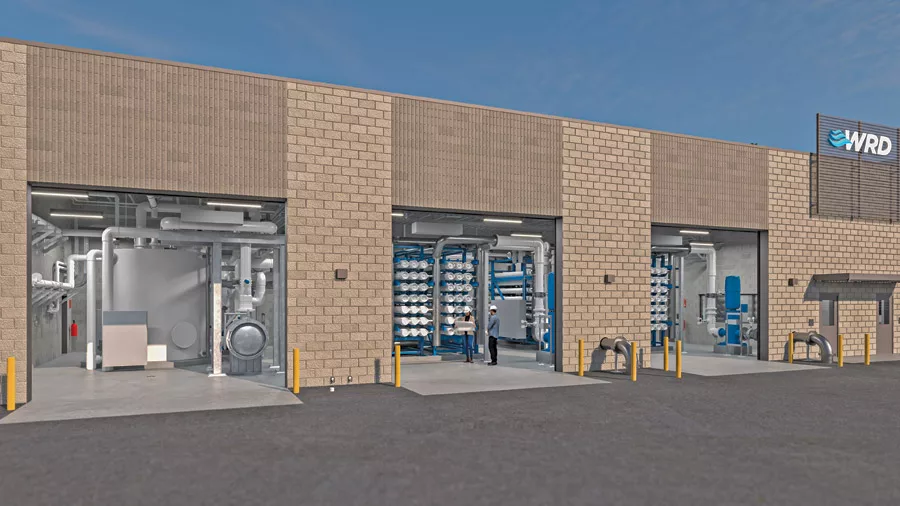
A rendering of the Water Replenishment District’s expanded Robert W. Goldsworthy Desalter in Torrance, Calif.
Situated underneath the city of Torrance, Calif., is a vast source of groundwater just waiting to be extracted. It’s just way too salty.
The Water Replenishment District (WRD) of Southern California is working on a solution as part of its Brackish Groundwater Reclamation Program. Although the program includes numerous capital projects, one of its most critical efforts is the Torrance Groundwater Desalter Expansion (TGDE), which will treat this salty underground plume and provide up to 7,100 acre-ft per year of clean drinking water for up to 105,000 local residents.
Realizing this project, for which a formal groundbreaking was held on June 10, has required a creative delivery, extensive piloting and some coordinated logistics to manage multiple site constraints. When completed by 2028, the TGDE will include four new production wells, feedwater pipelines and additional treatment capacity at the Robert W. Goldsworthy Desalter.
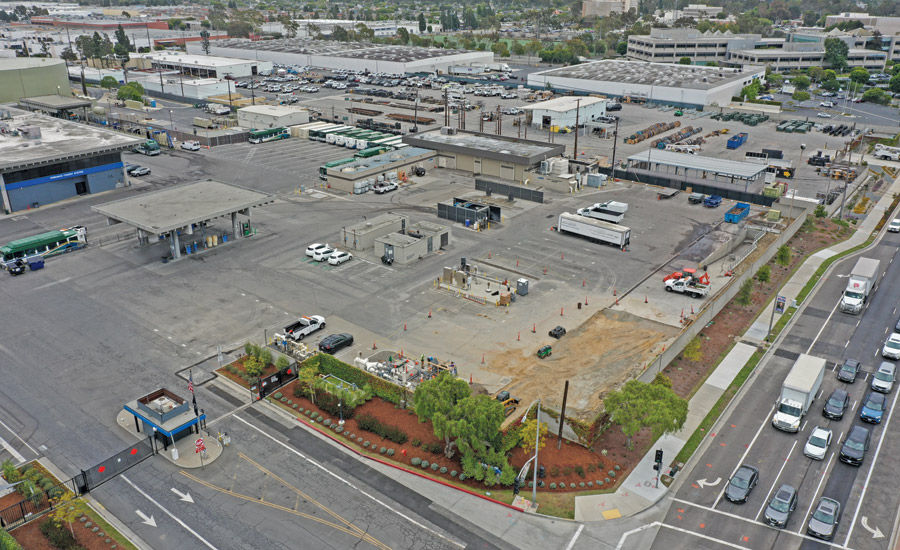
The desalter expansion shares its site with multiple other city functions, requiring careful planning and logistics as construction progresses.
Photo courtesy of the McCarthy-Jacobs JV
Salty Origins
How exactly did all that salt get into this particular body of water? That goes back to the 1900s, “when aggressive pumping in the region drew seawater inland. After that problem was addressed by installing seawater intrusion barriers—essentially walls of injection wells pushing clean potable water into the ground—it trapped that plume in place,” explains Joel Blair, manager of engineering at WRD. “So we’ve been sitting on this large volume of groundwater that couldn’t be used for local supply.”
Los Angeles County started installing these seawater barrier injection wells in the 1950s (completing the last ones in 1964), and today, the West Coast Barrier includes 159 injection wells that protect the aquifers from seawater contamination. That plume spans 14 sq miles, which has made groundwater pumping impossible in some areas.
In 2018, WRD held an initial meeting with a group of stakeholders about the possibility of joining forces to clean up the plume. By 2021, a feasibility study was complete.
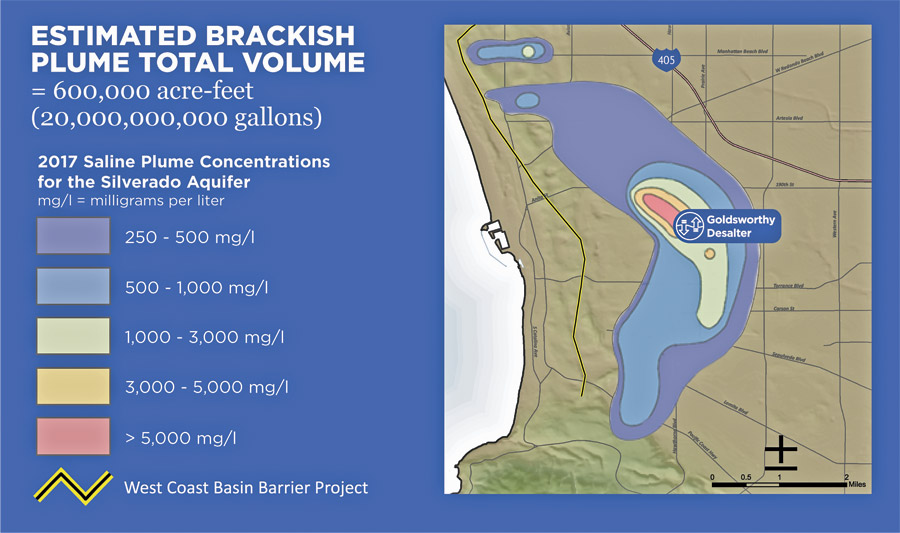
Aggressive pumping in the region drew seawater inland in the early 1900s. That plume became trapped after seawater intrusion barriers were built starting in the 1960s.
Graphic courtesy of the Water Replenishment District
“We knew we wanted wells in the ground to extract the water, we wanted to treat it for potable use, and we wanted to deliver it to local water users. By 2024, the project was more defined—but not so defined that we knew every detail,” Blair adds.
To find the solution, WRD began a water quality testing and treatment system pilot program. Completed in 2024, the pilot’s first phase saw small production wells installed to understand aquifer water attributes, and various treatment systems were tested.
“The delivery model allowed us to right-size the project and treatment features.”
—Joe Broughton, Design-Build Operations Manager, Jacobs
“The piloting plant and operation was conceived like most pilots—you expect it to help define or refine the project. In this case, we thought it would help us dial into the process. But quite the opposite happened; the pilot proved we didn’t need one of the unit processes, which is pretty uncommon,” explains Joe Broughton, design-build operations manager with Jacobs. “We realized we didn’t need nanofiltration, so at about 30% design, the pilot results caused the client, the owner’s advisory team and the design-build entity to rethink the right scope for the project.”
Reverse osmosis is a very mechanical and above-ground process compared with traditional water and wastewater plants, Broughton explains. Water moves under high pressure through a membrane with small pores, allowing clean water to exit and brackish material to remain.
“Brackish water requires significantly less pressure than seawater—in the 300–400 psi range,” he says. Seawater desalination requires around 1,000 psi. “For reference, home water pressure is typically 60–80 psi. We’re adding two new trains of reverse osmosis to the existing desalter.”
Since the main technical challenge for this project is organic fouling, going with reverse osmosis also ensures that WRD can always keep one train in cleaning mode while ensuring ease of operation, Blair says.
Although other more advanced technologies were considered, this tried and true process was chosen to keep the expansion simple and operable. “The real innovation was the strategy—we right-sized the project, and a lot of good decisions along the way focused it into the right project at the right scale,” Blair says. “Because this is progressive design-build (PDB), we’re still providing input to the design team and pilot-testing some technologies, including auto strainers. We’re getting close to wrapping that up.”
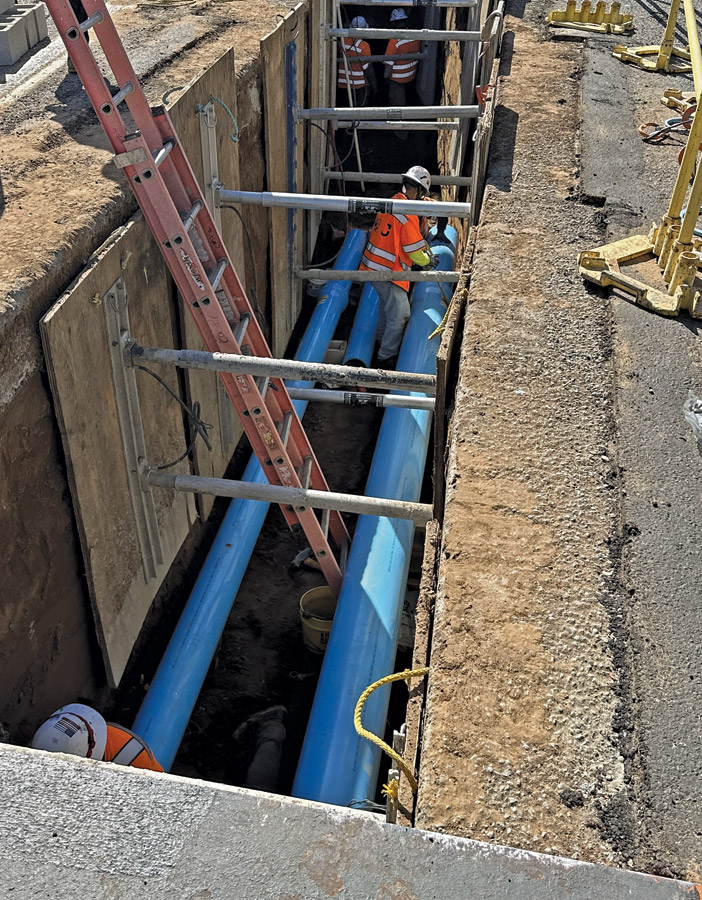
Crews work to install feedwater pipelines for the desalter expansion project.
Photo courtesy of the McCarthy-Jacobs JV
All in the Delivery
The Torrance desalter is WRD’s second major PDB project. “Since we knew the components and general direction but not all the specifics, PDB was the perfect fit. It let us stay involved in the process as we went and also allowed for faster delivery,” Blair says.
After the pilot’s first phase wrapped, McCarthy-Jacobs came on board as the design-builder in April 2024. PDB allowed the team to continue refining the design as construction began, mitigating risk and cost, but it also ensured an optimized facility for WRD.
“The most unique outcome to date is that the pilot drove a pretty significant shift in the treatment processes, and we achieved that with no cost or schedule impact,” Broughton says. “The delivery model allowed us to right-size the project and treatment features, and to package out parts of the work so construction caused minimal disruptions. That’s what successful PDB should achieve: being nimble and delivering work in a way that isn’t purely linear.”
This evolution toward WRDs and the city’s actual needs made it an entirely different project than it was at the RFQ phase, says Callie Nottingham, project director, McCarthy-Jacobs JV. “It was not because anyone did anything wrong, but because of what the data from the groundwater system told us,” she says.
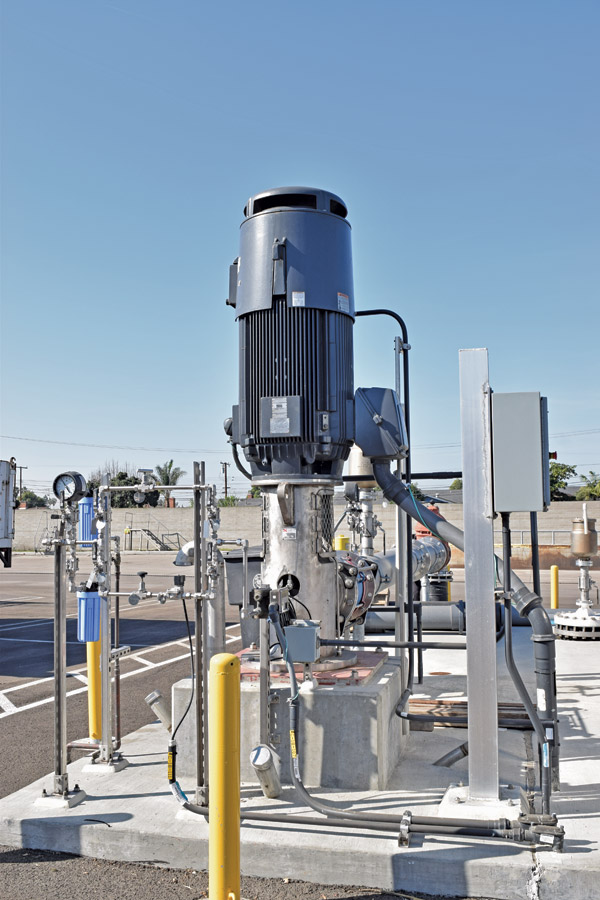
A vertical turbine pump at the maintenance yard in Torrance.
Photo courtesy of the McCarthy-Jacobs JV
A Bit Bigger
WRD’s existing desalter has a capacity of 5 million gallons per day, but the facility never actually reached that capacity because of how it was built and the variability of the water being extracted from the ground, Nottingham says. “We’re upgrading that facility to roughly 3.5 mgd and expanding by another 1.5 mgd. [At completion it will have] a total of about 7 mgd—essentially doubling capacity,” she continues. “Originally the plant was going to be 10–12 mgd, but the piloting data showed that wasn’t feasible. We continuously refined the design to get to the project’s actual needs.”
During groundwater modeling, the team also realized that it would need to avoid shifting contaminated plumes around. Starting with hydrogeology, engineers identified the precise number of wells in the right locations, allowing for a more streamlined scope, Blair notes.
“Construction costs are approximately $185 million. With construction management and advisory services, approximately $200 million total,” he adds.
The existing desalter sits on Torrance’s maintenance yard, which houses public works, transit, fleet maintenance, parks and recreation, and more.
“I don’t think I’ve ever seen a tighter location to build a project. The designers and the superintendents looking at drawings and adjusting scope and features to fit in this tiny footprint is quite remarkable,” Broughton says. “The pumping equipment sits below grade in vault-type structures, hidden from street view—unlike a typical well field where equipment is above ground. Access is through hatch and door systems for proper maintenance.”
“We continuously refined the design to get to the project’s actual needs.”
—Callie Nottingham, Project Director, McCarthy-Jacobs JV
Construction kicked off in November on feedwater pipelines, facilitated by extensive utility mapping and ground-penetrating radar, says Chris Kostelny, senior project manager, McCarthy-Jacobs JV. “There are high-pressure oil lines, gas lines, water mains, sewer lines, all things we’re excavating around and crossing beneath. On the treatment plant side, we coordinated with our building information modeling team to laser scan and map all the existing connections where we’re tying into the plant, to make sure what we’re designing matches existing conditions and everything will fit once we’re in the field,” he says.
The contract was structured with multiple GMPs, though the Del Amo pipeline was expedited first and completed earlier this year because the city of Torrance had a pavement moratorium and it had to be done before street repaving. “The early works package was a design-bid-build initiated first to prep the site for the expansion. The team has also finished the pipeline for three of the new wells,” he says. “Next up is installing wells Silverado 1, 2, and 3. GMP2, which covers the treatment plant expansion, is already approved.” GMP3, which includes the south pipeline and the fourth well, was approved by the WRD Board on May 27.
Upon completion, TGDE will provide discounted water to the community, while WRD will be able to replenish and store water in a previously unusable aquifer, Blair says.
“Part of the project also protects production wells for water users outside the plume, making sure the contamination doesn’t keep migrating toward clean wells,” he says. “We’re pretty unique in that we’re voluntarily cleaning up this plume. There are other contaminated plumes in the region, but typically there’s a regulatory order and a responsible party. We’re doing this because we believe it’s the right thing to do and a smart use of our resources.”

