Digging Deeper | Higher Education/Research
Mass Timber Breaks New Ground at Oregon Lab
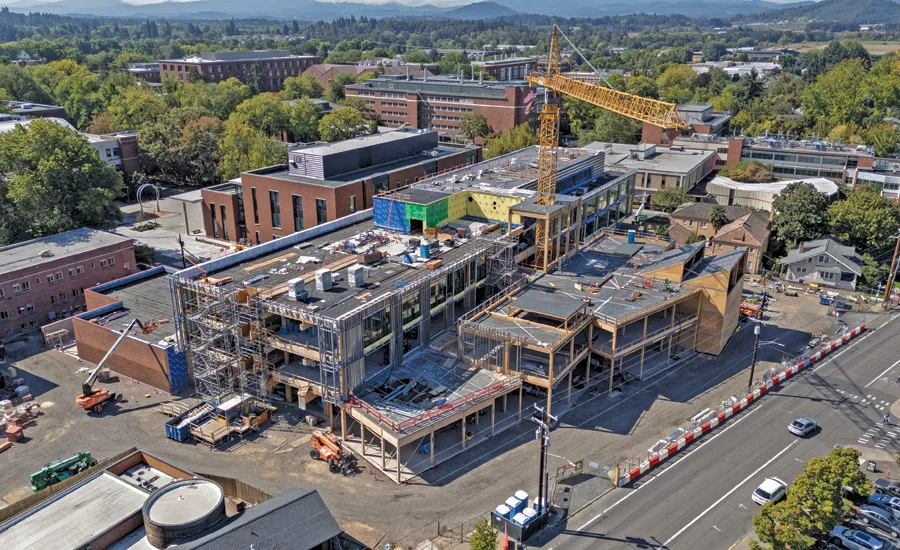
The Huang Collaborative Innovation Complex is located on Oregon State University’s Corvallis campus, which has pioneered the use of mass timber in construction projects.
Mass timber construction continues to set new benchmarks. At Oregon State University—a world leader in researching the power of timber in construction—work is underway as the Corvallis school readies the 2027 opening of the Jen-Hsun Huang and Lori Mills Huang Collaborative Innovation Complex, the first mass timber lab building on the West Coast and one that sets new standards across the country in meeting stringent research lab requirements.
“It is really interesting when you see this kind of wood structure,” says Vlad Pajkic, ZGF Architects partner and design partner on the Oregon State project. “It looks cool, but so much cooler with the lab equipment and fume hoods. That is the unusual part, the part I have never seen before.”
When completed, the complex is designed to strengthen university science programs by supporting collaboration among faculty, students and industry with its advanced supercomputing capacity and vibration-controlled experimental labs.
Work began in December 2023 on the $200-million, 143,000-sq-ft complex. Making it wood, though, wasn’t a design directive from the school, but a focus of the design team.
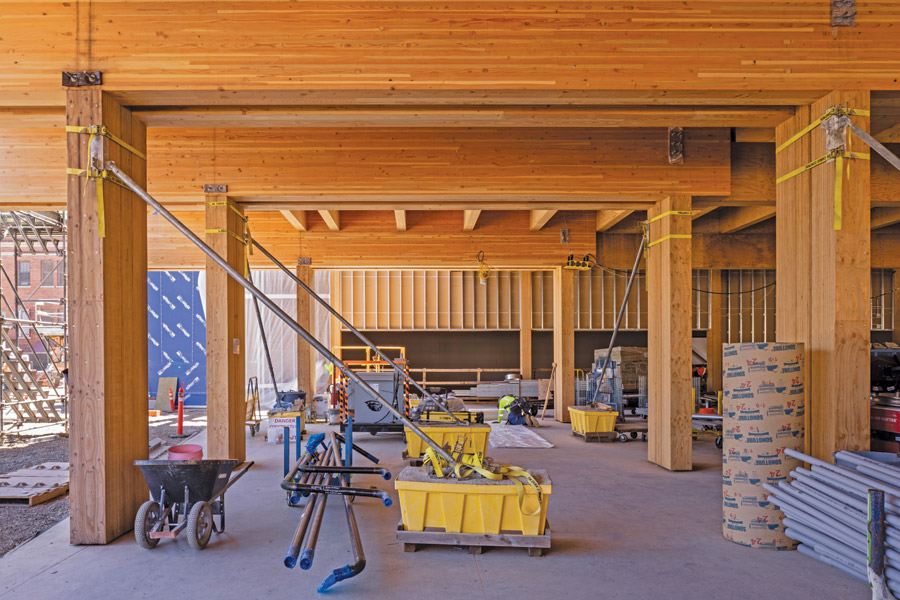
The unique mass plywood panels used for construction are capable of handling the intense vibration requirements needed for a working lab.
Photo courtesy ZGF Architects
Shake it Off
It’s one thing to construct a wood research building mainly packed with an atrium and offices, but “the challenge has been how to get the actual labs where you have the equipment,” Pajkic says, and that largely has to do with vibration requirements.
ZGF partner KPFF engineers helped solve the challenge of meeting the 2,000 micro-inches per second (MIPS) floor vibration requirement for a wet lab building by using a mass plywood panel. The fully plywood creation is stacked for structure and features glue for strength, but it creates a new product that can handle the vibration requirements.
Architects can work with panels, columns or beams. Pajkic says that while comparable to cross-laminated timbers, the plywood panels are arguably structurally performing because the glue inside the lamination adds more strength and allows them to be used as panels, columns and beams. The panels can stretch 40 ft long, and the columns and beams allow for building the complete structure in one material.
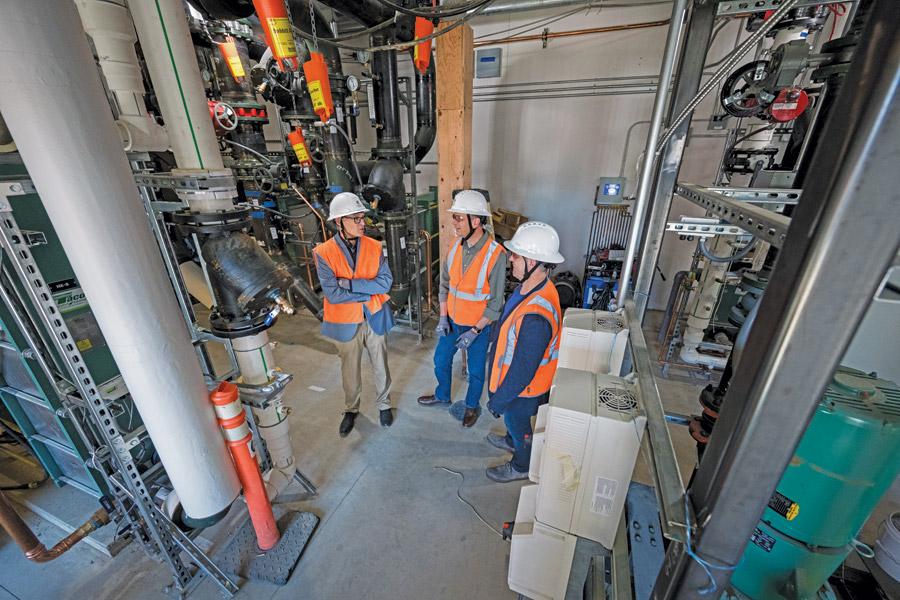
A supercomputer housed within the new complex required crews to connect it to the university’s central utility plant to capture the computer’s heat for energy across campus.
Photo by Karl Maasdam/Oregon State University
Freres Engineered Wood in Oregon, the only U.S. site making mass plywood panels, crafted the material. The company says it uses structural composite lumber with multiple layers of density-graded Douglas fir veneers glued and pressed in a variety of combinations and orientations to create 1-in. layers called lamellas.
“The construction of the Huang Complex is yet another demonstration that mass timber can be used in a building category that has traditionally relied on steel and concrete.”
—Tom DeLuca, Dean, Oregon State University College of Forestry
With the solution in hand, ZGF bid on the project alongside KPFF and Andersen Construction, all with plenty of mass timber in their portfolios. With the complex a flagship and gateway building for mass timber research at Oregon State, the school was fully on board.
“I think it’s highly innovative,” says Tom DeLuca, dean of the Oregon State University College of Forestry. “The construction of the Huang Complex is yet another demonstration that mass timber can be used in a building category that has traditionally relied on steel and concrete—highly sensitive laboratory and research space.”
Solving for vibration and those tight tolerances has propelled the project. “The Huang Complex demonstrates that mass timber can meet those standards,” says DeLuca, who joined the project to help gain the necessary approvals for the mass plywood panels. “In many ways, this project represents the next phase of mass timber adoption in the U.S. It shows that wood can compete not just aesthetically or sustainably, but technically, in some of the most demanding building environments. This project sets the standard for others to follow.”
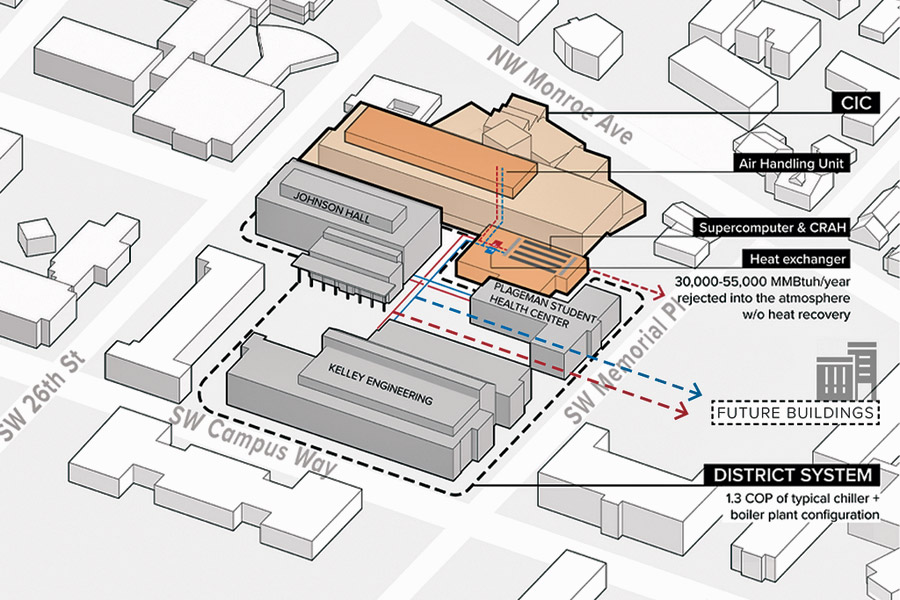
The complex ties into the Oregon State University campus system.
Graphic courtesy ZGF Architects
A Place in this World
Iain Macdonald, director of the TallWood Design Institute, says the use of the mass plywood panel as a structural composite lumber column is one of the first commercial uses of the material, helping to demonstrate the product’s capacity to meet the high-performance standards that the building requires.
“Up until this point in time, the conventional wisdom has been that mass timber cannot be used in these types of lab settings due to the sensitive equipment in them and the deleterious effects of floor vibration upon them,” he says. “The fact that the engineering team was able to solve for this issue opens mass timber to a whole new building typology that can include data centers and life sciences markets, which is fantastic.”
The next major challenge in the design was dealing with all that lab equipment, plus the mechanical and air needs needed to support it all. The team came up with a coordination solution to keep the same floor heights using wood as if they were using a flat concrete. Stacking beams created stiffness that allowed the architects to create natural raceways for mechanical systems.
“It is really organic,” Pajkic says. “It is modular, everything is done on bays. It had to be figured out very early in the process.”
Throughout the design phase, Pajkic says everything involved exploration since it had never been done before. Every time a wood solution was presented to the client, it required real numbers for both cost and functionality, making sure the wood matched the performance of concrete. Then, adding in carbon analysis (the building has the potential for net-zero operational carbon by 2030) allowed the client to make an informed decision and showed that timbers were a feasible alternative.
DeLuca says the university views mass timber through a systems-based lens. “It connects sustainable forest management, wildfire resilience, rural economics, advanced manufacturing and low-carbon construction,” he says. “Using mass timber for the construction of the Huang Complex is important because it reflects the continued mainstreaming of the material.”
Overall, the structure is relatively repetitive. The wood is exposed and daylight washes the interior. The way the system is designed, panels and beams are the norm.
“Using mass timber for the construction of the Huang Complex is important because it reflects the continued mainstreaming of the material.”
—Tom DeLuca, Dean, Oregon State University College of Forestry
The building features four entrances, each leading guests into a world of science on the main floor. The ground floor fills with both common areas and unique lab spaces, some open on the inside to the rest of the building and others facing the streets of Corvallis—including a local pizza parlor. While each entrance offers a unique story and eventually leads visitors to the three-story atrium, it becomes clear that showcasing the power of research—and wood—was part of the plan.
One of those entrances brings people near the school’s supercomputer, one of the more unique lab spaces tucked behind glass so students can see it working.
That supercomputer has its own story. It’s large enough to create an impact on the building’s heat exchange. The design connects the computer to the university’s central utility plant, capturing the computer’s heat to provide energy to dorms and water across the campus. A large glass window allows students to see “science on display” as red and blue pipes show off the heat exchange process.
“As you enter this main space, you see all these different things, the supercomputer, the heat exchange, the work,” Pajkic says. “That was very important, making science and engineering accessible.”
The building’s use of cascading air is distinct. The labs and office spaces have differing air exchange requirements, but the team reduced air exchange needs 30% by moving air from offices to labs, eliminating the need for an extra exit duct.
The complex is about more than wood that can handle vibration, it’s also about celebrating the material. On the inside, the north-facing three-story atrium allows natural light to illuminate the timber. “Once you do the wood building, you should have as much of that wood exposed,” Pajkic says. “We want the wood to glow as much as possible.”
The building rises via a staircase to the second floor. As visitors reach that level and then move on to the third floor, the complex becomes more private at each level, but the wood features continue.
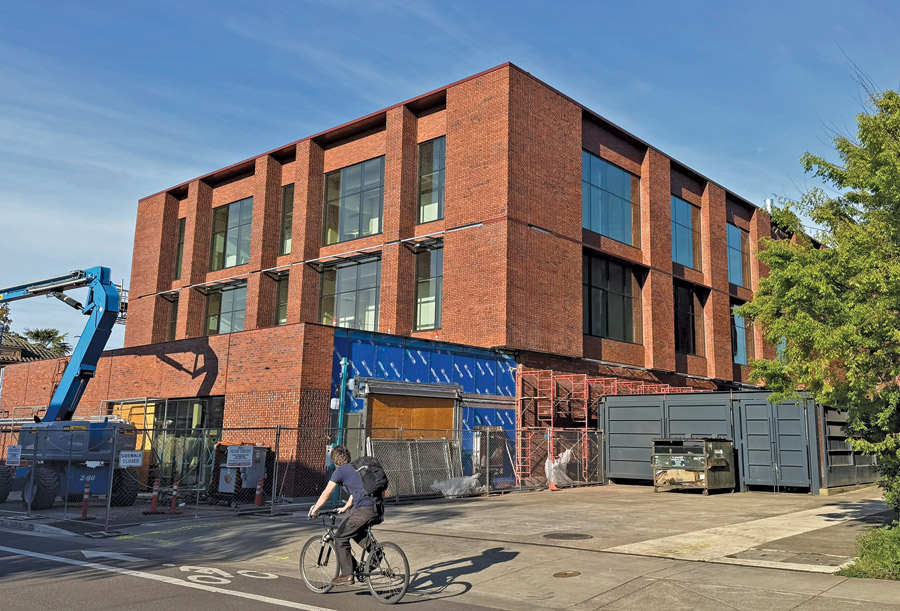
The complex used custom-shaped bricks from Oregon to match the Olmsted-designed master plan of the campus.
Photo courtesy ZGF Architects
Out of the Woods
A significant portion of the timber for the project came from Oregon and the Pacific Northwest, including the mass plywood panels and other engineered wood products, while some CLT components came from British Columbia. Roughly 5% of the timber came from the school’s own research forests just 10 minutes from campus.
“Those forests serve as living laboratories for sustainable forest management and wood utilization research,” DeLuca says, “and having that direct forest-to-frame connection between local sustainably managed forests, regional manufacturing and advanced construction is something we hope to continue expanding in the future.”
Macdonald says it was great to see the wood grown in Corvallis, purchased by Freres and then converted in its facility an hour away only to be brought back to campus.
The celebration of wood happens on the outside too. To match the Olmsted-designed master plan of the OSU campus, the building features custom-shaped bricks from a Gresham, Ore., brick maker as a cost-effective way of doing something different than the standard campus brick. It also adds a layer of texture and scale. Still, the wood is visible, cantilevering out over the brick.
Oregon was the first state to produce commercial CLT panels for structural buildings and is the top softwood producing state with more mass timber and engineered wood product manufacturing facilities than any other state by a wide margin, according to Oregon State University. As the Huang Collaborative Innovation Complex enters the fray, it will not only promote continued mass timber research on the campus but showcase the latest in mass timber innovation.
Oregon State was one of the first U.S. universities to make a major investment in mass timber research and education. The Emmerson Advanced Wood Products Lab opened in 2019 and now features a new fire testing facility under construction adjacent to it. It all positions OSU for unique structural testing, product development and fire performance research, while the TallWood Design Institute allows the OSU College of Forestry, College of Engineering and the University of Oregon School of Architecture to collaborate on new concepts, ideas and products meant to help shape the future of mass timber adoption.
“Knock on wood,” Pajkic says, “it’s pretty cool.”