GE Gets Underway on 13-Acre PCB Landfill in Western Massachusetts
Pending EPA approval, the facility designed by Arcadis will store 1.3 million cu yd of contaminated sediment from the Housatonic River
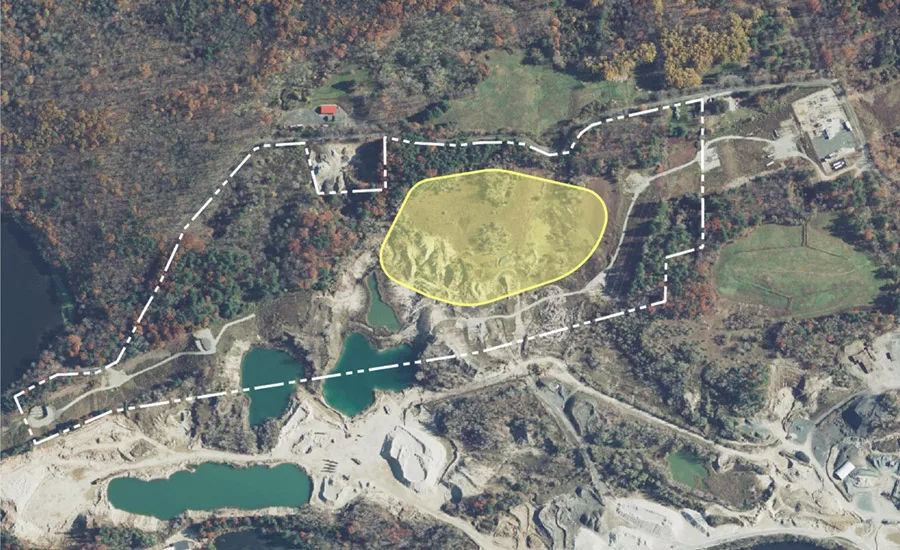
A map shows General Electric’s 13-acre landfill in Lee, Mass., including property boundaries and distance from a 500-year floodplain. The landfill will house 1.3 million cu yd of polychlorinated biphenyls (PCBs)-contaminated sediment from the Housatonic River.
RELATED
EPA Approves 13-Acre PCB Landfill in Western Massachusetts
General Electric predicts that the site will be completed by the end of 2027 and begin receiving sediment in 2028.
PCBs, used by General Electric in manufacture of electrical transformers, were released into the river between the 1930s and the 1970s and have been removed in stages in decades since. EPA banned PCB production in 1979 after uncovering numerous adverse health impacts, including effects on the human immune, endocrine, neurological and reproductive systems.
In 2000, a consent decree required General Electric to clean up the river, and in 2020, the company was ordered to build a new landfill, called the “Upland Disposal Facility."
A General Electric spokesperson said in an email to ENR: “Construction of a modern, safe … facility is a critical first step in implementing the U.S. EPA-approved cleanup of the Housatonic River and its floodplains.”
General Electric is paying for cost of the cleanup, which includes the landfill, but would not disclose that figure.
The landfill was engineered by Arcadis. Preconstruction activities, including tree clearing and fence building, were performed by Pittsfield, Mass.-based firm J.H. Maxymillian Inc., with construction to be performed by Boston-based Charter Contracting Co.
Sited at a former quarry next to Woods Pond, which is adjacent to the river, the facility will receive 50% of its sediment from the pond. Because of the landfill's proximity to the pond, material can be transported through hydraulic transportation, minimizing the need for trucks and trains for much of the project. The site was also selected because it is already highly disturbed, and two other sites considered are heavily forested.
The General Electric spokesperson said the facility is designed with redundant safety features, including clay layers, multiple high-density polyethylene liners, drainage layers and leachate water collection and treatment.
The baseliner system includes five individual liners, which exceeds EPA’s performance standard, which requires two bottom layers, the spokesperson said, adding that the high‑density polyethylene (HDPE) liners are several orders of magnitude less permeable than the performance standard.
“This is a fairly straightforward landfill construction project and we do not foresee any unusual challenges,” said the spokesperson.
Some residents have reservations about the project, including Mike Lucia, a toxicologist who lives in Lenox, a few miles from the disposal facility site. He is concerned about adverse environmental impacts that could result from PCB disposal—including truck pollution from construction and transportation, as well as potential for PCB release into the air.
He hopes that General Electric will be as “careful as possible in the cleanup and the building of the disposal [site] so that people are protected and that the environment is protected.”
Environmental advocates from the Berkshire Environmental Action Team support the continued remediation of the river, arguing that consolidating contaminated sediment in a disposal facility is better for the environment than leaving it in place. But they urge EPA to explore the possibility of in situ bioremediation at the Lee facility and at disposal sites in Pittsfield.
“Hopefully someday, let's go back and clean up those dumps,” said Jane Winn, founding director of Berkshire Environmental Action Team.
.jpg "A conceptual drawing")
A conceptual drawing shows the Upland Disposal Facility processes. In 2000, a consent decree required General Electric to clean up the river, and in 2020, the company was ordered to build the new landfill.
Image courtesy Environmental Protection Agency
The landfill design includes granulated activated carbon in the filtration system to ensure that leachate returning to Woods Pond is clean.
Kevin Sowers, a marine biotechnology professor at the University of Maryland, says bioremediation could also be employed to enhance that process. He co-founded RemBac, a start-up developing technology to treat PCBs in situ. The company produces a bioremediated activated carbon pellet that can “immediately sequester PCBs and keep them out of the food chain,” said Sowers.
These pellets are sprayed with microorganisms that then break down the PCBs, he adds. While this technology will not be used to clean up the river, the same microorganisms could be added to the landfill filtration system. Sowers recommends that the landfill take advantage of a technology like this to treat the leachate that will ultimately exit it. Since the landfill design includes activated carbon, he says that application of microorganisms to that carbon could help break down PCBs that have bound to the activated carbon.
In a statement to ENR, EPA spokesperson Joanne Kitrell said the agency “is currently evaluating use of a bio-amended activated carbon as a potential enhancement to the [landfill that] is in the early stages.”