Southwest Owner of the Year
New Mexico DOT Improves Safety on Highways and Rail Crossings

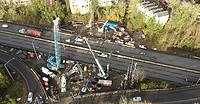
The I-25 Improved project is NMDOT’s largest project in recent history.
An unprecedented boom in the oil and gas industry has fueled New Mexico’s economy—and the New Mexico Dept. of Transportation’s budget. The infusion has propelled major projects and programs not only for highways, but now for rail. With a reorganization and additional funds from the Infrastructure Investment and Jobs Act, NMDOT is embarking on its own construction boom.
“In the past, we’d been tied to resources that were available from federal aid,” says David Quintana, acting secretary for the New Mexico DOT. “Those formula dollars were our ceiling. Often project scopes had to be adjusted to fit the available budget.”

The I-25 improvements are one of several ongoing NMDOT design-build projects.
Photo courtesy NMDOT
When oil and gas revenue started soaring in the state in 2019, it added $1.3 billion for the agency on top of the federal program. Then came the IIJA.
The agency received $2.5 billion for highways and bridges, some $366 million for public transit, around $38 million for electric vehicle charging and $90 million for airports.
“This added funding kept us at pace with construction costs,” says Quintana. But he adds, “We are always needing additional funding.”
In January, the National Transportation Research Group (TRIP) released a report finding that New Mexico roads and bridges that are deteriorated, congested or lack some desirable safety features cost the state’s motorists a total of $3.3 billion annually—as much as $3,061 per driver in some urban areas—due to driving on rough roads, congestion-related delays and the costs of traffic crashes. NMDOT has identified $7.5 billion to fully address its state of good repair needs.

NMDOT has identified $7.5B to address its state of good repair needs.
Photo courtesy NMDOT
A state senator is sponsoring Senate Bill 2, which would provide $1.5 billion in funding bonds over 20 years for NMDOT to address the most urgent highway and road needs.
In the meantime, the agency has several projects ongoing or on the horizon:
- I-25 Improved, Comanche to Montgomery project
The largest construction project in recent history, the $268-million design-build effort is expected to last through spring 2027. NMDOT is replacing aging bridges and modernizing interchanges between Comanche Road and Montgomery Boulevard. Construction began in 2024 and is expected to continue through 2027.
- US/Mexico Border Highway Connector
The Border Highway Connector is a roughly $170-million highway project designed to build a new four-lane roadway and bridge in Doña Ana County. It will reduce travel times, improve freight movement near the Santa Teresa Port of Entry and strengthen economic development tied to cross-border trade. The project is in the planning phases.
- Nogal Canyon Bridge Replacement
The Nogal Canyon Bridge Replacement project is a $142-million interstate infrastructure upgrade. The project proposes replacing the existing I-25 truss bridge over Nogal Canyon at mile marker 107 with two new bridge structures. The proposed improvements include a cast-in-place, segmented concrete girder bridge and roadway enhancements that include improving slope stability.
- Taos Gorge Bridge Raising Rails Project
The Taos Gorge Bridge Raising Rails Project is an estimated $8-million safety upgrade to increase the height of the bridge’s railings in order to prevent suicides and enhance safety at one of New Mexico’s most iconic landmarks.
“The public’s safety is at the forefront of NMDOT’s decision-making,” says Gabby Contreras-Apodaca, principal for transportation at Stantec. The firm recently completed a study for NMDOT of the US 285/NM 31 crossing, which has significant truck, vehicle and rail traffic.
“When embarking on this project, Stantec’s data showed that improvements would significantly increase safety for the traveling public,” Contreras-Apodaca says. “Although Eddy County was the initial project partner, NMDOT chose to participate in the project and collaborate with Eddy County to make that intersection safer. During our work, NMDOT provided quick, positive feedback and stayed in regular communication with Stantec on design efforts.”

A trip study found that road deficiencies cost New Mexico $3.3B a year.
Photo courtesy NMDOT
Embracing Partnering
NMDOT has created regional design centers in its infrastructure division centered on the southern, central and north regions, says Quintana. “As our program increases, we are looking more at alternative delivery methods” such as design-build and construction manager-general contractor.
“It’s appealing to work with a DOT like [NMDOT].”
—Michael Moehn, Vice President, Fisher Sand & Gravel
Two decades ago, NMDOT—then called the New Mexico State Highway and Transportation Dept.— brought the spirit of alternative delivery to its “Big I” project in Albuquerque. While legislation for alternative delivery did not yet exist, the principles of partnering between owner, designer and contractor allowed for the $289-million reconstruction of a convergence of Interstates 41 and 25 to be built in just 24 months. The I-25 Improved is the agency’s largest project since the Big I, and the largest design-build effort out of three in its history, says Quintana.
“We were the first local contractor to get this design-build job from NMDOT,” says Patrick Shaw, vice president of operations with AUI Inc., the contractor. “It’s been a great experience. We’ve worked with NMDOT for quite some time, partnering even before design-build.”
Michael Worrall, senior program management procurement engineer at Horrocks, working with AECOM and AUI, adds: “Our role started long before construction began. We’ve been working as an augmentation of DOT staff. We’ve been functioning as one team to deliver the project.”

The project to improve Comanche Road and Montgomery Boulevard will continue through 2027.
Photo courtesy NMDOT
Mike Moehn, vice president of Fisher Sand & Gravel, says the contractor is currently working on four or five different projects with NMDOT, including the $30-million Raton Pass.
“It’s really a partnership between the contracting community and NMDOT, from the legislative process all the way through bidding work and the construction and completion of the work,” he says. “We’ve never had a problem with them that we couldn’t work out at a low level—or, if we have to escalate it, it gets worked out fairly quickly. It’s appealing to work with a DOT like that.”
As design progressed on the 285/NM 31 crossing, Stantec found conflicts regarding a gas line and a nearby project, Contreras-Apodaca recalls. “Ultimately, this all required realignment at NMDOT’s direction late in our design. Thanks to the communicative nature of our partnership, we were able to make necessary changes with minimal disruption, and they were quick to compensate for the changes. Their responsiveness and willingness to take ownership of the redesigns helped the project move forward,” she says.

NMDOT’s rail program includes improving grade crossings.
Photo courtesy NMDOT
Evolving from Within
The agency was renamed in 2003 to reflect its broader transportation role. “A lot of DOTs used to be highway departments,” notes David Harris, modal programs executive director. “Then there was an evolution into [truly multimodal] transportation departments.”
NMDOT’s evolution is reflected by its 20-year state rail plan. This year, the agency finalized the first four years of that plan, intending to spend $283.1 million on grade separation projects such as:
- Gallup, with $44.89-million in Federal Railroad Administration funding and a start date to be determined.
- Texico, with $73 million in FRA funding, anticipated in 2030 in partnership with the Texas Dept. of Transportation.
- Santa Teresa, with $37 million in FRA funding. Design is now underway.
- Clovis. The FRA awarded $1 million for project design, which is now underway.
- Farmington Freight Rail Connection. NMDOT continues planning for a proposed new freight rail link connecting Farmington to the national rail network.

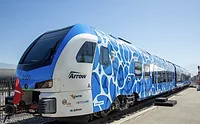
Expanding commuter service is one of NMDOT’s long-range goals.
Photo courtesy NMDOT
“We will take a look at expanding Rail Runner frequency and ways in which Amtrak service may be increased,” says Harris, noting that the state has a “huge freight network, considering how rural we are, and 100 miles of commuter rail.”
Quintana adds, “We are starting to go down the road of digital delivery,” with the goal of addressing the life cycles of infrastructure. The agency also has some $4.5 million in funding for Vision Zero pedestrian safety goals and is incorporating principles of Envision for resiliency and sustainability goals.