Intermountain Owner of the Year
St. Luke's Boise Health System Invests in Downtown Campus

A new entrance is just part of the $1.2-billion expansion at the flagship Boise hospital. A new patient tower, more operating rooms and additional medical office and clinic spaces are all under construction.
St. Luke’s Hospital in Boise has been operating nearly as long as Idaho has been a state. In 1902, St. Luke’s began as a six-bed frontier hospital in a downtown Boise cottage. Since then, the hospital has grown into a regional nonprofit health care system and community institution drawing patients from around the state as well as northern Nevada and eastern Oregon.
With its iconic red brick buildings and seven-story central tower, the campus is an instantly recognizable landmark in the capital city. Today, construction cranes, excavators and pump trucks have joined the familiar buildings as the health care provider prepares to serve the growing community into the next several decades.
The largest private employer in the state, St. Luke’s is currently in the midst of one of the largest construction projects in the region, the $1.2-billion, 860,000-sq-ft expansion of its Boise facilities known as the Downtown Commons Improvement Plan. The project includes a nine-story patient tower that will add 80 patient beds, bringing the facility’s total count to 500. There will also be shell space for adding up to 133 beds in the future.
Led by Sandy, Utah-based Layton Construction, the project’s construction manager at-risk, the expansion also includes seven new operating rooms for a total of 28 and a connected medical office building with 170,180 sq ft of space for health care providers.

Locally fabricated steel supports the nine-story patient tower. Construction crews have worked to minimize noise and disruption next to the still functioning hospital.
Photo courtesy of Layton Construction
Construction broke ground in 2024, with some smaller preparatory projects taking place in 2023. Construction of the hospital tower and medical office plaza is anticipated to run through 2029, with a projected opening of patient care in 2030. The current expansion project was preceded by the 2019 construction of the Children’s Pavilion for pediatric services and the new parking garage and utility plant in 2021, all located on the downtown site.
St. Luke’s health care system operates six hospitals and nearly 200 clinics across the region, but most high-level services like cancer care, pediatric specialties and cardiac surgery are concentrated at the Boise campus, says Dennis Mesaros, St. Luke’s vice president of population health for Boise, Elmore and McCall.
While the downtown campus is the largest St. Luke’s project underway, it is just one of several recent projects undertaken by the health care system. In 2025, St. Luke’s opened a 330,000-sq-ft consolidated service center in nearby Meridian that centralizes its supply chains, distribution and pharmacy services. The St. Luke’s hospital in the resort community of McCall, north of Boise, received a 70,534-sq-ft expansion and renovation in 2023, and a new clinic was opened in the growing city of Nampa just west of Boise in 2024.
In 2025, St. Luke’s reported operating revenue of around $4.5 billion, with the flagship Boise hospital having the highest patient revenue at just over $1 billion. Mesaros says the expansion is being funded through existing resources and bonds issued by the health system.
“Reinvesting in our communities is a significant part of the work we do,” says Sandee Gehrke, St. Luke’s executive vice president and chief operating officer. “St. Luke’s is committed to providing all patients with the highest quality health care, regardless of their ability to pay.” Last year the health system provided “$1.8 billion in community benefit, including $272 million in capital improvements, $176 million in community services and programs and $36 million in charity care,” Gehrke adds.
The Boise campus expansion was in the planning and approval process as the area experienced a population surge beginning around 2010, placing it among the fastest-growing metropolitan areas in the country. Idaho’s population is predicted to double by 2040, says St. Luke’s spokesperson Christine Myron.
“When you look at the growth we’ve had, we just don’t have the inpatient capacity that our population needs,” says Mesaros. “We are the seventh most under-bedded community in the country [and] don’t want people to have to leave our communities for care.”

Hemmed in by city streets and existing buildings, the construction team is paying extra attention to coordinating material deliveries.
Photo courtesy of Layton Construction
Planning and Preparation
St. Luke’s retained Salt Lake City-based design firm Architectural Nexus and Boise-based Hummel Architects for master planning, programming and design of the expansion project, which was approved by the city in 2015.
Kelly Schreihofer, principal health care planner for Architectural Nexus, says the design firm has a 20-year history of work with St. Luke’s and has designed projects in Magic Valley, Nampa and Meridian.
“For the Downtown Commons Improvement Plan, our work began in 2009 with comprehensive master planning efforts for the Boise campus,” says Schreihofer. “Since then, the project has advanced through a series of carefully phased implementations, each contributing to the long-term reenvisioning of the campus. The goal has been to modernize and integrate facilities while maintaining continuous operations in a dense urban environment.”
St. Luke’s turned to the building team not only for design and construction of the additions but also for help preparing for how the hospital would operate in the future.
“One of the primary challenges was aligning service lines across floors and buildings,” says Schreihofer. “In the existing campus, clinical groups were often dispersed, sometimes across multiple buildings. By reorganizing and co-locating services, the new design improves patient experience and supports a more integrated, modern care model.”
“There were a lot of ‘make ready’ projects just to facilitate this phase we are in now,” adds Jeremy Hobbs, vice president with Layton Construction, including demolition projects, moving some hospital operations to make way for tie-ins and placing “a connector bridge over an existing building before we started the mass excavation.”

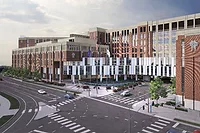
The East Tower will house 80 patient beds and maintain the familiar red brick look of the long-established community hospital.
Rendering by Architectural Nexus
Tight Spaces
Surrounded by city streets and the existing hospital facilities, there was no room for worksite trailers. The Layton team built out space on Levels 4 and 5 of the adjacent parking terrace to serve as its offices, says Layton construction manager Patrick Kelly.
“Architectural Nexus is right next to us, and there is room for all the trade partners [as well as] St. Luke’s planning and design team,” Kelly says.
The teams meet daily to ensure constant coordination, and “having us all together on site helps with collaboration,” he says.
Hobbs says significant effort goes into minimizing disruption to regular hospital operations to avoid disrupting patient care and the healing process.
“We have to prioritize patient health. You always need to be aware you are building right next to a functioning hospital, and that means being aware of noise, vibrations, smells, everything. [The construction work] is an orchestrated event, and we work with the St. Luke’s team to make sure we do the best we can.”
Hobbs says the building team regularly makes changes to the work schedule and coordinates the delivery of materials to minimize the impact on hospital operations. Prior to beginning construction, extra panes of glass were added to patient rooms to dampen the sounds of construction, and work can be paused if things like vibrations are found to be disrupting surgeries or the operation of equipment in the hospital, Myron adds.
Schreihofer says one of the “make ready” projects prior to construction was the relocation of MRI services. “Their MRI suite was right up against our construction site, so we built a new MRI facility on the other side of the campus so there wouldn’t be a disruption in services. At one point we had to demolish a stairway that was up next to the cardiovascular surgery. There were months of planning to shift [the hospital] schedule a couple days a week, and then we worked 10- or 12-hour shifts Saturday through Tuesday so we weren’t working during surgery hours.”
The hospital has committed to the Health and Human Services Health Sector Climate Pledge, a voluntary commitment to reducing emissions and building resilience in health care organizations. New energy efficient mechanical systems will help reduce emissions, and steel for the project was fabricated in the Treasure Valley to reduce the shipping distance.