Legacy Awards
ENR Texas & Louisiana Legacy Award Winner Michael Morris has Championed North Texas Transportation

Michael Morris speaks at the 2017 ribbon cutting for the $1.4B 35Express project that improved 26 miles of I-35E between Dallas and Denton.
Over the past four decades, North Texas has enjoyed a degree of growth that few regions in the country can match. The Dallas-Fort Worth metropolitan area boasted 3.2 million residents in 1990. That total has almost doubled to 6.7 million today, and the wider 12-county region now holds approximately 8.6 million.
As transportation director for the North Central Texas Council of Governments (NCTCOG), Michael Morris has been at the center of the effort to keep this widely spread, fast-growing area connected.
Today, the region boasts almost 50,000 miles of roadway that support more than 238 million miles traveled daily. There are three major transit systems that include 93 miles of light rail and more than 100 miles of commuter rail.
His success in helping to bring this about once prompted State Sen. Royce West of Dallas to describe him as “the Tom Landry of regional transportation,” a nod to the legendary coach of the Dallas Cowboys.
Morris’ mantra for meeting that challenge is simple: “Stay focused on your outcomes. Try to build partnerships. Continue to have communication and bring data to the table.”
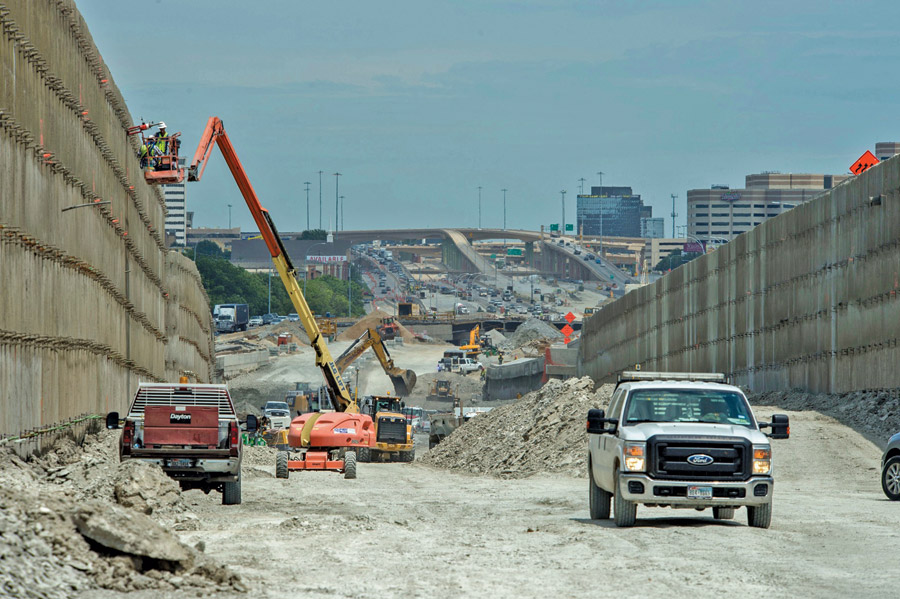
The $2.7B expansion of I-635 in North Dallas was delivered using a PPP-financed managed lane model.
Photo courtesy LBJ Express
Highways and Heartaches
Last December, Morris announced he would step down as NCTCOG Transportation Director and transition to an advisory role with the organization. A timeline for the change has not been set.
"It will be hard to find a person of high caliber to fill Michael's shoes", said Texas Rail Advocates President Peter LeCody in a statement. "He was able to apply for and squeeze every nickel possible out of billions of dollars of federal and state grants for rail, road and air projects to benefit the North Texas economy. “
NCTCOG is a federally designated Metropolitan Planning Organization (MPO), and its executive board sets policy for regional comprehensive planning and coordination. The Regional Transportation Council (RTC) serves as a policy board that guides decision-making on the region’s transportation needs.
Morris and his team evaluate the region's transportation needs and compile available funding sources. The most recent version of this analysis is exemplified in NCTCOG’s Mobility 2050 plan. Then, working with the RTC, projects are prioritized and pursued, with Morris often emerging as the public champion pushing them forward.
“As far as a partnership goes, he's recognized as the leader nationwide,” says Bill Hale, former Chief Engineer with the Texas Department of Transportation (TxDOT). “We [the TxDOT Dallas District] had partnerships on all the funding of our programs, and that’s not always the case in other places.”
Morris, Hale notes, would work closely with all the government agencies affected by a project to nail down all available funding sources and build consensus to keep the process moving forward. As a result, North Texas projects often found themselves better prepared to take advantage of opportunities than other regions that were less organized or foresighted.
“I think in other communities they lose the momentum on these critical projects. But that's not our history,” Morris explains. “Our history in our region is that we stay focused until we get the project across the goal line.”
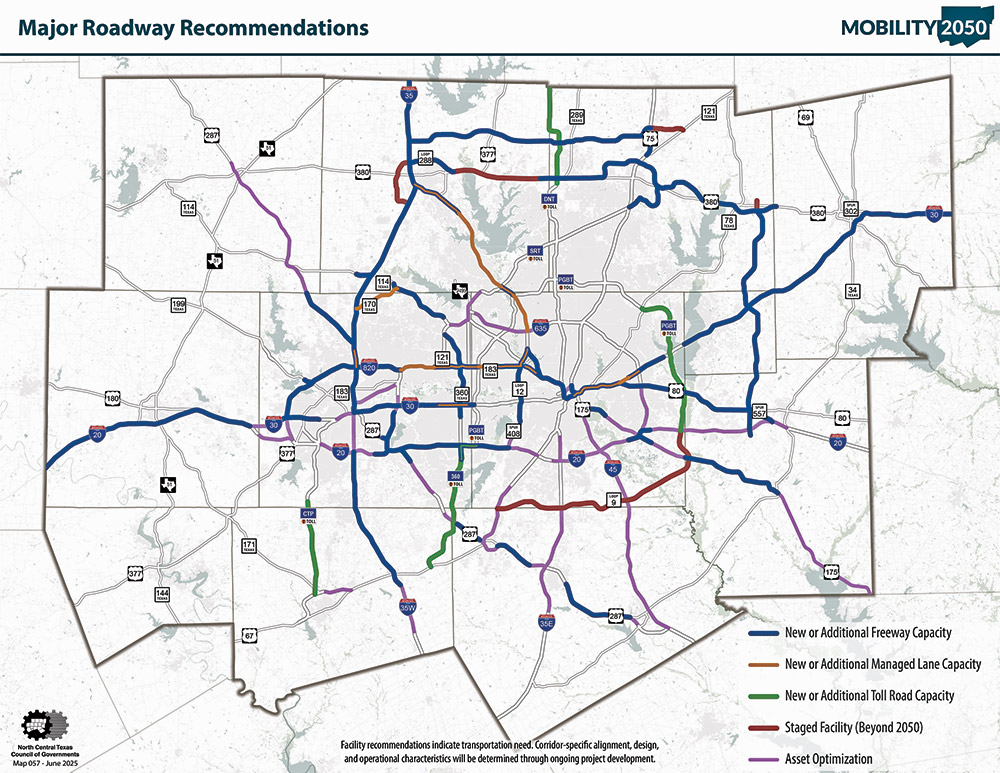
More than 12.3 million people are projected to live in the 16-county North Texas region by 2050, and efforts are already underway to provide the robust transportation network that will be required.
Map courtesy NCTCOG
*Click on the map for greater detail
Gone to Texas
In 1979, Morris graduated with a master’s in civil engineering from the State University of New York at Buffalo in 1979. During his studies, he served on a committee for the Transportation Research Board, where he met an NCTCOG assistant director.
“So, I sent him a note about applying for a job and got an interview,” Morris said. “I graduated in May, [got] married in August, and moved to Texas in September of 1979.”
His first job at NCTCOG was as an entry-level planning engineering position. He found that his interest in data analysis dovetailed well with the organization's growing needs.
Unlike more built-out urban areas on the East Coast, North Texas required forecast models to determine where the future roadways should be constructed. It was the perfect opportunity for the young engineer whose master’s thesis was a combination of engineering and physics
“A lot of these facilities need very detailed analytics to forecast demand,” he says. “And my background was in analysis, software and traffic simulation.”
Morris found himself putting together traffic simulations for the contentious and complicated expansion of North Central Expressway (U.S. 75). The critical highway, which terminates in Dallas’ downtown, had been overwhelmed by traffic by the mid-1980s.
His simulations showed that one critical east-west connection at Mockingbird Boulevard needed to be expanded. The problem was that the nearby residents were adamantly opposed to the idea.
Morris was called to make a presentation that made the case for the larger intersection using his simulations as evidence of the approach.
“And, obviously, that presentation didn't go very well,” he says with a chuckle.
Instead, the setback became an exercise in consensus-building. Rather than letting the controversy hold up the effort, the decision was made to depress the main lanes of the expanded expressway and cantilever the frontage roads overhead. The new highway then fit within the footprint of the old one, minimizing impacts on the adjacent neighborhoods.
The colossal $750 million project was completed in December 1999.
“It taught me an early lesson about different viewpoints and how you can maximize outcomes,” he explained. “The expression I use is you try to put as many ornaments on the tree as you possibly can.”
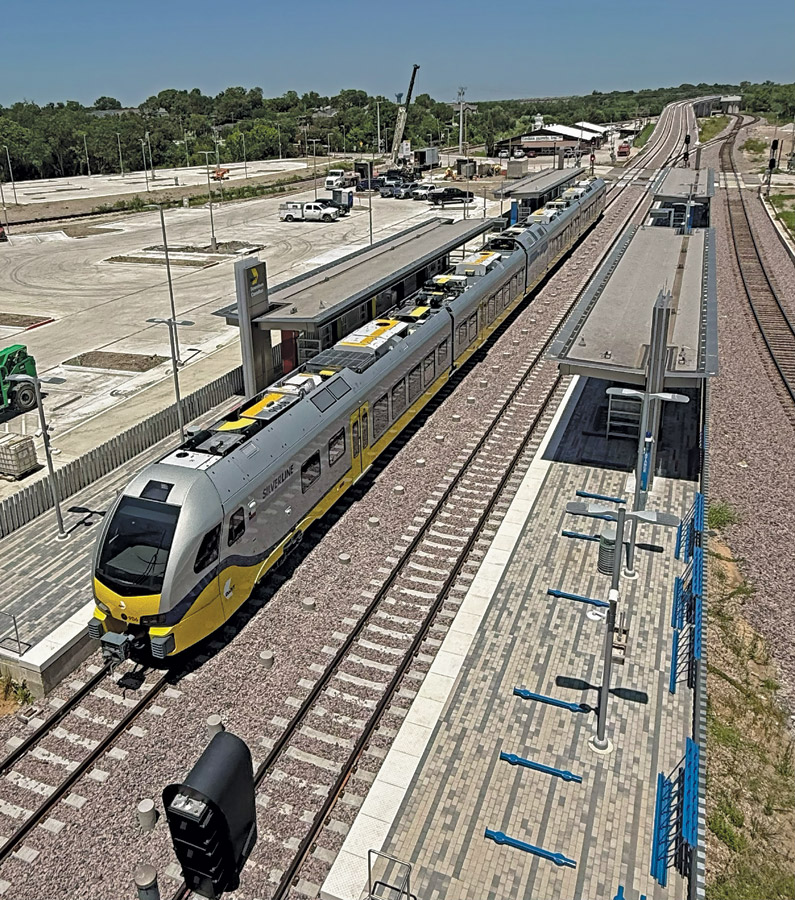
Transit projects, such as the recently completed DART Silver Line commuter rail and proposed high-speed rail lines, will be increasingly important to the region in the future, Morris says.
Photo by Ruben Landa/WSP
It's Not Big, It's Large
Morris was named NCTCOG’s Transportation Director in 1990. Again, the timing was fortuitous. The demographic growth of the region continued to accelerate, creating a renewed investment in transportation, but the way it would be planned was about to change.
In 1991, the Intermodal Surface Transportation Efficiency Act (ISTEA) focused on improving transportation to achieve important national goals, including economic progress, cleaner air, energy conservation, and social equity.
MPOs emerged as the primary tool to implement those initiatives. Their funding and authority were substantially increased, and they emerged as a key means for agencies and municipalities to cooperatively navigate the thicket of regulations governing federally funded projects.
He also found a role mitigating conflicting resources and priorities among the regional governments and agencies, a role he once described as a “marriage counselor.”
ISTEA also required increased public participation in the planning process, which dovetailed well with Morris’ “Christmas Tree” approach. The increased transparency helped with the consensus-building he had learned was critical for success.
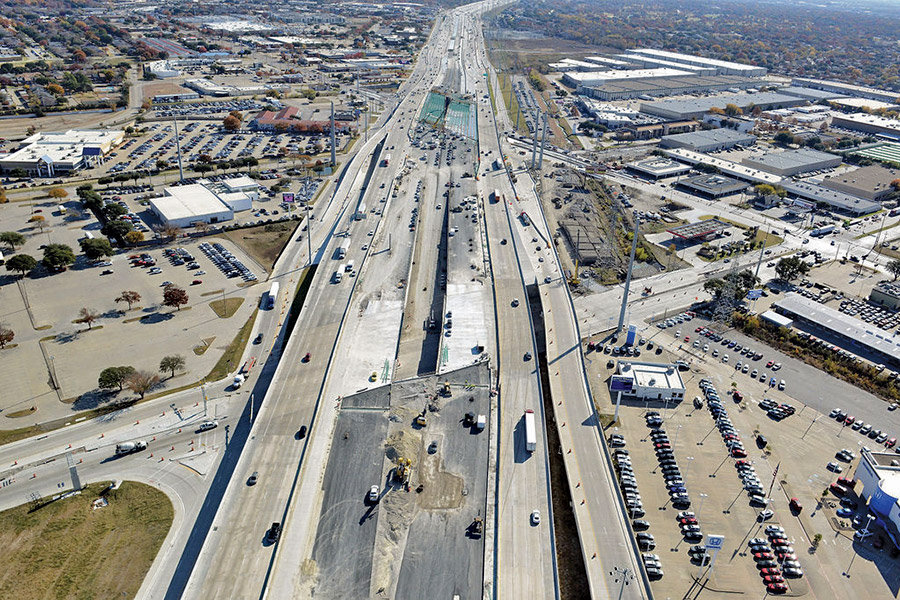
The $1.6B LBJ East project, scheduled for completion next year, is a testament to Morris’ consensus-building approach.
Photo courtesy Pegasus Link Constructors
If You've Got the Money, I've Got the Time
Two projects that stand out as examples of Morris’ leadership are those to expand the northern portion of Dallas’ ring road, Interstate 635 (which is also known as the Lyndon B. Johnson Freeway and referred to locally as “LBJ.”)
As planning for the LBJ Freeway Reconstruction, which covered the western section of the highway intersecting I-35E, began, the state was experiencing a funding squeeze. The solution was to reach out to the private sector and finance the project through a Public-Private Partnership.
Once the funding was secured, Morris went to work building a consensus for the project. Immediately, he ran into a similar issue to the one he had seen on the North Central Expressway: residents and officials opposed a wider road that would affect their neighborhoods.
“We went out to the community, and I used the phrase “No higher. No wider,” he says. “It took time, and there wasn’t buy-in right away, but when they saw the road would be in the same footprint, they said OK.”
The $3 billion project, featuring toll lanes beneath the main lanes and frontage roads, was completed in 2015. It became the standard bearer for regional PPP projects, and more than 250 miles of TEXpress Lanes opened on select corridors across the region
Yet the political mood in the state shifted against tolling drivers to fund roadways, and the last PPP project approved by the legislature came in 2017. That limited funding options for the 11 miles of I-635 east of US 75 that touch the cities of Dallas, Garland and Mesquite are still in need of upgrading.
“We promised these communities this would be built, and we were 10 to 15 years late,” he recalls. “I went to the [TxDOT] Dallas district and told them we had to take it back and get it moving.”
Then, just as with the earlier LBJ project, Morris and his team worked to build local consensus and develop project champions who could appeal to state leaders for assistance. That support paved the way for the RTC to reallocate funding to the projects and convinced state legislators to contribute as well.
Instead of a tolled road, the road featured managed lanes—individual tolled lanes were separated from the free general-purpose lanes by a barrier. With funding secured and with the political momentum from public support, that project moved forward as well.
“The community wanted to have the choice of using the tolled lanes or not,” Morris says.
Work on the $1.74 billion expansion, which started in 2020, is slated for completion next year.
A sampling of the massive projects planned, constructed and completed during Morris’ tenure includes the following:
- North Tarrant Express: a $2 billion effort to modernize and expand highways around Fort Worth.
- Dallas–Fort Worth Connector: a $1.5 billion project to increase the capacity of highways north of the DFW airport.
- High Five Interchange: A $261 million 5-level stack interchange connecting North Central Expressway and I-635 in North Dallas.
- I-35E Managed Lanes: A $1.4 billion modernization of I-35E between Dallas and Denton was completed in 2017.
- Chisholm Trail Parkway: The $1.4 billion, 27-mile toll corridor for one of Fort Worth’s critical commuter routes.
The Road Goes on Forever
By 2050, the North Texas region’s population is expected to surge more than 43 percent to an estimated 12.3 million residents, more than 400 people every day. NCTCOG projects there will be approximately $217.3 billion in funding to meet the region’s transportation needs at that time.
The plan calls for $217.3 billion in road, rail and air quality improvements for the North Texas region to serve the projected 12.5 million residents by 2050. Mobility 2050 also emphasizes multimodal solutions, congestion management, and equity in underserved communities, aspects of transportation often overlooked in the region.
“He's been building highways while at the same time trying to lay the framework for this multi-modal solution to take root,” says Brendon Wheeler, the executive director of the Alamo Area Metropolitan Planning Organization and former NCTCOG staffer. “I think he has been a visionary leader, to be honest.”
Morris says he foresees a point at which the region will have to place greater emphasis on transit rather than roadbuilding to meet its transportation needs.
“We have this whole network of regional rail moving ahead,” he says. “The whole legislative program the RTC is working on is this network of regional rail connecting our cities to our airports and connected to our high-speed rail.”