Data Centers
Former Fed Uranium Enrichment Site in Ohio Is Set to Be Data Center-Power Megaproject
New project is set for former Portsmouth Gaseous Diffusion Plant complex in Piketon, opened in 1955 but now being decommissioned
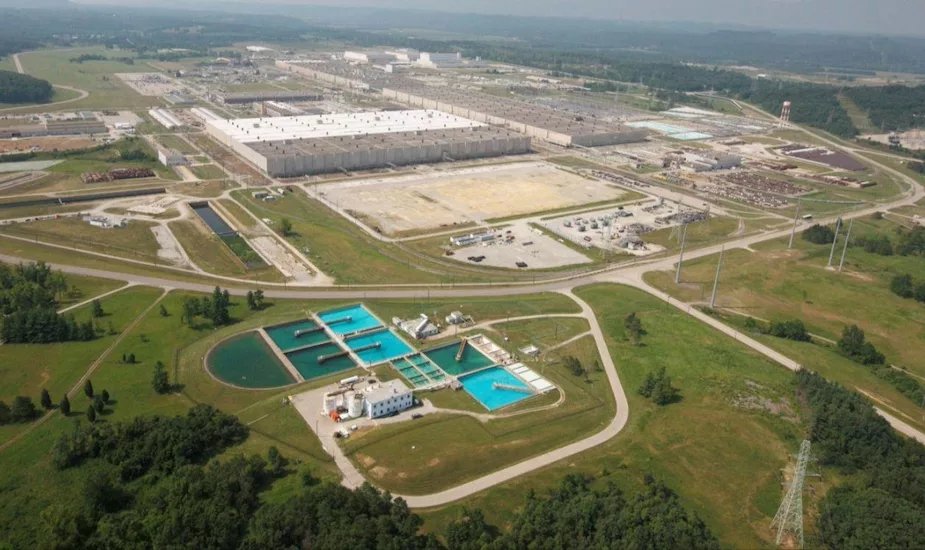
Former 3,700-acre federal uranium enrichment facility in Ohio now being decommissioned will be site of planned 10 GW data and new fossil fuel power plant
A massive 10-GW data center, along with 10 GW of power generation capacity— 9.2 GW of which would be natural gas generation, is moving forward on the site of the former Portsmouth Gaseous Diffusion Plant, a long-shuttered uranium enrichment facility in Piketon, Ohio, near Columbus.
Bechtel and Kiewit Corp. have been tapped for the project, called the PORTS Technology Campus, that is planned to meet surging AI‑driven energy demand. Construction is expected to start this year, according to the U.S. Dept. of Energy, which owns the 3,700-acre site. The firms are among members of the Portsmouth Consortium, which will participate in development.
The two firms, which rank No. 2 and No. 3, respectively, on the ENR 2025 Top 400 Contractors list, will provide engineering, procurement, construction and other services to build power plants, substations and transmission systems. The site already has existing high-voltage power lines in place.
The project is part of a public-private partnership with DOE, the U.S. Dept. of Commerce, SoftBank, and AEP Ohio to redevelop the site, modernize energy infrastructure, and develop advanced computing in southern Ohio, according to DOE.
The partnership was announced in October 2025 as part of a U.S.-Japan strategic trade and Investment agreement, which includes about $33 billion in Japanese funding for 9.2 GW of new natural gas generation and also calls for a major expansion of U.S. energy exports to Japan.
Japan had committed previously to investing $550 billion in the U.S. including $332 billion for U.S. energy infrastructure.
“The Portsmouth Consortium is a powerful signal that the market is moving from AI ambition to AI execution, anchored in the infrastructure that makes it real,” said Catherine Hunt Ryan, president of Bechtel Manufacturing & Technology.. The Portsmouth Gaseous Diffusion Plant opened in 1955 to support the U.S. commercial nuclear power mission through production of enriched uranium, according to a DOE website. It closed in May 2021 when DOE began decontamination and decommissioning.
Also part of the Japan trade deal last year is a new U.S. Commerce Dept. announcement that Japan could fund up to $33 billion for natural gas power projects in east Texas and in Pennsylvania's shale gas region jointly owned by the two countries, with NextEra Energy as operator. The Pennsylvania project would support up ro 3.5 GW of large load demand, with the Anderson County, Texas project set to power up to 5GW.
In addition, GE Vernova-Hitachi, s joint venture between the American and Japanese manufacturers. could gain up to a $40 billion ivestment on advanced nuclear power small modular reactors at the site of former power plants in Tennessee and Alabama that would generate about 3 GW of power. Projects would use the GE Vernova-Hitachi 300-MW BWRX-300 SMR model for a smaller version of large scale boiling water reactors built in the past.
The U.S. Nuclear Regulatory Commission now is reviewing a construction application from the Tennessee Valley Authority for the BWRX-300 at the utility’s Clinch River site in Oak Ridge, Tenn. The agency has said a decision is expected by the end of 2026..
Separately, Japan's government said that Mitsubishi Materials Corp. and Mitsubishi Corp. will be part of rare-earth mining and recycling projects in Indiana and Arizona, while Japanese companies could invest in an Albemarle Corp. lithium-ion project in North Carolina.
Investment bank Jefferies said that U.S. nuclear deployment depends on "federal and allied support," adding that the administration announcements "reinforce this and highlight [its] commitment to nuclear.” But, the bank said, the NextEra projects are “contingent on securing power customer offtake — i.e. [data center] hyperscalers."



.webp?height=200&t=1740697566&width=200 "EPA.Line5 Worker_tight_-_Enbridge_Oil_Spill_pipeline_removal_2_(4869018519).jpg")