MidAtlantic Legacy Award Winner Leo Titus Jr.: Virginia Engineer Shares 9-11 Experience to Inspire
Leo Titus Jr. stepped into the smoky, dark, smoldering Pentagon illuminated only by glowing embers and flashlights following the Sept. 11, 2001, terrorist attack as a rookie on the Fairfax County, Va., Urban Search and Rescue Team. He was helping to shore and stabilize areas where first responders and investigators needed to work. His team leader told him to guard his “only pen” to distract Titus from the carnage. “It was surreal, because I didn’t know what I was doing,” says the 56-year-old civil engineer who at the time did not realize how his life and career would add a parallel track.
Before Sept. 11, Titus was already a leader at geotechnical and environmental design firm Engineering Consulting Services Ltd., Chantilly, Va., serving as chief operating officer of the firm that ranks at No. 66 on ENR’s 2025 Top 500 Design Firms list with $453.8 million in prior-year revenue and a current staff of more than 3,000 in regional businesses across the U.S. The ECS MidAtlantic unit ranks at No. 35 on ENR East’s 2025 Top Design Firm ranking, reporting $152.25 million in 2024 revenue.
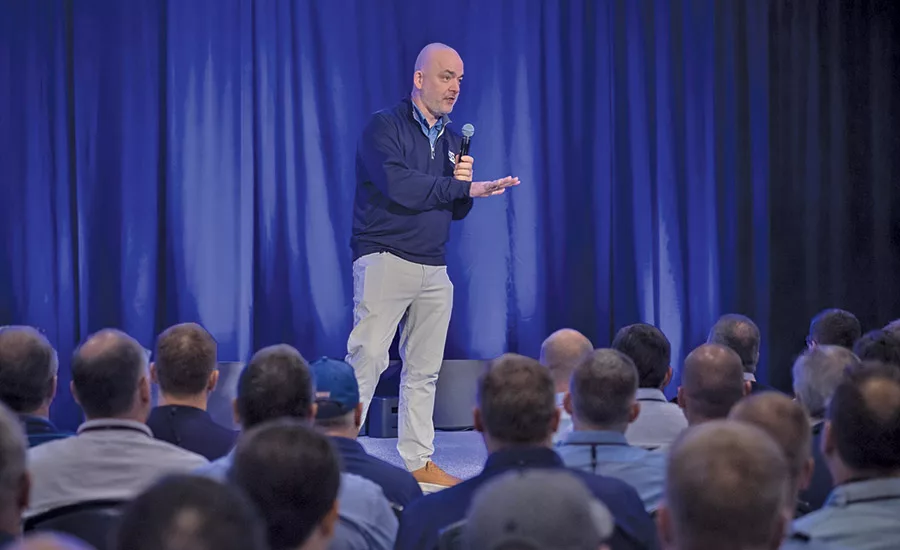
In addition to his corporate duties, Titus has spent significant time since Sept. 11 touring the U.S. to recount that experience. “I have been giving presentations around the country since October 2001 sharing that story,” he says.
“I’ve done it for 10 people; I’ve done it for 1,000 people,” Titus says. He also faced a personal challenge in becoming a single father to three young children after his first wife, Jennifer, died of cancer in 2003 at age 34.
Matt Kroll, vice president of land entitlement at Ashburn, Va.-based construction and development firm Timber Ridge Management, says Titus is successful because “his character and values lead him in all areas of his life.” Kroll, who has worked with Titus on Northern Virginia residential and mixed-use developments for 20 years, says he “leads with heart and a zest for life. He is genuine and authentic, no matter the environment.”
Civil Engineering Odyssey
Growing up in Saratoga Springs, N.Y., the son of a teacher and food service worker, Titus says he was inspired by the movie 2001: A Space Odyssey to study mechanical engineering at Clarkson University in upstate Potsdam, N.Y., with dreams of building space stations. After struggling to wrap his brain around “rigid body dynamics” in one of his early courses, Titus says a summer job assisting masons in sidewalk and building construction led to a switch to civil engineering, where “everything stood still … and I was good at statics,” he recalls.
He changed majors only to graduate into the 1991 recession, but still landed a geotechnical engineering job in Baltimore. Joining ECS in 1997, Titus worked his way up to both company and industrywide leadership roles. He was elevated to the COO role in 2021 from a previous spot as MidAtlantic unit president and served as president of the Geoprofessional Business Association in 2022-23.
“Leo is a thoughtful, values-driven leader who consistently brings strategic vision, inclusive leadership, humor and hard work to every room he’s in,” says Joel Carson, the group’s CEO and executive director.

Leo Titus (left) had his first mission with the Fairfax County, Va., Urban Search and Rescue Team at the terrorist-damaged Pentagon in the wake of the Sept. 11, 2001, attack.
Photo courtesy Leo Titus
Pentagon Rebuild
As a young manager, Titus butted heads with an older employee. After discovering the employee was passionate about field qualifications, Titus empowered him to create a company training program. Titus was eventually invited by the employee to join the county search and rescue team and completed Federal Emergency Management Agency structural specialist training one month before the Sept. 11 attacks. He spent about one week at the Pentagon with the team before ECS, which had already been working on the building’s renovation program, turned its attention to the actual reconstruction.
“Leo is successful because his character and values lead him in all areas of his life.”
—Matt Kroll, Vice President, Timber Ridge Management
The company’s project scope included determining building elements to be retained and removed. Analysis involved “looking at concrete under a microscope to get a sense of the heat and fire and how badly the concrete was damaged,” Titus says.
ECS also verified foundations for a heavier redesign, including pile load testing. Running the firm’s concrete laboratory at that time, Titus oversaw field testing and inspections. “We set up a concrete testing laboratory right there at the heliport, and we were testing concrete around the clock,” he says.
Crews demolished 500,000 sq ft of Pentagon concrete in late October 2001 before replacing it with new material in mid-April 2002, five months before the building’s reopening ceremony on Sept. 11, 2002, which finally gave Titus a chance to pause to consider “what’s really important.”
Talking Legacy
About one month after the Sept. 11 attacks, Titus was asked by his boss to give a presentation to the firm’s employees about his experience. That led to another talk to the local American Society of Civil Engineers chapter and to a rotary club. “I’ve probably given it now well over 250-300 times,” Titus says.
Titus also has shared the experience of Jennifer Titus’ death in leading the family’s fundraising for breast cancer awareness through the Susan G. Komen nonprofit that now totals more than $400,000. “It’s hard to do; I don’t like asking people for money,” Titus says. “But I do it. I tell the story.”
In 2005, he married Rosalie Titus, who was working for a fire protection engineering firm when they met at an industry event.
Titus’ career is still going strong as ECS continues to grow, recently reporting 100 offices—including an expansion to California—and $552 million in 2025 revenue. Titus is focused on helping scale the business, with Titus projecting growth to $1 billion in revenue and 6,000 employees by 2032.
Titus—who continues to teach a civil engineering course on construction inspections at Clarkson University—recalled a recruiting trip to the school when a student told him that one of his lectures a few years earlier inspired the student to pursue a master’s degree in geotechnical engineering.
“When it comes to having an impact, I tell people, ‘Get involved, share your stories, go talk to kids,’” he says. “You’re never going to know what your impact is, but you could change peoples’ lives or get them on a path they never even thought possible just by sharing your experience.”