Digging Deeper | Highway/Bridge
Pennsylvania's $88-Million Bridge Replacement: A Milestone in the Making
Team for bridge replacement tackles original challenges
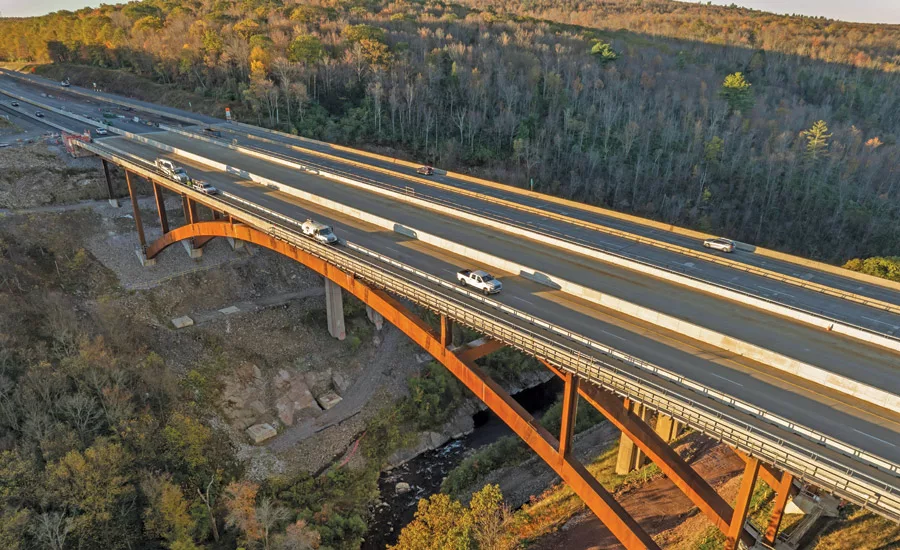
The Hawk Falls Bridge’s $88-million replacement effort being built in Pennsylvania’s Hickory Run State Park in the Pocono Mountains is safeguarding the park’s natural features with a steel superstructure that allows future widening with minimal disruption.
Speaking at the March 1954 groundbreaking ceremony for the Pennsylvania Turnpike’s 110-mile northeastern extension, then-Gov. John S. Fine summed up the looming challenge of constructing a superhighway through the rugged terrain of the Pocono Mountains with a reference to a planned bridge set to rise nearly 200 ft above the Mud Run gorge in Carbon County’s Hickory Run State Park.
Later named for a nearby scenic waterfall, the Hawk Falls Bridge “will triumphantly typify the trailblazing strategy that took the Pennsylvania Turnpike System across streams of great width and turbulence … and through the rocky cores of mighty mountains,” said Fine, a Republican who served from 1951 to 1955.
For nearly 60 years, the dual three-span, 738-ft steel deck truss crossing has more than merited the governor’s oratorical eloquence—both as an engineering marvel and as part of the primary north-south connection between suburban Philadelphia and the Scranton–Wilkes-Barre metropolitan area.
But with the Hawk Falls Bridge reaching the end of its design service life after decades of use and exposure to the mountainous area’s often harsh weather, the Pennsylvania Turnpike Commission launched a five-year, $88-million replacement effort, which is on track for completion by general contractor Trumbull Corp. in late 2026. The project also replaces the nearby three-span, 111-ft-long Hickory Run Road Bridge over State Route 534, one of the state park’s key roadways.

For nearly 70 years, the original dual three-span, 738-ft steel deck truss crossing was a key part of the north-south connection between suburban Philadelphia and the Scranton– Wilkes-Barre metropolitan area.
Photo courtesy Modjeski and Masters
Revisiting a Legacy
Institutionally, at least, the project has been familiar territory for design consultant Modjeski and Masters Inc., which designed the original Hawk Falls and Hickory Run Bridges more than 70 years ago. Tom Murphy, senior vice president, notes that while the replacement goals mirror many of the site and constructibility challenges tackled by the project’s 1950s predecessors, it also incorporates many 21st-century transportation concerns—such as safeguarding and harmonizing with the park’s natural and recreational features, ensuring durability and minimizing maintenance, ultimately reducing the need for a costly and disruptive rehabilitation in the future.
For that reason, Murphy says, the team initially considered the feasibility of a less invasive rehabilitation.
“We found that approach would result in a bridge that still fell short of modern service needs and extend service life only for a short time,” he says, adding that the choice for a new design was readily apparent.
“The gorge’s rocky walls lent themselves to a structural steel arch design.”
—Tom Murphy, Senior Vice President, Modjeski and Masters Inc.
“The gorge’s rocky walls lent themselves to a structural steel arch design, providing solid foundations for the outward thrust that an arch creates,” Murphy explains. The design checked other boxes as well, including versatility and ease of modification. “Along with reducing long-term maintenance, the steel superstructure allows for more flexibility for future widening with minimal disruption,” he adds.
Modjeski and Masters’ final design is a 720-ft-long, four-lane bridge featuring a 480-ft deck arch span flanked by two 60-ft deck plate I-girder spans on each end. Unlike the current crossing, the new bridge will provide 12-ft-wide outside shoulders and 6-ft-wide median shoulders.
Murphy says the bridge’s focal point is the three-rib system of two-hinged arches. Each rib section is composed of 11 segments, weighing from 60,000 to 202,000 lb. The two-hinged design also allows the ends of the ribs to rotate slightly as loads shift. The bridge is founded on spread footings bearing on the rock walls of the gorge, with the interface angle adjusted to avoid the need for shear keys.
He adds that the footings were stepped down to a small pedestal upon which the arch bearings rest, “resulting in a very small portion of the foundation that will be visible after construction is completed,” Murphy says.

The arch’s keystone piece weighs 101,000 lb and has a 418-ft radius.
Photo courtesy Modjeski and Masters
Arch Arrangements
Anticipating the access and construction challenges presented by the gorge, Murphy says the team designed the arch rib segments successively shorter further into the span, allowing large cranes to position segments from behind the new abutments.
Developing the most effective construction strategy required a year’s worth of planning by Trumbull Corp., construction manager STV Inc. and erection engineer Genesis Engineering. Jarred Musser, Trumbull project manager, says the team pivoted from its original plan to limit work in the gorge through use of stay cables anchored to the abutments to a strategy of shoring towers.
“We owned a large amount of shoring towers, grillages and cap beams from previous work that could be retrofitted for this project,” he explains.
Four lines of shoring towers would be built within the turnpike-owned easement, ranging in height from 60 to 180 ft.

As the arch neared completion, the team sought to pinpoint the ideal conditions for closing the structure, using daily surveys to gauge thermal effects on the steel.
Photo courtesy Modjeski and Masters
Musser’s team also used the months of preparation time to become familiar with the two Liebherr LB11000 cranes, which would be used to pick bridge sections approaching a weight of a quarter-million pounds when full construction got underway in 2023.
Counterweight management would be critical, Musser says, as would managing the steps from delivery to placement. Although the bridges were being built on a new alignment just east of the existing structures, the massive cranes will still be too close to the highway to swing 180°. Instead, bridge components would be delivered in front of each crane along a specially built 300-ft runway. There, the sections were lifted off the transport trailer, manipulated as necessary during further assembly, then hoisted and set into place atop the shoring towers.
“Each of those steps required an engineered pick plan,” Musser says. “Most were critical lifts for the crane by the nature of how many counterweights we had loaded on the machine at a particular time and other configurations. Just understanding those cranes was a large undertaking.”
So, too, was managing construction with the dynamics of mountain weather, particularly windy conditions that frequently exceeded the cranes’ operational limit of 28 mph. Activity was also suspended during the winter of 2023-2024 due to extended periods of sub-freezing temperatures.
“We wanted to be as efficient as possible to get the cranes out of there as soon as possible.”
—Jared Musser, Project Manager, Trumbull
“We wanted to be as efficient as possible to get the cranes out of there as soon as possible,” Musser says. “That meant a lot of coordinating with steel fabricators and timing of deliveries and almost constant preplanning to optimize the flow of the work and keep the crane moving.”
Using the vertical hydraulic jacking capabilities on the taller shoring tower lines, each half of the arch was initially erected high on each shoring tower. Musser estimates that more than 100 picks from both cranes were required for the operation, the largest of which—a preassembled set of three box columns and one floor beam—weighed 243,000 lb with a 170-ft radius, pushing the crane to 94% of its capacity. The arch’s keystone piece, weighing 101,000 lb with a 418-ft radius, was the farthest pick.
As the arch neared completion, Musser’s team sought to pinpoint the ideal conditions for closing the structure, using daily surveys to gauge thermal effects on the steel.
“We determined the ideal ambient temperature would be around 68°, and it was best if the entire arch was as close to the same temperature as practical,” he says. The morning of June 3, 2024, provided ideal for that operation, he adds. “The conditions were best before 10:00 in the morning as the sun wasn’t high enough to warm the east face of the arch while the west side was still cool from overnight.”
Each arch half was lowered down incrementally until the apex of the arch was closed. Musser says the arch’s apex was closed on a temporary pin until the final bolting could be completed. Once all bolts were installed, the temporary pins were removed.

The gorge’s rocky walls provide solid foundations for the outward thrust that the arch creates.
Photo courtesy STV Inc.
Finishing Features
With the new Hawk Falls Bridge complete, Trumbull now is working to complete the smaller Hickory Run Road Bridge—a 120-ft long, single-span steel plate girder structure. It eliminates two existing concrete piers to provide a more open feel for travelers on State Route 534, and it also has room for future roadway upgrades. Both crossings are scheduled to be fully open in 2026, when full-scale demolition of the original structures will get underway. Trumbull’s remaining work also includes excavating up to 60,000 cu yd of material for additional erosion and sediment control features.
Although the new Hawk Falls Bridge may not inspire the soaring oratory of its predecessor, the Pennsylvania Turnpike Commission will welcome the advantages of a structure that lends itself to easier maintenance. While the patina developed by the weathering steel components eliminate the need for periodic painting, Murphy says the welded stiffened steel box sections are sized to allow inspectors to walk upright inside and are equipped with lighting, ventilation fans and drainage systems.
“The arch’s Vierendeel bracing system also reduced component count and will minimize debris accumulation and corrosion,” he adds.
Musser says that the Hawk Falls Bridge project has provided valuable insights into the construction of large-scale steel structures.
“The more you can do prior to the erection stage the better,” he says. “Keeping this project moving was a large task.”


