Harvard University Commits to Sustainability with Hybrid Mass Timber Concrete Treehouse
The structure’s branchlike geometry created complexity for design and construction
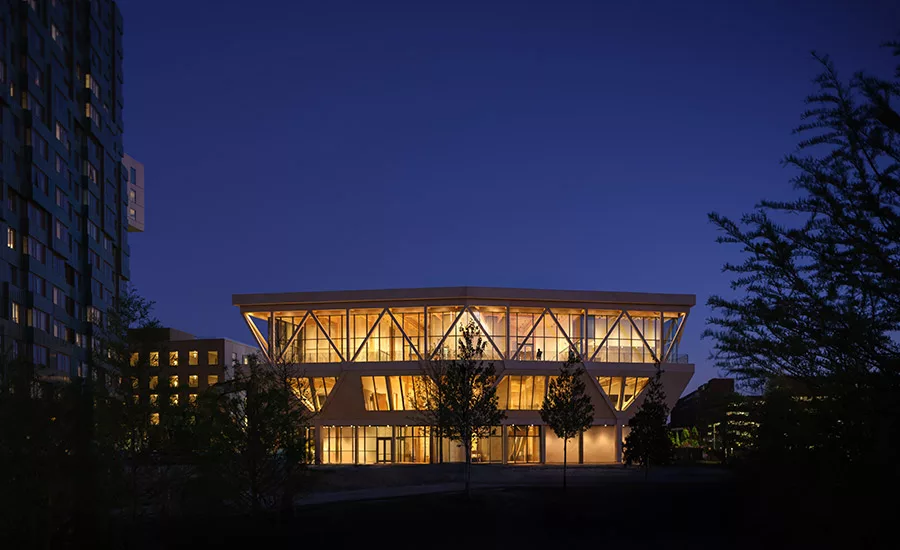
Designed by Studio Gang, the 55,000-sq-ft David Rubenstein Treehouse conference center is the first building in Massachusetts to use healthier, low-embodied concrete on a large scale.
Harvard University’s first hybrid mass timber and low-carbon concrete conference center is a bold commitment to sustainability.
Designed by architecture firm Studio Gang, the school’s David Rubenstein Treehouse conference center is the first building in Massachusetts to use low-embodied concrete on a large scale, says the project’s joint venture Consigli-Smoot construction management team. The team is finishing punch list items, including a cafe and retail space on the first floor set for completion in February.
Situated in the Allston neighborhood of Boston near the Harvard Business School and School of Engineering and Applied Science, the 55,000 sq-ft treehouse opened in October and is one of the first completed buildings in the university’s Enterprise Research Campus—a mixed-use campus with five other buildings under construction.
John Lehane, Consigli director and project executive says the Treehouse required “coordination with several other project teams, subcontractors and other stakeholders while delivering a one-of-a-kind mass timber structure.”
In addition to navigating more than 1 million sq ft of ongoing construction at the ERC, the team managed more than 2 acres of landscape and hardscape work and more than 900 workers onsite at peak.

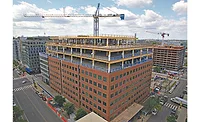
Riggs carpenters from Consigli’s self-perform division, which erected the mass timber structure, attached specialized structural nodes to glulam columns.
Courtesy of Consigli Construction Co. Inc.
Precise Sequencing
The structure’s custom design adds complexity as its 213 columns, 343 beams and 239 cross-laminated timber panels were sourced “from international suppliers in a precise sequence,” says Lehane, adding that this required “meticulous planning and choreography with Riggs, Consigli’s in-house self-perform team, which managed the mass timber installation, to ensure a seamless execution.”
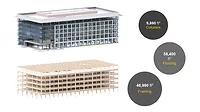
Suppliers Nordik Structures, South County Post & Beam, Hasslacher Norica Timber and Westdek provided 60,000 cu ft of timber, including cross laminated timber panels of spruce, pine and fir, exterior glulam and cladding of Alaskan yellow cedar and interior glulam beams and columns of European spruce.

Temporary shoring towers engineered to support each of the 35 unique structural node connections were critical to creating the building’s signature mass timber columns that branch outward to support its cantilevered upper level.
Courtesy of Consigli Construction Co. Inc.
Branchlike Geometry
While meeting spaces in a conference center are often situated at the ground level for easy access, the three-story treehouse’s conference center is located on the top floor, which simulates climbing up treehouse rungs and stimulates creativity, says design architect, Jeanne Gang, founding partner of Studio Gang and Kajima professor in practice of architecture at the Harvard Graduate School of Design.
Studio Gang worked with Henning, Larson, Scape and Utile on the master plan that will transform the former vacant industrial site on Harvard property into a vibrant 900,000 sq-ft mixed-use community with residential, office and lab space, along with retail and restaurants.
The building’s treehouse shape expands as it rises “to accommodate the programming needs of the space,” says Michael Shearer, associate structural engineer for Arup, which in collaboration with Studio Gang delivered multidisciplinary engineering, including structural, mechanical, electrical and plumbing engineering, acoustics and sustainability services.
“The branching mass timber columns slant outward to create this form, resulting in a push and pull at the second and third floors that are resolved through the building’s diaphragm,” he says.
Arup teamed with South County Post and Beam, the fabricator, and Aspect Structural Engineers, the mass timber design-assist engineer, to strengthen the diaphragms to deliver the lateral forces to the building’s cores, Shearer says.
The complexity of the unique branchlike geometry required the team “to erect 35 temporary shoring towers to support each structural node until the diaphragm was locked in and the structure was fully erected”—an innovation developed in preconstruction with Aspect, Lehane says.
As with other mass timber projects, this project required acoustics engineering to tune sound reflection that the human ear processes as reverberation. This helped achieve “speech clarity and isolate sound between quiet and active areas,” says Arup associate principal Alban Bassuet, who added that Arup’s “SoundLab auralizations guided the team to a solution using 50% ceiling absorption in meeting rooms and similar wall coverage in the atrium to control reverberation and people noise.”
Using auralization, acoustic engineers create a reproduction of a soundscape through loudspeakers (or headphones) in an acoustically controlled environment like Arup’s SoundLab, Bassuet notes.

Crews installed protective coverings on glulam columns and the CLT deck during the project’s construction on an active, logistically challenging site.
Courtesy of Consigli Construction Co. Inc.
Sustainable Design
The treehouse design combines various sustainability strategies to optimize building performance and will help Harvard move toward its goal of being fossil-fuel free by 2050, while also complying with city building emissions reduction requirements. The structure incorporates natural daylighting and self-shading to reduce energy use and bioswales that work in combination with a rooftop system to retain and reuse rainwater and stormwater runoff, Studio Gang says. The treehouse also connects to Harvard's District Energy Facility, which provides the building with heating, cooling, and electricity.
Aside from using low-carbon mass timber, Boston Sand and Gravel supplied 206 yd of concrete made from ground glass pozzolan, a cement replacement made from locally sourced waste glass containers and produced by Urban Mining Industries.
“Ground glass pozzolans (GGPs) and slag replaced up to 70% of cement in concrete mixes to achieve significant embodied carbon reductions from typical mix designs,” says Arup's Sheare.
Harvard’s hope is that their use of innovative climate friendly materials such as GGPs will spur other institutions to do the same. “We’re really trying to scale a healthier, more sustainable supply chain – using our campus and capital projects as a test bed to translate the multidisciplinary research and ideas into practice for results that can be scaled beyond Harvard,” Heather Henriksen, Harvard’s chief sustainability told the Boston Globe.
Every material and finish used for the project’s construction achieved Harvard’s Healthier Building Academy requirements, exceeding Living Building Challenge standards, says the Consigli-Smoot project team. Consigli worked with Studio Gang along with Perkins & Will Architects, Harvard Office for Sustainability and Arup to achieve the project’s sustainability goals.
One-half mile away, Shawmut Design and Construction is also building a mass timber project for Harvard. Nearly 75% complete, the university’s American Repertory Theater is set to open in early 2027.