ENR 2025 Top 25 Newsmakers
René Morkos: Makes Artificial Intelligence Work for Contractors for an Industrialized Future
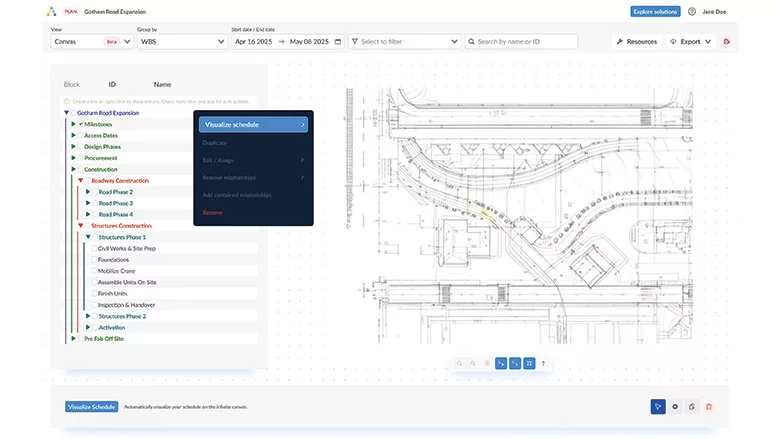
ALICE Core allows contractors to analyze resources such as best use of its workforce, materials or lay-down space and offers optimization scenarios based solely on a P6 XER file output.

Related Article:
Zachry Adopts ALICE, Suffolk to Partner With Trunk Tools on AI
Back to:
25 Top Newsmakers
René Morkos is a second-generation civil engineer who has worked on underwater pipeline construction, automation engineering on a $350-million gas refinery expansion project in Abu Dhabi and as a project manager in Afghanistan. But over a 23-year career in construction and academia, one question kept coming up: Why can’t we use computer vision and machine learning to help decide the best way to go about building something?
“ALICE is the world’s first construction ‘optioneering’ platform,” Morkos said on the ENR Critical Path podcast in 2023. “Instead of deciding how many cranes I need or sequence A, B or C, why can’t the computer give you options?”
Artificially Intelligent
ALICE evolved out of several project management scenarios Morkos used in construction while studying for his Stanford PhD (he is now an adjunct professor in civil and environmental engineering at the Stanford Center for Integrated Facility Engineering). He had developed an algorithm that optimized the space utilization on a job site in Amsterdam, and that and other scheduling automations led to the founding of ALICE Technologies in 2015, which used artificial intelligence algorithms to automate construction sequencing scenarios based on BIM files.
In 2024 the company released ALICE Optimize, which can take a Primavera P6 XER file and automatically create scheduling and sequencing scenarios from that alone.
“What happened to manufacturing in the 1970s and ’80s—it getting digitized, getting automated—is happening now in construction. It’s getting optimized, digitized and connected,” Morkos says. “The way that’s happening is slowly—every startup out there tries to digitize a piece of the puzzle. But slowly, those pieces are coming together.”
Morkos says when he founded ALICE, he had to explain to contractors what a startup was, what a pilot project was. At the time, DPR Construction was one of the only contractors with a venture capital arm investing in tech startups. Today, many more invest in startups, like Suffolk Construction, which has standardized its complex projects on the ALICE platform.
“High complexity [in a] project is one case in which we use it, and the second is when there is a requirement to accelerate the project,” says Aleksey Chuprov, senior vice president of data and information technology at Suffolk. “Whatever the external circumstances are that cause a project delay, you need to recover, and ALICE is great in those kinds of scenarios where you baseline the project and have a target that’s been pushed out. You need to bring it back to that target, and [ALICE] helps you find the best ways to actually bring it back.”
While Morkos is a devoted construction technologist who has been working on AI, machine learning and computer vision technologies for 30 years, and generally a proponent of AI in construction, he’s not among those who believe AI will change everyone’s workflow drastically in the near term. For Morkos, there is still a need for human know-how in tasks like scheduling.
“There’s absolutely progress,” he says. “The machines get better, but then we realize these aren’t the only things that we need to take into account, and these specific problems aren’t solved. So let’s work on that next layer. The truth is, that has been the pattern for 50 years now.”
But Morkos thinks that the coordination and sequencing approaches that began with Gantt charts in the 1890s and grew into critical path scheduling in the 1940s still have room for improvement.
“Think about running [a schedule] through a computer simulation, and then you look at the [critical path method], which is like 16 lines of code. It’s very clear that the level of complexity doesn’t match what’s happening in reality,” he says.