City Scoop | San Antonio
San Antonio Construction Remains Strong, Signaling More Growth Ahead

Burton Hackney
President
Joeris
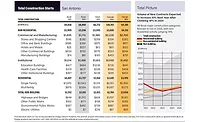
San Antonio wrapped up 2025 with a projected $11.5 billion in construction starts, down from the record pace of 2024 but still one of the strongest years on record. Forecasts from Dodge Data & Analytics estimate total starts will reach $12.6 billion in 2026, signaling a market that is stabilizing rather than pulling back.
For Joeris President Burton Hackney, the past year reflected resilience across the firm’s core markets.
“We saw strong demand across all our sectors and maintained a record backlog through 2026 and into 2027,” he says. “The year reinforced that our strategy of focusing on clients and building for the long term continues to pay off as we look toward 2027 and 2028.”
Non-residential construction starts were projected to total nearly $4.2 billion in 2025, according to Dodge, anchored by institutional work. Education projects were expected to account for $1.3 billion in starts, while health care facilities added $464 million. Office and bank construction remained elevated at $839 million, and manufacturing projects were forecast at $170 million, continuing to gain traction heading into 2026.
A major initiative supporting the city’s industrial growth is JCB’s new manufacturing facility on San Antonio’s south side, where Joeris is serving as the project’s general contractor.
Vertical construction advanced during 2025, and the $500-million project, rising on roughly 400 acres, is expected to employ about 1,500 workers when fully operational, with production targeted for mid-2026.
Residential starts strengthened during 2025, reaching a projected $4.1 billion, according to Dodge. Single-family homes represented $2.9 billion, while multifamily projects accounted for $1.2 billion. Both segments are projected to expand further in 2026, topping $4.5 billion.
Non-building construction starts are estimated at $3.2 billion, led by nearly $2 billion in highway and bridge contracts and nearly $1.1 billion in environmental and public works. While Joeris does not perform roadway construction, Hackney says the impact of infrastructure spending is visible in San Antonio and across Texas.
“What we’re seeing a lot in our markets is the pushing out from the city centers,” he says.

Looking ahead, technology is playing a central role in construction discussions throughout the industry.
Hackney says interest in artificial intelligence is less about changing how buildings are built and more about improving operations. Over the past year, Joeris has focused on organizing and consolidating internal data across the organization.
“Last year we really battled on how we’re going to clean and harvest our data,” Hackney says. “Our strategy is to get it clean in-house so we can start figuring out what AI really means for us and how to leverage it in 2026.”
Data centers are among the fastest-growing segments in Texas construction. Hackney says Joeris is monitoring the sector closely while remaining selective in its involvement.
“The year reinforced that our strategy of focusing on clients and building for the long term continues to pay off”
—Burton Hackney, President, Joeris
“It’s a really crowded space right now,” Hackney says. “There’s a lot of work going on, but there’s just not a lot of people who can build, especially on the trade side. Electricians, skilled pipefitters and all the craft labor needed to put these systems together are in very short supply.”
He adds that the scarcity of skilled workers is influencing how quickly projects can progress and could create hurdles for the industry in 2026.
Beyond industrial and technology-driven work, several large-scale civic projects could further influence San Antonio’s construction outlook.
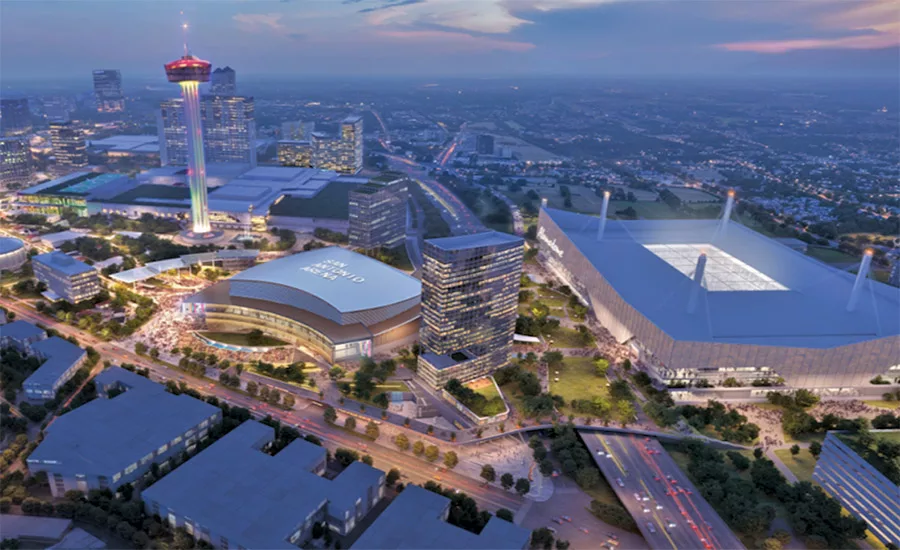
Among them is Project Marvel, a proposed downtown sports and entertainment district anchored by a new San Antonio Spurs basketball arena. Voters approved funding mechanisms in 2025 to support venue taxes for the project, estimated at $1.3 billion to $1.5 billion, along with additional mixed-use development and infrastructure improvements tied to the broader district.
Looking forward, the outlook for San Antonio remains positive. According to Dodge, total construction starts are projected to climb to $12.6 billion in 2026, driven by steady demand across residential; institutional; commercial and industrial; highway; and other infrastructure sectors.