Energy
San Antonio Military Base Weighs Nuclear Option for Grid Independence
Prototype microreactor would be integrated into installation's existing microgrid
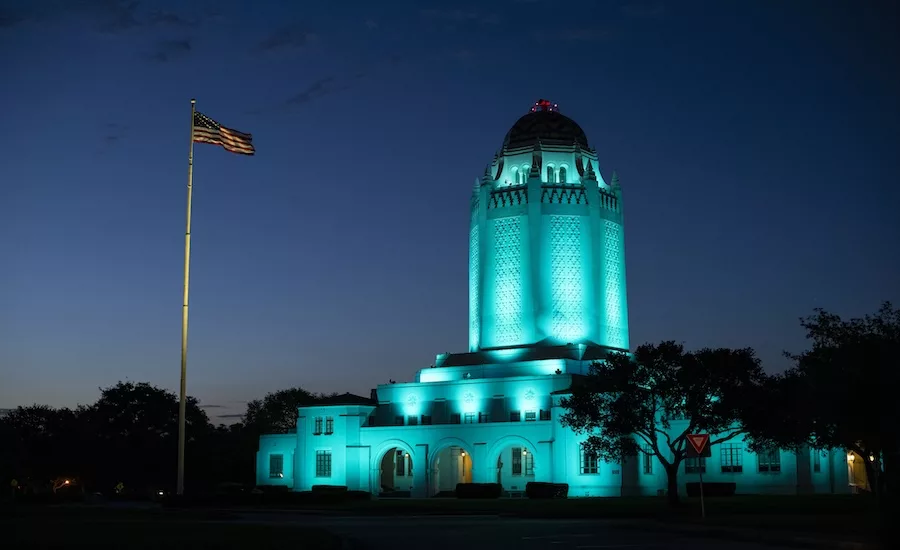
Joint Base San Antonio–Randolph as seen at night in San Antonio, Texas. The base is one of four installations that make up JBSA, which is under consideration to host a prototype nuclear microreactor as part of a new federal partnership.
Joint Base San Antonio, the U.S. Defense Dept.'s largest joint installation, is in line to host a prototype nuclear microreactor under a new federal pairing that would put commercial atomic power on Texas soil for the first time.
The Dept. of the Air Force and the Defense Innovation Unit selected Antares to propose deploying its R1 microreactor at the base under the Advanced Nuclear Power for Installations program. Under the initiative, Antares would be responsible for siting, licensing, constructing, operating and decommissioning reactors at the base. They are targeted to be online by 2029 or sooner.
According to the U.S. Energy Dept., the base was chosen because of its utility infrastructure, land availability and mission requirements. It spans more than 46,000 acres with 11 operating locations within a 50-mile radius of San Antonio. The complex also has a plant replacement value of approximately $10.3 billion and more than 8,000 operations and support personnel.
The base has pursued grid independence for nearly a decade. In 2018, the Defense Logistics Agency awarded a $132.1-million, 22-year energy savings performance contract there, executed by Ameresco, that built an islanding-capable microgrid integrating 18.5 MW of solar generation and 4 MW/8 MWh of battery storage across five installations, according to DOE and the firm. The proposed microreactor would add a nuclear power source to that existing infrastructure.
For Brig. Gen. Randy Oakland, joint base and 502nd Air Base Wing commander, the selection reflects a broader strategic focus. "Energy resilience is imperative to sustaining operations," he said. "If selected as a site under this initiative, Joint Base San Antonio's resilience would take a tangible step forward to ensure reliable support for its many important missions."
Antares CEO and founder Jordan Bramble said the collaboration with Joint Base San Antonio underscores the company’s defense focus. "We built this company to deliver resilient power for missions like this."
The R1 is a unit cooled by a sodium heat pipe and powered by tri-structural isotropic (TRISO) fuel. According to Antares, the system requires no connection to the commercial power grid or specialized infrastructure and can operate for years between refueling.
Antares plans to test a first electricity-producing reactor in 2027, with initial production deployments for defense and space customers targeted for 2028, one year ahead of the proposed joint base deployment. Fuel fabrication has been underway at BWX Technologies since October 2025.
The announcement is one of several recent Advanced Nuclear Power for Installations site selections. The Air Force announced on April 8 that Buckley Space Force Base in Colorado and Malmstrom Air Force Base in Montana were also identified as candidate sites, with vendor pairings for those installations still pending and deployment targeted for 2030 or earlier, according to the service.
The Advanced Nuclear Power for Installations program is separate from a standalone Air Force microreactor pilot at Eielson AFB in Alaska and from the U.S. Army's parallel Janus Program, which independently targets microreactor deployment at domestic Army installations by 2030, according to the American Nuclear Society's Nuclear Newswire.
