2025 West Best Projects
Best Sustainability, Award of Merit, Higher Education/Research: Western Washington University Kaiser Borsari Hall
Western Washington University Kaiser Borsari Hall
Bellingham, Wash.
EXCELLENCE IN SUSTAINABILITY and Award of Merit, Higher Education/Research
Submitted by M.A. Mortenson Co.
Owner Western Washington University
Lead Design Firm Perkins&Will
General Contractor M.A. Mortenson Co.
Civil Engineer KPFF Consulting Engineers
Structural Engineer Coughlin Porter Lundeen
MEP Engineer Affiliated Engineers Inc.; McKinstry
Mechanical Engineer Hargis Engineers Inc.
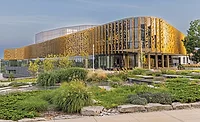
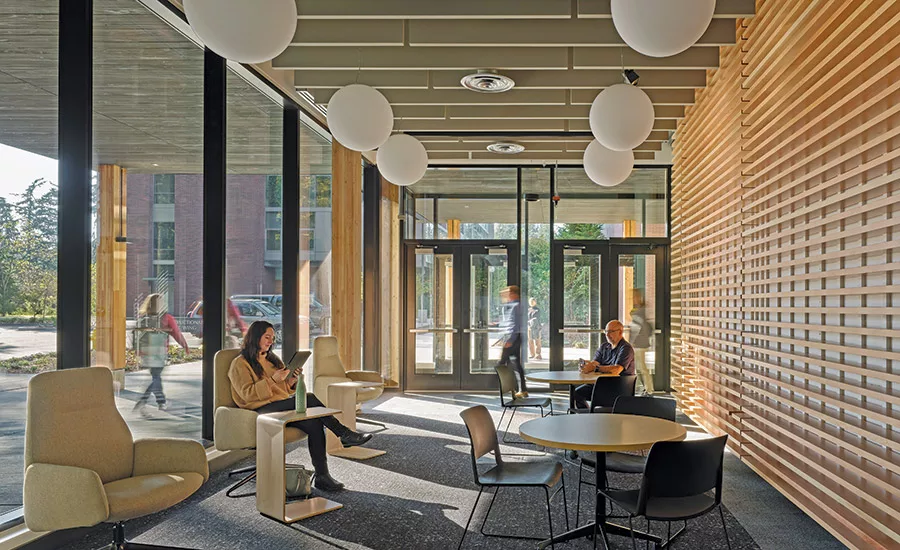
Washington State’s first publicly funded zero-energy and zero-carbon academic building on a university campus is a $54.8-million, four-story mass timber facility for the electrical engineering and computer science department.
When initial estimates revealed costs exceeding $69 million, the project team worked through extensive value engineering to help identify more than $17.25 million in savings without reducing educational space or compromising zero-carbon and zero-energy certification goals.
One critical change was eliminating the basement from the schematic design and relocating the electrical room to the first floor, which saved $2 million and reduced embodied carbon by 226 tons through decreased concrete usage.
The mass timber structure dramatically reduced embodied carbon compared with traditional steel and concrete construction. All wood was responsibly sourced within a 600-mile radius, with exterior Shou Sugi Ban siding providing durability through traditional Japanese charring techniques. The prefabricated glulam beams, columns and cross-laminated timber (CLT) decks were manufactured off site for efficient and seamless assembly at the project location.

Photo by Kevin Scott
Energy performance exceeded expectations thanks to variable refrigerant flow mechanical systems, which achieved an 80% reduction in lab energy use compared with typical facilities and 25% savings beyond LEED Gold standards.
The building operates entirely on renewable energy, with photovoltaic panels covering 75% of available roof area and remaining power purchased through green energy programs.
During construction, electric equipment and generators replaced gas-powered alternatives and strict no-idling policies reduced emissions. Local material sourcing minimized transportation impacts.
Close collaboration with trade partners ensured that the team was sourcing local and domestic materials, minimizing transportation emissions and supporting regional economies.