Urban Icons
Full Demolition of Beloved Boston Pub Blindsides Neighbors
An editor explores why developer had to remove iconic facade
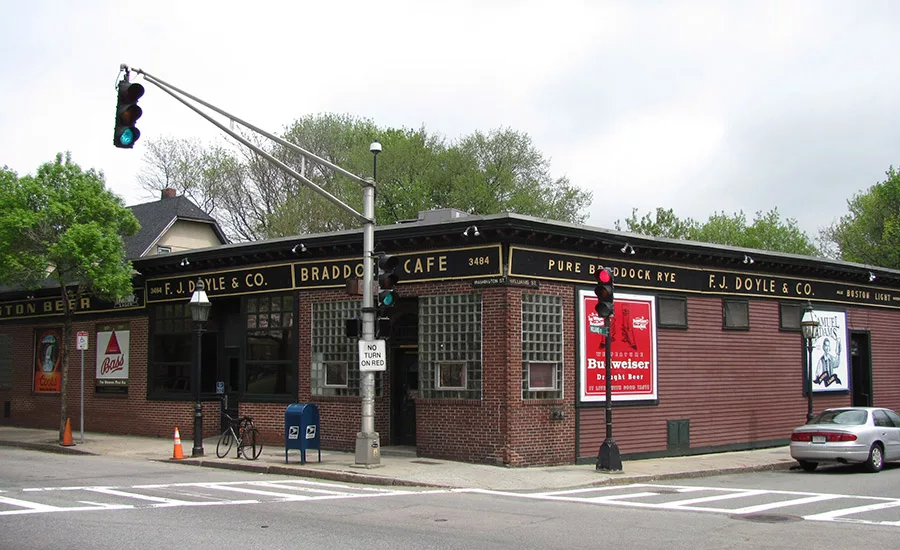
Boston residents were surprised when a former iconic Irish pub in the city's Jamaica Plain neighborhood called Doyle's Cafe was fully demolished Dec. 2.
The full demolition of a former iconic Boston Irish pub on Dec. 2—part of an ongoing project to transform the property into a more than 57,500 sq-ft mixed-use development—shocked residents in the city's Jamaica Plain neighborhood.
Doyle’s Café was a popular watering hole for politicians for decades and it was also featured in the 2003 film Mystic River before it closed in 2019 after nearly 140 years in business.
While neighbors had an understanding that the original design for the project including a restaurant with a roof deck and a four-story residential building called for salvaging portions of the existing building, the project's owner said doing so ultimately wasn't feasible.
“It just wasn’t part of what we were told would happen," says Pete Fraunholtz, a member of the Stoneybrook Neighborhood Association that covers the project located at 3484 Washington St. “This wasn’t part of the plan. It’s not what we were sold on so it’s not so much [feeling] sad as it feels like a bait and switch.”
The project's design, approved by the Boston Planning & Development Agency (BPDA), was “to selectively demolish and rebuild the façade … with new fenestration and brick,” says Lee Goodman of Watermark Development Inc., the project's Boston-based owner.

While the original project plans called for selectively demolishing and rebuilding the façade, the project team ended up demolishing the entire former pub because it became structurally unsound.
Rendering by Scales Architecture courtesy City of Boston
As a longtime Jamaica Plain resident who frequented Doyle's, I delved into this story after reading unhappy posts about the demolition on the neighborhood Facebook group. My wife's aunt, Joy Silverstein, is also a member of the Stoneybrook Neighborhood Association.
While my reporting points to no sign of illegal or improper activity on the developer's part, I know how difficult it is for large cities such as Boston to keep tabs on neighborhood developments that residents are often emotionally attached to. The cities and neighbors struggle with the fact that developers are within their rights to demolish buildings without landmark status, such as Doyle's.
But in my opinion residents are right to bemoan owners' failure to be proactively transparent about what they do.
Attempts to Salvage
The developer says it had good intentions.
The project team tried to “salvage the floor system and exterior walls and sister onto them to create the new window and door openings” seen in the project renderings while lowering the entire floor system to comply with the Americans with Disabilities Act, said Goodman.
But Goodman said after BPDA's approval, the Boston Water and Sewer Commission (BWSC) notified him that he was prohibited from adding structural load to Stony Brook conduit—a major 13-ft-dia. drainage tunnel that carries roughly one-third of Boston’s stormwater—buried underneath Doyle's.
As a result, BWSC "required" his team to install a micropile and structural slab system to keep extra load off the buried public infrastructure, said Goodman.
This, Goodman said, necessitated removing large chunks of the existing building to fit rigs inside the building footprint. "The remaining structure became unsafe to work under," Goodman said, "and we were forced to remove the two remaining walls and rebuild the wall and floor assembly.”
But John Sullivan, chief engineer at BWSC, said, “We never dictate how you need to build something” when prohibiting a developer from adding additional structural load onto city water and sewer infrastructure. Sullivan said tying a grade beam into existing walls being saved "for historical purposes" would have been "prohibitively expensive."
When I informed Goodman that Sullivan said BWSC doesn't require specific construction methods, Goodman replied: “There is no other way to transfer that amount of load 40 feet into the ground than piles with a grade beam on top of the piles.”
Goodman also notes: “Historically important pieces” were “removed and documented” and “are being stored for reinstallation.”

The project includes a four-story residential building.
Photo by Joy Silverstein for ENR
Fraunholtz, who has lived in Jamaica Plain for 24 years, says neighbors were blindsided when the entire building was torn down because they were told two thirds of the Doyle’s building would be maintained.
Fraunholtz said he “understands” things happen during construction when you start “digging things up,” but “I guess I figured someone who was going to tackle an old building would have a more realistic sense of what might be encountered.”
Loaded Letter
I looked back at some of the project's history.
A Nov. 11, 2022 letter from the project’s structural engineering firm—Waltham, Mass.-based ST&P—to the project's design firm, Boston-based Scales Architecture, includes schematic drawings for a grade beam and micropiles preventing loads from sitting directly over the Stoney Brook conduit.
"All proposed walls and framing above the conduit will be supported by a partially concrete-encased full story height steel truss along Williams Street and fully concrete-encased steel wide-flange beams along Washington Street and the rear of the building," the letter states. "The truss and beams will be designed to support the formwork and the weight of the concrete encasements, thus imposing no new loads on the conduit."
The letter continues, "Once the concrete achieves its design strength, the truss and beams and their concrete encasements will act as composite members to support the building loads over the existing water conduit without imposing any new loads upon it."
The only reference in the letter or its enclosed schematic drawings to existing walls is to loads being absorbed by "a 6 in. compressible filler positioned between the bottoms of the concrete encasements and the tops of the existing foundation walls which will be cut down in height to accommodate the new work."
Scales Architecture, features the project on the front of its webpage, but could not be reached for comment. ST&P declined to comment.

Schematic drawings for a grade beam and micropiles preventing structural loads from sitting directly on the Stoney Brook conduit. Image: courtesy Boston Water and Sewer Commission.
Sullivan said BWSC reviews only water, sewer, and drain plans, requiring engineers to show how any foundation conflicts with BWSC infrastructure will be mitigated to maintain future access. He said that while the BWSC approved the project team's site plan on Aug. 10, 2023, project teams often decide to build things differently from how they are designed once construction starts and they deem adjustments need to be made.
“Things change in the field, contractors come up with all kinds of good ideas," he said. "The contractor may have said, 'Look it will be easier if I do this, it won’t cost you as much' or 'We have to do something different because the walls will fall down on me.'”

The site of the former Doyle's pub in the Jamaica Plain neighborhood of Boston after it was demolished on Dec. 2.
Photo by Joy Silverstein for ENR
According to the Boston Preservation Alliance, Doyle’s opened in 1882 and “hosted everything from community meetings and birthday parties to a roll-call of political figures including then-U.S. Senator John F. Kerry, Ted Kennedy, Boston mayors Ray Flynn, Kevin White, Tom Menino, and many others.”
Watermark Development needed several years to assemble the site. In 2022, it purchased a two-family home on Washington Street adjacent to Doyle's and a Williams Street site for $5.5 million, according to the Boston Business Journal.
 Framing for the new walls and floor were installed shortly after the old walls were demolished on Dec. 2.Photo by Joy Silverstein for ENR
 The three-building development now taking shape will include 29 residential units, including four affordable ones. In addition to a new restaurant, the proposal called for a more than 4,000-sq-ft grocery market.
Goodman, who declined to say if the project is on budget, originally hoped to complete the effort this summer but now eyes a fall 2026 finish.
I understand that if saving the existing facade was going to be a huge expense for the developer, it probably didn't make sense.
So based on the renderings, I believe that the final facade will pay homage to the original —and I'm looking forward to seeing it.